Peter Steinberger’s 100 AI Agents Generate $1.3 Million in OpenAI Tokens Through OpenClaw Development

Context

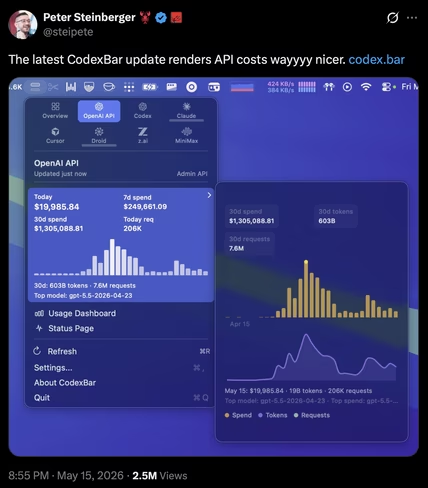
The advent of artificial intelligence (AI) in software development has ushered in unprecedented changes, as exemplified by Peter Steinberger’s recent endeavors with OpenClaw. Over a span of 30 days, Steinberger, now an engineer at OpenAI, utilized 100 AI Codex instances, resulting in an expenditure of $1.3 million in API tokens. This expenditure, amounting to 603 billion tokens across 7.6 million requests, serves as a pivotal case study, shedding light on the economic implications of employing autonomous AI agents in software development without financial constraints. The data underscores not only the rapid escalation of costs associated with continuous AI operation but also provides a crucial public data point regarding the financial dynamics of large-scale autonomous coding.

Main Goal and Achievement Methodology

The principal objective of Steinberger’s initiative is to explore the capacities and economic ramifications of autonomous AI-driven software development. By leveraging an extensive array of Codex instances, Steinberger aimed to establish a benchmark for understanding the cost implications tied to the operation of AI agents in a large-scale coding environment. Achieving this goal necessitates a rigorous approach to monitoring resource consumption, understanding token economics, and optimizing AI operations to discern the balance between cost and productivity. Furthermore, the commitment to open-source principles ensures that the insights generated can benefit the broader developer community.

Advantages of AI in Software Development

  • Increased Efficiency: Steinberger’s autonomous development pipeline enables tasks such as reviewing pull requests and scanning for security vulnerabilities, traditionally requiring a larger engineering team, to be executed by a small group of humans overseeing multiple AI agents.
  • Scalability: The ability of AI agents to manage extensive workloads, as evidenced by the completion of 7.6 million requests, demonstrates the potential for scaling development processes far beyond human capabilities.
  • Real-time Performance Monitoring: AI agents can continuously monitor performance and flag regressions, ensuring immediate feedback and adjustments to the development process.
  • Cost Transparency: Steinberger’s detailed breakdown of costs, including the implications of different pricing models, provides valuable insights for organizations contemplating the integration of AI tools into their development workflows.

Caveats and Limitations

Despite the advantages, there are significant caveats to consider. The high operational costs, as demonstrated by the $1.3 million expenditure, highlight the financial risks associated with extensive AI deployment. Additionally, reliance on proprietary models may pose challenges regarding sustainability and accessibility for smaller enterprises. The necessity of a robust infrastructure to support such operations cannot be overlooked, as it may not be feasible for all organizations to replicate Steinberger’s model.

Future Implications

The implications of Steinberger’s project extend beyond immediate financial considerations and into the broader landscape of software development. As organizations increasingly adopt AI-assisted coding tools, fundamental questions regarding the economics of AI development will arise. The divergence in pricing models, where traditional subscription frameworks may not align with the demands of autonomous agents, signals a need for new pricing structures that reflect the realities of AI usage. Furthermore, as advancements in AI technology continue, the potential for reduced inference costs and enhanced efficiencies could reshape the economic landscape, making these tools more accessible to a wider array of developers and organizations.

Disclaimer

The content on this site is generated using AI technology that analyzes publicly available blog posts to extract and present key takeaways. We do not own, endorse, or claim intellectual property rights to the original blog content. Full credit is given to original authors and sources where applicable. Our summaries are intended solely for informational and educational purposes, offering AI-generated insights in a condensed format. They are not meant to substitute or replicate the full context of the original material. If you are a content owner and wish to request changes or removal, please contact us directly.

Source link :

Click Here

How We Help

Our comprehensive technical services deliver measurable business value through intelligent automation and data-driven decision support. By combining deep technical expertise with practical implementation experience, we transform theoretical capabilities into real-world advantages, driving efficiency improvements, cost reduction, and competitive differentiation across all industry sectors.

We'd Love To Hear From You

Transform your business with our AI.

Get In Touch