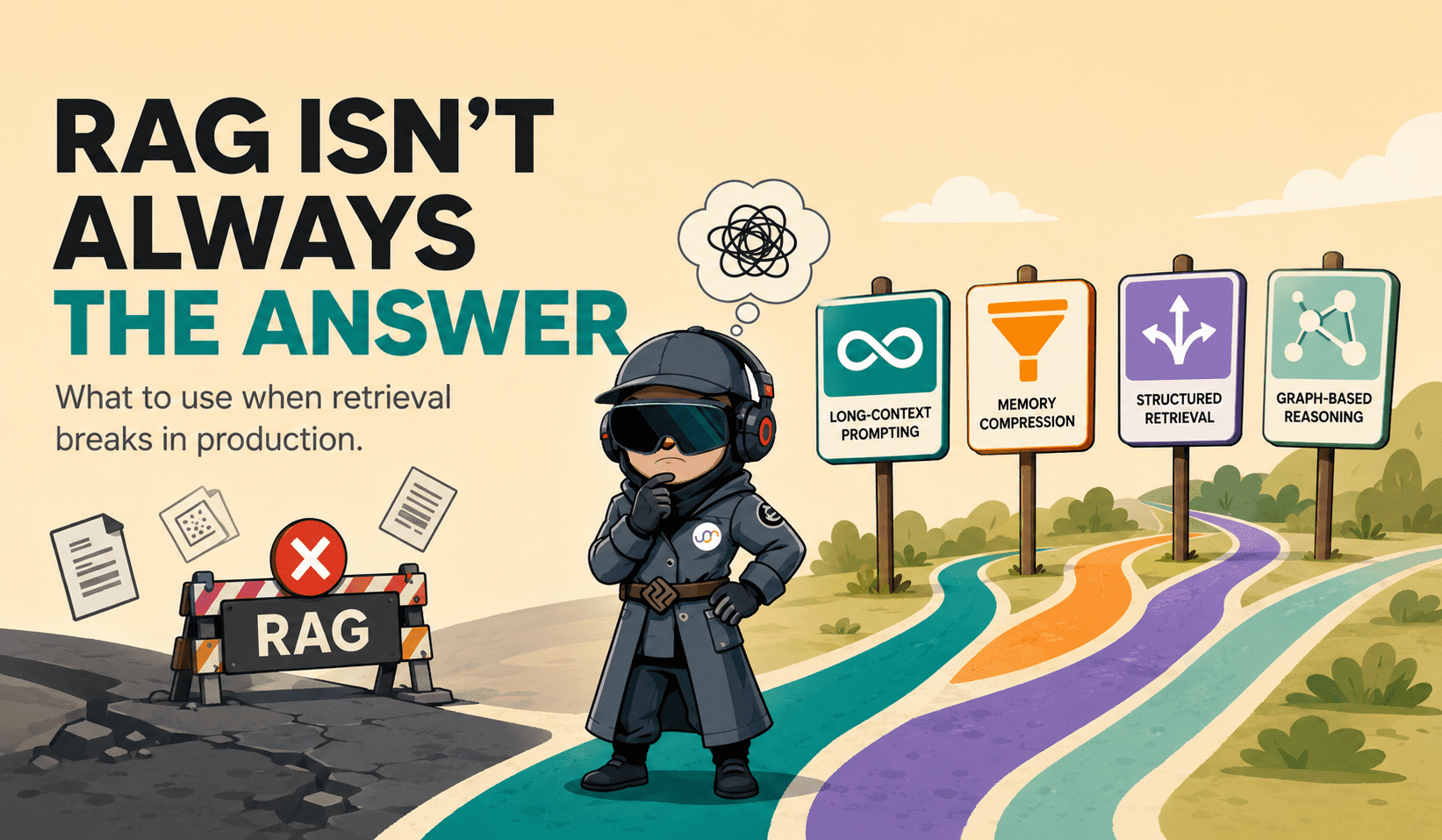
Retrieval-augmented generation (RAG) has emerged as a prominent methodology for augmenting the capabilities of large language models (LLMs) by effectively linking them to a corpus of documents. This integration involves a straightforward procedure: embedding a corpus, retrieving relevant segments via vector similarity, and incorporating them into model prompts. While this framework shows promise in practical applications, it often falters under the pressures of real-world deployment, revealing failure modes that are not apparent during initial demonstrations. Understanding these limitations and exploring alternative approaches is paramount for optimizing the efficacy of LLMs in natural language understanding (NLU).
In practical applications, one of the most frequently encountered issues with RAG systems is retrieval irrelevance. For instance, when a user inquires about a parental leave policy, the system may return multiple outdated or off-topic documents that superficially align with the query based on shared vocabulary but fail to provide the necessary context. This results in the model generating responses that are confidently articulated yet factually incorrect, highlighting a critical distinction between topical similarity and factual relevance.
Another insidious challenge is context poisoning, which arises in enterprise knowledge bases where multiple versions of the same document exist. When a retrieval system draws from these conflicting sources, the model amalgamates the information without recognizing inherent contradictions, again producing misleading outputs. These scenarios underscore the fundamental structural conflicts within the chunk-embed-retrieve pipeline that complicate the balance between recall and coherence.
In response to the shortcomings of standard RAG systems, a prevalent but misguided approach is to introduce complexity through higher-dimensional embeddings and advanced reranking strategies. This over-engineering often exacerbates existing issues rather than resolving them. For example, a global manufacturing corporation initially budgeted $400K for its RAG implementation but incurred costs of $1.2M in the first year, achieving only a 23% accuracy rate on technical documentation queries. Such experiences reflect a broader trend of failure in enterprise RAG implementations, with a staggering 72% failure rate reported in the first year of operation.
Increasing the sophistication of vector models does not guarantee improved performance; it often leads to heightened computational expenses and diverts attention from the more critical question of whether the initial retrieval architecture was appropriate.
A practical alternative to circumvent the complexities of a malfunctioning RAG pipeline is to adopt long-context prompting. This strategy eliminates the retrieval step entirely by loading the entire corpus directly into the model, provided it fits within the model’s context window. Research has indicated that long-context models can consistently outperform traditional RAG on question-answering tasks when computational resources permit, albeit at a significantly higher cost in terms of latency and per-query expenses.
When the corpus exceeds the context window, an effective strategy is to utilize summarization before retrieval. This approach involves compressing documents prior to their integration into the model, which can yield performance comparable to long-context methods while avoiding the pitfalls of raw chunk retrieval. Evidence suggests that well-compressed relevant documents can outperform larger sets of tangentially related chunks.
In instances where retrieval remains a viable architecture, implementing structured retrieval can enhance accuracy and reduce computational costs. By classifying queries based on their type—whether they require full context or focused retrieval—systems can optimize their responses accordingly. Recent studies demonstrate that adaptive systems employing this hybrid approach have achieved significant improvements in retrieval precision, thereby validating the efficacy of explicit routing in enhancing overall system performance.
For queries that necessitate an understanding of relationships across datasets, traditional vector retrieval methods fall short. Multi-hop questions, which require synthesis of information across various documents, benefit from graph-based reasoning techniques. Microsoft Research has introduced systems that construct knowledge graphs from the corpus, enabling the exploration of entity relationships rather than mere vector matching. While this method incurs higher costs, it is particularly advantageous for thematic analysis and multi-hop reasoning, albeit less effective for straightforward factual lookups.
While RAG serves as a reasonable default for many applications, its limitations become apparent in predictable ways, such as retrieval irrelevance and context poisoning. Adding complexity to an already flawed design often results in increased expenses without resolving the core issues. By aligning the architectural choices with the nature of the queries, practitioners can enhance both performance and efficiency. The four outlined alternatives—long-context prompting, memory compression, structured retrieval, and graph-based reasoning—offer distinct pathways to improve the functionality of NLU systems, ultimately paving the way for more robust and reliable AI applications in the future.
Disclaimer
The content on this site is generated using AI technology that analyzes publicly available blog posts to extract and present key takeaways. We do not own, endorse, or claim intellectual property rights to the original blog content. Full credit is given to original authors and sources where applicable. Our summaries are intended solely for informational and educational purposes, offering AI-generated insights in a condensed format. They are not meant to substitute or replicate the full context of the original material. If you are a content owner and wish to request changes or removal, please contact us directly.
Source link :