
Contextualizing Power Station Usage in Applied Machine Learning In recent years, the proliferation of smart devices and the emphasis on uninterrupted power supply have gained significant traction in various fields, including Applied Machine Learning (AML). The original blog post highlights the importance of maintaining continuous power to essential devices, such as modems, routers, refrigerators, and security cameras, particularly during power outages. For AML practitioners, the reliability of power sources directly impacts their ability to conduct research, manage data pipelines, and ensure the seamless operation of machine learning models. This discussion underscores the necessity of integrating uninterruptible power supplies (UPS) to mitigate risks associated with unexpected power disruptions. Main Goal of Power Station Utilization The primary objective of keeping specific devices connected to a power station is to maintain functionality during power outages. This is particularly critical for individuals who rely on technology for both professional and personal purposes. By utilizing UPS systems, practitioners can ensure that their essential devices remain operational, thereby enhancing productivity and safeguarding valuable data. Advantages of Utilizing Power Stations Continuous Connectivity: Maintaining power to modems and routers ensures uninterrupted internet access, which is crucial for remote work and data management tasks. Without connectivity, AML practitioners may face challenges in model training and performance evaluation. Data Integrity: By keeping devices such as refrigerators operational, practitioners can ensure that data related to environmental conditions or data collection remain viable, preventing data loss or degradation. Enhanced Security: Continuous power to security systems allows for the ongoing monitoring of premises, ensuring the safety of physical infrastructure that houses sensitive data or hardware used in AML projects. Caveats and Limitations While the advantages of utilizing power stations are substantial, several factors must be considered. The capacity of the power station must align with the energy requirements of the connected devices. For instance, not all power stations can accommodate high-demand appliances or multiple devices simultaneously. Additionally, reliance on a UPS may provide a false sense of security if practitioners do not regularly test and maintain their systems, potentially leading to failures during critical moments. Future Implications of AI Developments The rapid advancement of AI will continue to influence the need for reliable power sources in AML. As machine learning models become increasingly complex and data-intensive, the demand for consistent power supply will surge. Future AI developments may lead to the integration of intelligent power management systems capable of dynamically allocating resources based on current demand, further enhancing the resilience of machine learning infrastructures. Additionally, as the Internet of Things (IoT) expands, the reliance on connected devices will necessitate robust power solutions, making UPS systems even more critical for practitioners in the field. Disclaimer The content on this site is generated using AI technology that analyzes publicly available blog posts to extract and present key takeaways. We do not own, endorse, or claim intellectual property rights to the original blog content. Full credit is given to original authors and sources where applicable. Our summaries are intended solely for informational and educational purposes, offering AI-generated insights in a condensed format. They are not meant to substitute or replicate the full context of the original material. If you are a content owner and wish to request changes or removal, please contact us directly. Source link : Click Here
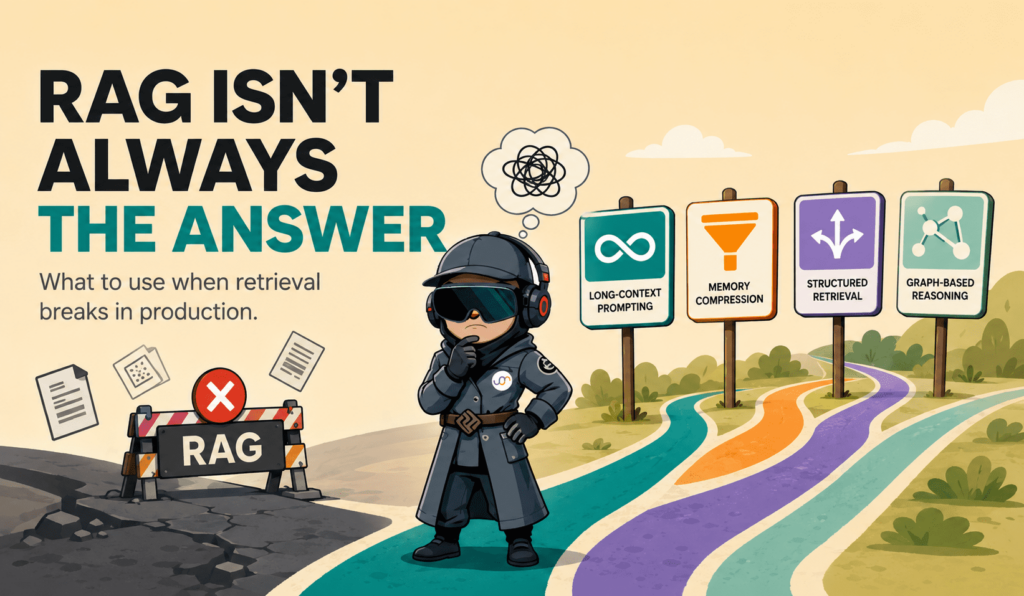
Introduction Retrieval-augmented generation (RAG) has emerged as a prominent methodology for augmenting the capabilities of large language models (LLMs) by effectively linking them to a corpus of documents. This integration involves a straightforward procedure: embedding a corpus, retrieving relevant segments via vector similarity, and incorporating them into model prompts. While this framework shows promise in practical applications, it often falters under the pressures of real-world deployment, revealing failure modes that are not apparent during initial demonstrations. Understanding these limitations and exploring alternative approaches is paramount for optimizing the efficacy of LLMs in natural language understanding (NLU). When RAG Fails in Production In practical applications, one of the most frequently encountered issues with RAG systems is retrieval irrelevance. For instance, when a user inquires about a parental leave policy, the system may return multiple outdated or off-topic documents that superficially align with the query based on shared vocabulary but fail to provide the necessary context. This results in the model generating responses that are confidently articulated yet factually incorrect, highlighting a critical distinction between topical similarity and factual relevance. Another insidious challenge is context poisoning, which arises in enterprise knowledge bases where multiple versions of the same document exist. When a retrieval system draws from these conflicting sources, the model amalgamates the information without recognizing inherent contradictions, again producing misleading outputs. These scenarios underscore the fundamental structural conflicts within the chunk-embed-retrieve pipeline that complicate the balance between recall and coherence. The Common (Wrong) Fix: Over-Engineering In response to the shortcomings of standard RAG systems, a prevalent but misguided approach is to introduce complexity through higher-dimensional embeddings and advanced reranking strategies. This over-engineering often exacerbates existing issues rather than resolving them. For example, a global manufacturing corporation initially budgeted $400K for its RAG implementation but incurred costs of $1.2M in the first year, achieving only a 23% accuracy rate on technical documentation queries. Such experiences reflect a broader trend of failure in enterprise RAG implementations, with a staggering 72% failure rate reported in the first year of operation. Increasing the sophistication of vector models does not guarantee improved performance; it often leads to heightened computational expenses and diverts attention from the more critical question of whether the initial retrieval architecture was appropriate. Alternatives When RAG Fails Long-Context Prompting A practical alternative to circumvent the complexities of a malfunctioning RAG pipeline is to adopt long-context prompting. This strategy eliminates the retrieval step entirely by loading the entire corpus directly into the model, provided it fits within the model’s context window. Research has indicated that long-context models can consistently outperform traditional RAG on question-answering tasks when computational resources permit, albeit at a significantly higher cost in terms of latency and per-query expenses. Memory Compression When the corpus exceeds the context window, an effective strategy is to utilize summarization before retrieval. This approach involves compressing documents prior to their integration into the model, which can yield performance comparable to long-context methods while avoiding the pitfalls of raw chunk retrieval. Evidence suggests that well-compressed relevant documents can outperform larger sets of tangentially related chunks. Structured Retrieval In instances where retrieval remains a viable architecture, implementing structured retrieval can enhance accuracy and reduce computational costs. By classifying queries based on their type—whether they require full context or focused retrieval—systems can optimize their responses accordingly. Recent studies demonstrate that adaptive systems employing this hybrid approach have achieved significant improvements in retrieval precision, thereby validating the efficacy of explicit routing in enhancing overall system performance. Graph-Based Reasoning For queries that necessitate an understanding of relationships across datasets, traditional vector retrieval methods fall short. Multi-hop questions, which require synthesis of information across various documents, benefit from graph-based reasoning techniques. Microsoft Research has introduced systems that construct knowledge graphs from the corpus, enabling the exploration of entity relationships rather than mere vector matching. While this method incurs higher costs, it is particularly advantageous for thematic analysis and multi-hop reasoning, albeit less effective for straightforward factual lookups. Conclusion While RAG serves as a reasonable default for many applications, its limitations become apparent in predictable ways, such as retrieval irrelevance and context poisoning. Adding complexity to an already flawed design often results in increased expenses without resolving the core issues. By aligning the architectural choices with the nature of the queries, practitioners can enhance both performance and efficiency. The four outlined alternatives—long-context prompting, memory compression, structured retrieval, and graph-based reasoning—offer distinct pathways to improve the functionality of NLU systems, ultimately paving the way for more robust and reliable AI applications in the future. Disclaimer The content on this site is generated using AI technology that analyzes publicly available blog posts to extract and present key takeaways. We do not own, endorse, or claim intellectual property rights to the original blog content. Full credit is given to original authors and sources where applicable. Our summaries are intended solely for informational and educational purposes, offering AI-generated insights in a condensed format. They are not meant to substitute or replicate the full context of the original material. If you are a content owner and wish to request changes or removal, please contact us directly. Source link : Click Here

Context: The Significance of the Rousseeuw Prize in Data Analytics The Rousseeuw Prize for Statistics serves as a hallmark of excellence in the field of statistics, recognizing significant contributions made by individuals and teams who advance statistical methodologies and applications. Recently, this prestigious award was presented to the R Core Team, which includes notable figures such as Brian Ripley, Martin Mächler, Kurt Hornik, Peter Dalgaard, and Luke Tierney. The R programming language has become a cornerstone of modern statistical computing, driven by a commitment to open-source principles and community collaboration. As the R community prepares to launch version 4.6.1, it underscores the continuous evolution and impact of this tool within the analytics landscape. Main Goal: Recognition of Contributions to Statistical Research The primary objective of the Rousseeuw Prize is to acknowledge the groundbreaking efforts of statisticians who have dedicated their careers to enhancing statistical tools and methodologies. Achieving this goal involves fostering an environment that promotes innovation, collaboration, and open access to statistical resources. By recognizing these contributions, the prize not only celebrates individual achievements but also inspires future generations of statisticians and data engineers to pursue excellence in their work. Advantages of the Rousseeuw Prize for Data Engineers Validation of Open-Source Contributions: The award highlights the importance of open-source projects like R in advancing statistical knowledge, providing data engineers with a robust framework that they can leverage for their analytics tasks. Encouragement of Community Engagement: By recognizing collaborative efforts within the R community, the prize encourages data engineers to participate in open-source projects, thereby enhancing their skills through shared knowledge and experience. Enhanced Trust in Statistical Tools: The acknowledgment of the R Core Team’s work reinforces the credibility of R as a statistical tool, encouraging data engineers to adopt it for critical projects, especially in regulated industries such as pharmaceuticals and finance. Inspiration for Innovation: The recognition of significant contributions serves as a motivational factor, prompting data engineers to innovate and experiment with new methodologies, thus advancing the field of data analytics. Future Implications: The Role of AI in Data Analytics The ongoing expansion of artificial intelligence (AI) technologies is poised to further transform the landscape of data analytics. As AI methodologies increasingly intersect with statistical practices, data engineers will need to adapt to new paradigms of data interpretation and analysis. Tools like R will continue to evolve, incorporating AI capabilities that enable more sophisticated data modeling and predictive analytics. This evolution will not only refine existing statistical techniques but also broaden the scope of analytics applications across various industries, enabling data engineers to derive deeper insights from complex datasets. Conclusion The Rousseeuw Prize for Statistics embodies the commitment to excellence and innovation within the field of statistics, particularly through the contributions of the R Core Team. For data engineers, the recognition of such contributions not only validates their work but also provides a framework for future advancements in data analytics. As the integration of AI technologies continues to shape the industry, data engineers are positioned to leverage these developments to enhance their analytical capabilities and drive meaningful insights. Disclaimer The content on this site is generated using AI technology that analyzes publicly available blog posts to extract and present key takeaways. We do not own, endorse, or claim intellectual property rights to the original blog content. Full credit is given to original authors and sources where applicable. Our summaries are intended solely for informational and educational purposes, offering AI-generated insights in a condensed format. They are not meant to substitute or replicate the full context of the original material. If you are a content owner and wish to request changes or removal, please contact us directly. Source link : Click Here

Contextual Overview of the Fractional General Counsel Market The legal profession is undergoing a transformative shift, particularly in the realm of legal technology. A segment that has been notably underserved is the fractional general counsel (FGC) market. FGCs serve as external legal advisors for multiple organizations, often those too small to maintain their own legal departments. This emerging niche presents unique challenges and opportunities, as traditional legal tech platforms generally overlook the specific needs of these professionals. One innovative solution addressing this gap is Sapphire Legal, developed by Brett Wilson, a former enterprise IT expert turned entrepreneur. The platform is designed to optimize the operational efficiency of FGCs by providing tailored legal tools that account for their distinct workflows and clientele management. Main Goal and Its Achievement The primary goal of Sapphire Legal is to offer a comprehensive legal operating system specifically tailored for fractional general counsels. This is accomplished through a unique architecture that ensures data privacy and client confidentiality, which are critical for FGCs who manage sensitive information across multiple clients, some of whom may be direct competitors. By utilizing a dedicated private large language model (LLM) for each client, Sapphire Legal minimizes the risk of data contamination and enhances operational effectiveness. This innovative approach allows FGCs to maintain high standards of confidentiality while streamlining their legal processes. Advantages of Sapphire Legal for Fractional General Counsels Enhanced Data Privacy: Sapphire Legal’s architecture creates isolated environments for each client, ensuring that sensitive data does not intermingle. This significantly reduces the risk of data breaches and potential legal repercussions. Operational Efficiency: The platform consolidates various legal functions—such as document drafting, billing, and client management—into a single solution. This integration allows FGCs to streamline their workflows and minimize the time spent managing disparate tools. Customizable Features: Users can toggle between specific practice area modules that are relevant to their needs, which enhances the user experience by providing a focused and uncluttered interface. Robust Client Intelligence: The platform’s ability to analyze past cases and predict outcomes based on historical data empowers FGCs to provide informed legal advice, thereby increasing their value to clients. Comprehensive Resource Pooling: Built on a foundation of 12 million indexed legal cases and documents, Sapphire Legal provides a rich repository of information, ensuring that FGCs have access to the latest legal precedents and statutes. However, it is essential to acknowledge a few limitations. As of now, Sapphire Legal has a limited customer base, which may affect user feedback and feature development. Additionally, the reliance on proprietary technology could present challenges for scalability as the company grows. Future Implications of AI Developments in LegalTech The evolution of artificial intelligence in legal tech is poised to significantly impact how fractional general counsels operate. As AI technologies continue to advance, we can anticipate even more sophisticated systems that can automate complex legal tasks, enhance predictive analytics, and provide deeper insights into client needs. This could lead to an overall increase in efficiency and a reduction in operational costs for legal professionals. Moreover, the growth of AI could democratize access to high-quality legal services, allowing smaller firms and businesses to benefit from advanced legal capabilities that were previously reserved for larger organizations. The trajectory of AI in legal tech suggests a future where fractional general counsels will not only have the necessary tools to serve their clients effectively but also drive innovation in the legal industry itself. Sapphire Legal’s pioneering approach may serve as a model for future legal tech solutions, emphasizing the importance of privacy, efficiency, and tailored services for niche legal markets. Disclaimer The content on this site is generated using AI technology that analyzes publicly available blog posts to extract and present key takeaways. We do not own, endorse, or claim intellectual property rights to the original blog content. Full credit is given to original authors and sources where applicable. Our summaries are intended solely for informational and educational purposes, offering AI-generated insights in a condensed format. They are not meant to substitute or replicate the full context of the original material. If you are a content owner and wish to request changes or removal, please contact us directly. Source link : Click Here


