Assessing Occupational Similarity through O*NET Job Classification and Rating Systems

Context

The analysis of occupational similarity is vital in the Data Analytics and Insights field, particularly for Data Engineers tasked with optimizing workforce transitions. The original post on O*NET ratings, job descriptions, and classification codes as measures of occupational similarity discusses methodologies for identifying transition pathways based on the alignment of skills, abilities, and knowledge across various occupations. This analysis provides a framework for understanding how closely related different occupations are, which is critical for workforce planning and development initiatives.

Main Goal

The primary goal is to evaluate whether alternative measures, such as semantic similarity from job descriptions and US Standard Occupational Classification (SOC) code distances, can effectively substitute for O*NET ratings when the latter is unavailable. By employing these proxies, it is possible to derive meaningful insights into occupational transition pathways. The analysis suggests that while these measures do not replace O*NET’s comprehensive data, they can provide useful estimates for transition pathways where detailed data is lacking.

Advantages of the Proposed Methodologies

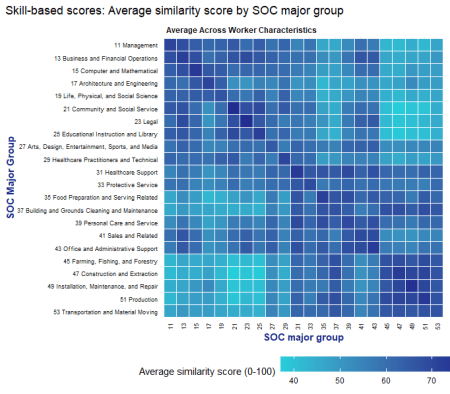
  • Complementarity of Measures: The findings indicate that job descriptions and SOC codes work well in conjunction with O*NET ratings. They explain approximately one-third of the variation in skill-based scores overall and 10 to 15 percent within specific major groups, making them useful for workforce transition assessments.
  • Accessibility: The methods discussed are accessible and cost-effective. They utilize readily available data sources, which is particularly beneficial for regions lacking comprehensive occupational databases.
  • Flexibility: By utilizing job descriptions and classification codes, analysts can adapt their approach based on the available data. This flexibility allows for a broader application across various labor markets and occupations.
  • Intuitive Proxy Measures: The use of SOC codes as a proxy for occupational similarity offers a straightforward method for grouping comparable jobs, enhancing the ease of understanding job relationships.
  • Practical Utility: These methodologies can serve as valuable tools for sense-checking transition pathways derived from non-traditional data sources like online job postings or vocational curricula. This enhances the reliability of insights drawn from such analyses.

Caveats and Limitations

While the methodologies offer significant advantages, it is essential to acknowledge their limitations. For instance, the accuracy of SOC codes as a proxy may vary depending on the specific job pairs being analyzed. Furthermore, job descriptions are often not designed to capture the full complexity of job requirements, which can result in less precise similarity assessments. Therefore, while these methods are valuable, they should be considered as part of a wider analytical toolkit rather than standalone solutions.

Future Implications

As artificial intelligence continues to evolve, its integration into occupational analysis will likely enhance the methodologies discussed. AI advancements, particularly in natural language processing and machine learning, will improve the accuracy of semantic similarity assessments derived from job descriptions. Additionally, more sophisticated models can provide deeper insights into the nuances of job characteristics, thereby refining transition pathway predictions. The ongoing development of AI tools will enable Data Engineers and analysts to leverage complex datasets more effectively, leading to more informed workforce planning and strategic decision-making.

Disclaimer

The content on this site is generated using AI technology that analyzes publicly available blog posts to extract and present key takeaways. We do not own, endorse, or claim intellectual property rights to the original blog content. Full credit is given to original authors and sources where applicable. Our summaries are intended solely for informational and educational purposes, offering AI-generated insights in a condensed format. They are not meant to substitute or replicate the full context of the original material. If you are a content owner and wish to request changes or removal, please contact us directly.

Source link :

Click Here

How We Help

Our comprehensive technical services deliver measurable business value through intelligent automation and data-driven decision support. By combining deep technical expertise with practical implementation experience, we transform theoretical capabilities into real-world advantages, driving efficiency improvements, cost reduction, and competitive differentiation across all industry sectors.

We'd Love To Hear From You

Transform your business with our AI.

Get In Touch