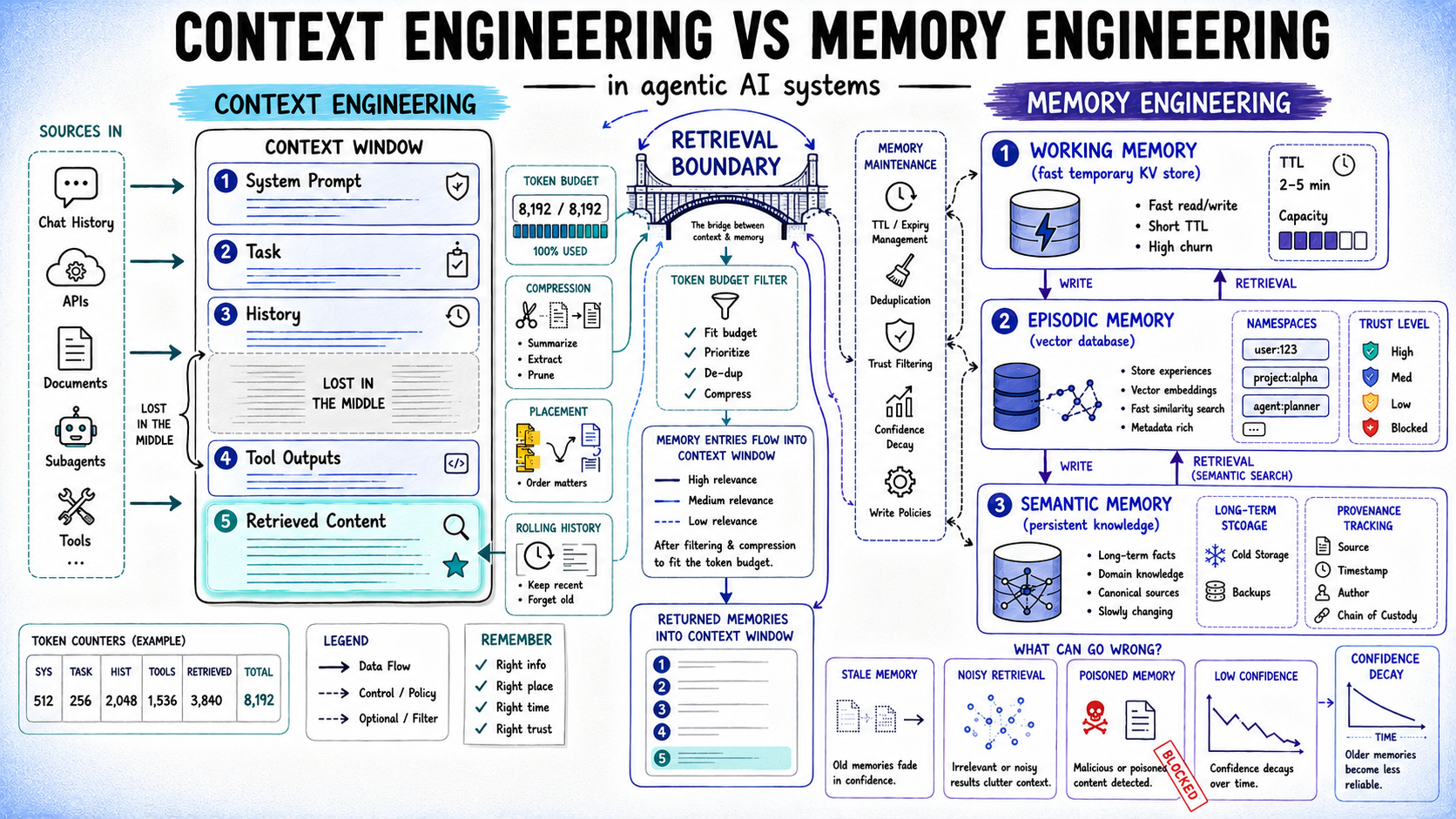
In the domain of Applied Machine Learning, particularly in the deployment of agentic AI systems, the interplay between context engineering and memory engineering is vital. These two disciplines address distinct yet interconnected challenges that arise as AI agents navigate complex workflows and multi-session tasks. Context engineering focuses on what information is utilized during a specific inference call, while memory engineering pertains to the mechanisms that ensure relevant information is retained and accessible across multiple interactions.
This article delves into the nuances of these engineering disciplines, elucidating their respective roles in enhancing the efficacy of AI systems. Key topics include:
As AI agents become integral to increasingly intricate workflows, challenges such as information leakage, task constraints, and context confusion emerge. These issues often stem from the lack of clarity in the roles of context engineering and memory engineering, which, although related, fail in unique ways. Understanding the distinctions and interactions between these disciplines is critical for ensuring AI systems perform reliably throughout real-world applications.
The primary goal of aligning context and memory engineering practices is to ensure that AI agents have access to the right information at the right time. Achieving this involves meticulous management of what information enters the context window during inference and what is preserved in memory for future interactions. The objective is to create a seamless integration where memory serves as a foundation for context, allowing the AI to leverage past knowledge effectively while maintaining the relevance and clarity of current tasks.
However, these advantages come with caveats. Mismanagement of context and memory can lead to issues such as information overload, retrieval misses, and degraded system performance. Thus, careful design and implementation are essential to mitigate these risks.
The evolution of AI technologies and methodologies will profoundly affect the landscape of context and memory engineering. As AI systems become increasingly sophisticated, the demand for robust memory architectures and adaptive context engineering will grow. Future advancements may lead to more intelligent, self-optimizing systems capable of dynamically adjusting their memory and context strategies based on real-time feedback and performance metrics.
Moreover, the integration of more advanced neural architectures and algorithms will likely enhance the ability of AI agents to understand and manage complex dependencies between context and memory, thereby improving their overall functionality and reliability. As these developments unfold, the potential for AI applications in various sectors, including healthcare, finance, and customer service, will expand significantly, further highlighting the importance of effective context and memory engineering.
In conclusion, the relationship between context and memory engineering is fundamental to the success of agentic AI systems. By understanding and optimizing these two layers of engineering, practitioners in the field of Applied Machine Learning can build more effective, reliable, and user-friendly AI solutions. The future of AI will undoubtedly necessitate a deeper exploration into these disciplines, ensuring that AI systems not only learn from the past but also act intelligently in the present.
Disclaimer
The content on this site is generated using AI technology that analyzes publicly available blog posts to extract and present key takeaways. We do not own, endorse, or claim intellectual property rights to the original blog content. Full credit is given to original authors and sources where applicable. Our summaries are intended solely for informational and educational purposes, offering AI-generated insights in a condensed format. They are not meant to substitute or replicate the full context of the original material. If you are a content owner and wish to request changes or removal, please contact us directly.
Source link :