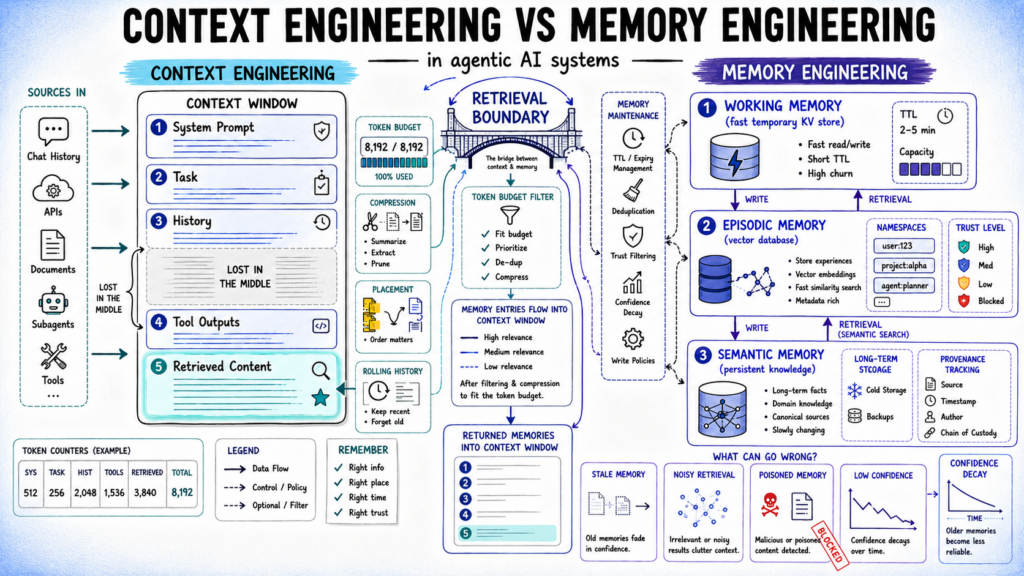
Contextual Framework: Understanding Context and Memory Engineering in Agentic AI Systems In the domain of Applied Machine Learning, particularly in the deployment of agentic AI systems, the interplay between context engineering and memory engineering is vital. These two disciplines address distinct yet interconnected challenges that arise as AI agents navigate complex workflows and multi-session tasks. Context engineering focuses on what information is utilized during a specific inference call, while memory engineering pertains to the mechanisms that ensure relevant information is retained and accessible across multiple interactions. This article delves into the nuances of these engineering disciplines, elucidating their respective roles in enhancing the efficacy of AI systems. Key topics include: The principles of context engineering, encompassing selective inclusion, structural placement, and compression, and their implications for reasoning quality. The fundamentals of memory engineering, covering write policy design, storage layer selection, retrieval strategies, and maintenance, which collectively shape long-term reliability. The intersection of memory and context engineering at the retrieval boundary, highlighting common failure modes when this boundary is not effectively managed. Introduction As AI agents become integral to increasingly intricate workflows, challenges such as information leakage, task constraints, and context confusion emerge. These issues often stem from the lack of clarity in the roles of context engineering and memory engineering, which, although related, fail in unique ways. Understanding the distinctions and interactions between these disciplines is critical for ensuring AI systems perform reliably throughout real-world applications. Main Goal and Achievements The primary goal of aligning context and memory engineering practices is to ensure that AI agents have access to the right information at the right time. Achieving this involves meticulous management of what information enters the context window during inference and what is preserved in memory for future interactions. The objective is to create a seamless integration where memory serves as a foundation for context, allowing the AI to leverage past knowledge effectively while maintaining the relevance and clarity of current tasks. Advantages of Effective Context and Memory Engineering Enhanced Reasoning Quality: Proper context engineering leads to improved inference outcomes by ensuring that only relevant, high-quality information is included in the context window. Increased Long-Term Reliability: Memory engineering facilitates the systematic storage and retrieval of critical information, which enhances the reliability of AI systems over extended periods. Optimized Resource Utilization: By implementing selective inclusion and compression strategies, AI systems can operate more efficiently, thereby reducing computational overhead and resource consumption. Improved User Interaction: Clear memory and context management enhances user experiences through more coherent and contextually aware AI interactions, leading to higher user satisfaction. Scalability: Well-defined engineering practices allow AI systems to scale effectively, managing more extensive datasets and complex workflows without loss of performance. However, these advantages come with caveats. Mismanagement of context and memory can lead to issues such as information overload, retrieval misses, and degraded system performance. Thus, careful design and implementation are essential to mitigate these risks. Future Implications The evolution of AI technologies and methodologies will profoundly affect the landscape of context and memory engineering. As AI systems become increasingly sophisticated, the demand for robust memory architectures and adaptive context engineering will grow. Future advancements may lead to more intelligent, self-optimizing systems capable of dynamically adjusting their memory and context strategies based on real-time feedback and performance metrics. Moreover, the integration of more advanced neural architectures and algorithms will likely enhance the ability of AI agents to understand and manage complex dependencies between context and memory, thereby improving their overall functionality and reliability. As these developments unfold, the potential for AI applications in various sectors, including healthcare, finance, and customer service, will expand significantly, further highlighting the importance of effective context and memory engineering. Conclusion In conclusion, the relationship between context and memory engineering is fundamental to the success of agentic AI systems. By understanding and optimizing these two layers of engineering, practitioners in the field of Applied Machine Learning can build more effective, reliable, and user-friendly AI solutions. The future of AI will undoubtedly necessitate a deeper exploration into these disciplines, ensuring that AI systems not only learn from the past but also act intelligently in the present. Disclaimer The content on this site is generated using AI technology that analyzes publicly available blog posts to extract and present key takeaways. We do not own, endorse, or claim intellectual property rights to the original blog content. Full credit is given to original authors and sources where applicable. Our summaries are intended solely for informational and educational purposes, offering AI-generated insights in a condensed format. They are not meant to substitute or replicate the full context of the original material. If you are a content owner and wish to request changes or removal, please contact us directly. Source link : Click Here
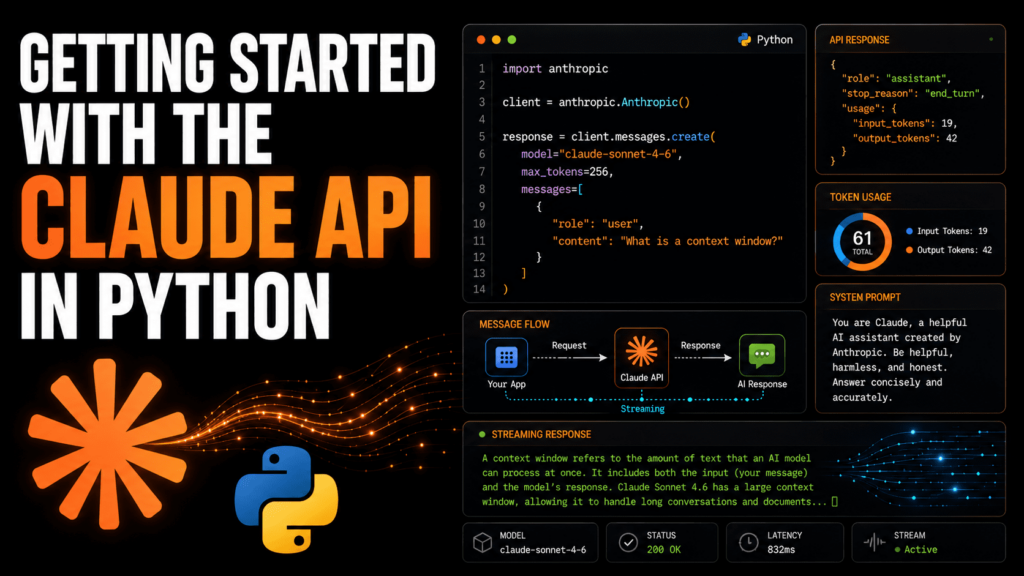
Introduction The advent of advanced artificial intelligence (AI) systems has revolutionized various domains, particularly in Natural Language Understanding (NLU) and Language Understanding. A key player in this transformation is the Claude API, which enables developers to integrate sophisticated language models into their applications. This blog post aims to elucidate the steps necessary for utilizing the Claude API within a Python environment, focusing on practical considerations such as response object interpretation, streaming outputs, and effective prompt structuring. These skills are essential for Natural Language Understanding scientists and developers seeking to enhance their applications with AI-driven capabilities. Establishing a Foundation To begin leveraging the Claude API, developers must first meet specific prerequisites, including the installation of Python 3.9 or higher, as well as the creation of a free Claude Console account that provides access to an API key. The significance of utilizing the Claude Python SDK cannot be overstated, as it streamlines API interactions by offering typed response objects, built-in retry mechanisms, and a user-friendly interface. This foundational setup is pivotal for ensuring seamless communication with the Claude API, thereby facilitating the effective integration of language understanding functionalities into applications. Main Goals of Using the Claude API The primary objective of this blog post is to guide users through the process of making their first API call and interpreting the subsequent outputs. Achieving this goal involves a series of methodical steps: Installation of the Claude SDK and proper API key management. Execution of an API call to retrieve meaningful responses from the language model. Understanding the structure of the response object to extract relevant information. Utilizing system prompts to dictate the behavior of the AI in conversations. Implementing streaming responses to enhance user experience during interactions. Advantages of Utilizing the Claude API The Claude API offers several advantages that can significantly benefit developers and NLU scientists: Ease of Integration: The SDK simplifies API interactions, allowing developers to focus on application logic instead of API intricacies. Structured Responses: The API returns structured response objects, making it easier to extract and utilize data effectively. System Prompts: Users can set persistent roles and constraints across conversations, enhancing the contextual relevance of interactions. Streaming Capabilities: Real-time output streaming improves user engagement by providing immediate feedback rather than waiting for complete responses. However, it is essential to recognize limitations, such as the necessity for careful token management to avoid exceeding the model’s context limits and the potential for responses to be cut off if the max_tokens parameter is not adequately set. Future Implications of AI Developments in NLU The implications of ongoing advancements in AI and NLU are profound. As language models like Claude continue to evolve, we can anticipate enhancements in understanding context, sentiment, and even nuances in human communication. These improvements will empower developers to create more sophisticated applications capable of handling complex interactions. Moreover, as the technology matures, we may witness further integration of AI in various sectors, such as education, customer service, and healthcare, transforming how we interact with technology and each other. The future landscape of NLU promises to be dynamic and increasingly intertwined with everyday life, making it essential for professionals in this field to stay informed and adaptable. Disclaimer The content on this site is generated using AI technology that analyzes publicly available blog posts to extract and present key takeaways. We do not own, endorse, or claim intellectual property rights to the original blog content. Full credit is given to original authors and sources where applicable. Our summaries are intended solely for informational and educational purposes, offering AI-generated insights in a condensed format. They are not meant to substitute or replicate the full context of the original material. If you are a content owner and wish to request changes or removal, please contact us directly. Source link : Click Here
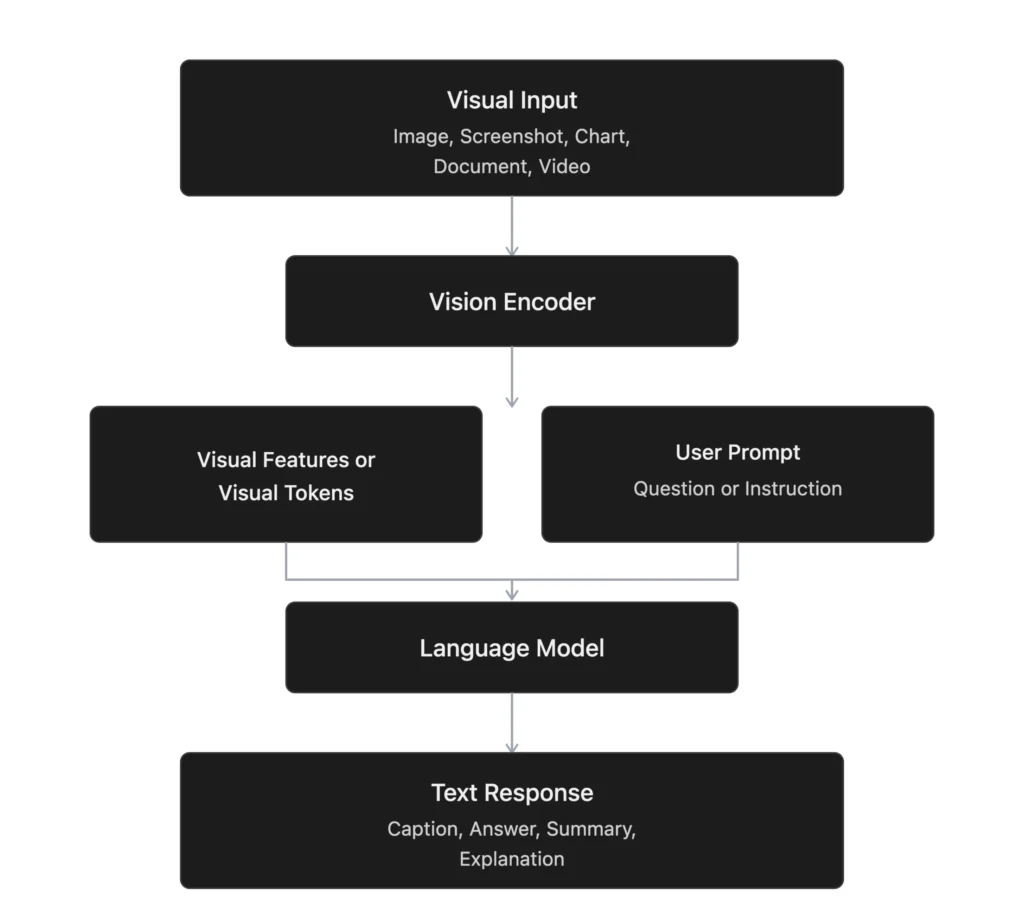
Context Vision Language Models (VLMs) represent a significant advancement in artificial intelligence, uniquely capable of interpreting both visual and textual information. Unlike their predecessors, such as CLIP and BLIP, which primarily bridged images and text, modern VLMs extend their capabilities to encompass complex tasks, including image analysis, document comprehension, chart interpretation, and interactive multimodal engagements. This evolution has made VLMs indispensable across various sectors including education, healthcare, business, automation, and accessibility, enhancing the practical applications of visual AI in real-world scenarios. What Are Modern Vision Language Models? Modern Vision Language Models are sophisticated AI systems engineered to process and understand visual content alongside language. These models are not limited to object recognition; they can articulate contextual narratives, respond to inquiries, read textual data within images, interpret layouts, and perform comparative analyses of visual information. By integrating a vision system that translates images into actionable visual features and a large language model that leverages these features in response to user prompts, VLMs provide a comprehensive approach to understanding multimodal inputs. From CLIP and BLIP to Modern VLMs While CLIP and BLIP laid the groundwork for early VLM development by demonstrating the potential for mapping images and text, modern VLMs have evolved to function as comprehensive multimodal assistants. They possess the capability to execute instructions, engage in dialogue, analyze documents, and reason through visual details. This transition marks a paradigm shift, transforming VLMs from mere image-text models into versatile tools that facilitate user action based on visual context interpretation. Understanding the Functionality of Leading VLMs Key examples of modern VLMs, such as GPT-4o, Gemini, Claude Vision, and Qwen-VL, exemplify the remarkable capabilities of contemporary AI technology. Each model showcases unique strengths: GPT-4o excels in real-time multimodal interaction, seamlessly integrating text, images, audio, and video to create an interactive user experience. Gemini leverages strong reasoning abilities across diverse information types, making it particularly effective for detailed analyses involving long documents, videos, and complex charts. Claude Vision focuses on meticulous visual understanding, providing clear explanations and summaries of complex visual content. Qwen-VL specializes in reading textual information from images and performing advanced document parsing, which is especially useful in Optical Character Recognition (OCR) scenarios. Key Differences Between Modern VLMs The primary distinctions among these models lie in their unique strengths and ideal use cases. For instance, GPT-4o is tailored for interactive user assistance, while Gemini is adept at comprehensive analysis. Conversely, Claude Vision is designed for precise visual communication, and Qwen-VL focuses on structured visual understanding. These differences underscore the importance of selecting the appropriate VLM based on the specific requirements of a task. Strengths and Limitations of Modern VLMs Strengths of Modern VLMs Limitations of Modern VLMs Ability to understand and articulate visual content in natural language. Potential to overlook subtle details or misinterpret unclear images. User-friendly compared to traditional computer vision systems. May present confident but inaccurate answers. Capable of diverse tasks such as summarizing documents and supporting multimodal conversations. Challenges with complex visuals, low-quality images, and contextually rich tasks. Facilitates faster understanding of intricate information. Requires substantial computational resources for effectiveness. Future Implications The ongoing advancements in VLM technology hold significant implications for various sectors. As these models improve in their ability to interpret visual data and provide contextually relevant insights, they will increasingly influence how professionals engage with visual information. For data engineers and analysts, the integration of VLMs into data workflows can enhance efficiency, reduce manual data processing, and facilitate deeper insights into complex datasets. However, as VLMs become more prevalent, the importance of human oversight will remain critical, particularly in sensitive areas such as healthcare and finance, where nuanced understanding is paramount. Conclusion Modern Vision Language Models mark a pivotal development in AI, bridging the gap between visual and linguistic understanding. The transition from earlier models to contemporary VLMs like GPT-4o, Gemini, Claude Vision, and Qwen-VL exemplifies the growing sophistication of AI technologies. While these models offer impressive capabilities across multiple industries, careful consideration of their limitations and the necessity for human oversight will be essential as their applications expand. Frequently Asked Questions Q1. What are modern Vision Language Models? A. Modern Vision Language Models are AI systems that understand and process images and text together, enabling them to describe visuals, read documents, and answer visual questions. Q2. How are modern VLMs different from CLIP and BLIP? A. CLIP and BLIP focused on matching images with text, while modern VLMs can execute complex tasks such as analyzing documents and engaging in conversations. Q3. What are the main limitations of modern VLMs? A. Modern VLMs may miss intricate details, misinterpret unclear visuals, and require significant computational power for optimal performance. Disclaimer The content on this site is generated using AI technology that analyzes publicly available blog posts to extract and present key takeaways. We do not own, endorse, or claim intellectual property rights to the original blog content. Full credit is given to original authors and sources where applicable. Our summaries are intended solely for informational and educational purposes, offering AI-generated insights in a condensed format. They are not meant to substitute or replicate the full context of the original material. If you are a content owner and wish to request changes or removal, please contact us directly. Source link : Click Here


