Extending Neural Architectures for Operator Learning in Function Spaces

Contextual Overview

The rapid advancement of deep learning technologies over the past decade has demonstrated transformative potential across various fields, notably in computer vision, speech recognition, and natural language processing. As these technologies evolve, they are set to revolutionize the natural sciences, particularly in domains such as Smart Manufacturing and Robotics. Traditional deep learning models, primarily based on neural networks, process data in finite-dimensional vectors, which can be limiting when addressing the continuum descriptions inherent in many physical phenomena, such as those governed by partial differential equations (PDEs). These phenomena often require outputs that can be evaluated at arbitrary coordinates, necessitating models that are not constrained by fixed discretizations.

Main Goals and Achievements

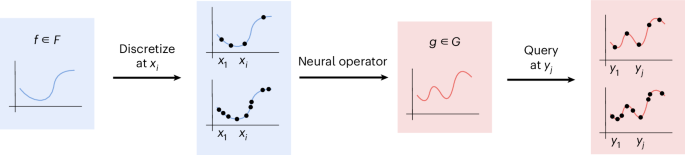
The primary objective is to develop neural operators that extend standard neural architectures to function spaces, allowing them to learn mappings between continuous functions. Achieving this goal involves several key principles: ensuring that the learned mappings are discretization agnostic, maintaining a fixed number of learnable parameters regardless of discretization, and being able to universally approximate regular operators with minimal error. By doing so, neural operators can effectively model complex physical systems and phenomena that are not adequately captured by traditional neural networks.

Structured Advantages of Neural Operators

  • Discretization Agnosticism: Neural operators can process functions at any discretization, producing consistent outputs across varying resolutions. This property enhances the robustness of models in real-world applications where data may come from different sources or formats.
  • Data Efficiency: Neural operators can leverage datasets with varying discretizations, thus making efficient use of available training data. This is particularly beneficial in the Smart Manufacturing sector, where computational resources are often limited, and high-resolution data can be scarce.
  • Universal Approximation Capability: The architecture of neural operators enables them to approximate complex function-to-function mappings, ensuring high fidelity in predictions across a range of applications. This is crucial in robotics, where precision is paramount.
  • Flexible Inference: Trained neural operators can deliver consistent predictions even for discretizations that were not included in the training dataset, facilitating applications such as zero-shot super-resolution—an important feature for manufacturing scenarios where real-time adaptability is needed.
  • Streamlined Training Processes: The ability to implement curriculum learning, where simpler tasks are tackled before progressing to more complex ones, can accelerate training and improve overall model performance.

Implications for the Future of AI in Smart Manufacturing and Robotics

The integration of neural operators into Smart Manufacturing and Robotics signifies a paradigm shift in how complex systems are modeled and controlled. As AI technologies continue to develop, we can anticipate several key implications:

  • Enhanced Automation: With improved predictive capabilities, AI systems will better integrate into automated manufacturing processes, allowing for more dynamic and responsive production lines.
  • Real-Time Adaptability: The ability of neural operators to generalize across resolutions will enable robots and automated systems to adapt to new tasks and environments without the need for extensive retraining.
  • Cost Reduction: More efficient data usage and reduced computational demands will lower operational costs, making advanced AI applications accessible to a broader range of industries.
  • Increased Collaboration Between Humans and Robots: As AI systems become more sophisticated, they will enhance human-robot collaboration, leading to safer and more efficient workplaces.

Disclaimer

The content on this site is generated using AI technology that analyzes publicly available blog posts to extract and present key takeaways. We do not own, endorse, or claim intellectual property rights to the original blog content. Full credit is given to original authors and sources where applicable. Our summaries are intended solely for informational and educational purposes, offering AI-generated insights in a condensed format. They are not meant to substitute or replicate the full context of the original material. If you are a content owner and wish to request changes or removal, please contact us directly.

Source link :

Click Here

How We Help

Our comprehensive technical services deliver measurable business value through intelligent automation and data-driven decision support. By combining deep technical expertise with practical implementation experience, we transform theoretical capabilities into real-world advantages, driving efficiency improvements, cost reduction, and competitive differentiation across all industry sectors.

We'd Love To Hear From You

Transform your business with our AI.

Get In Touch