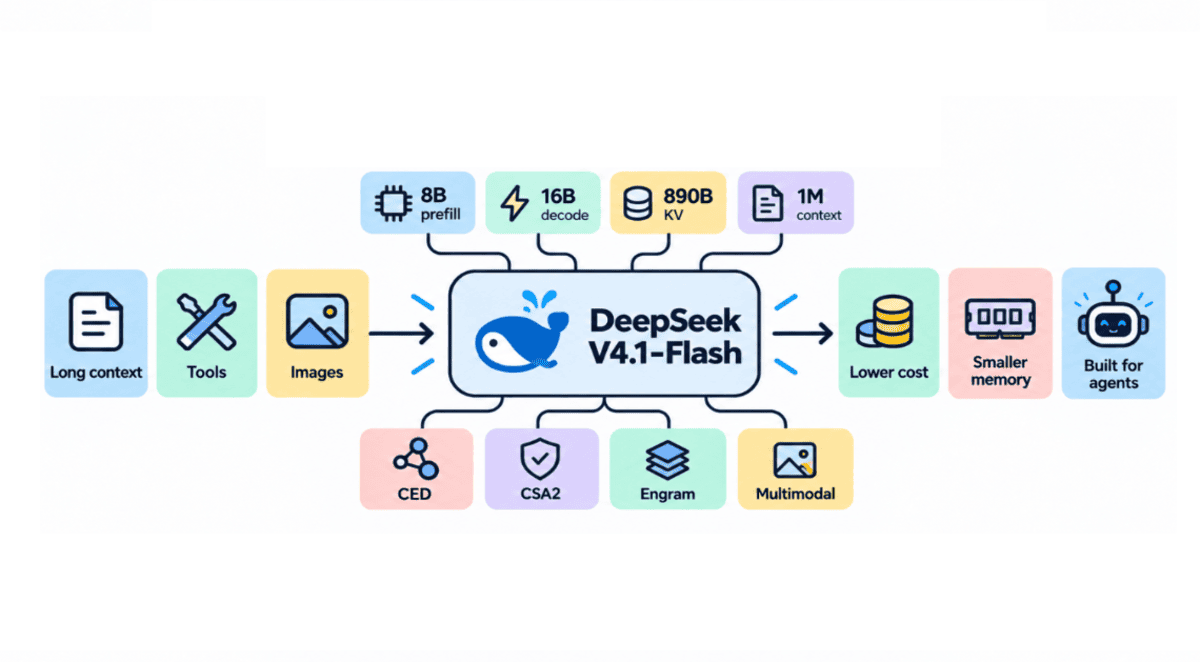
The recent release of DeepSeek-V4.1-Flash marks a significant advancement in the field of Natural Language Processing (NLP), particularly for applications involving long-context AI systems. While the performance metrics of the model are noteworthy, the architectural innovations represent the most compelling aspects of this release. DeepSeek addresses critical challenges in the realm of AI agents, including the high costs associated with prefill computations, extensive key-value (KV) caches, prolonged contexts, and the efficiency of maintaining agent states throughout interactions. Rather than merely scaling up model size, DeepSeek has re-engineered various components within the architecture and inference stack to facilitate more economical operations for long-context AI systems. This article will elucidate the transformative changes introduced in DeepSeek-V4.1-Flash and their implications for the field of Natural Language Understanding (NLU).
The central objective of DeepSeek-V4.1-Flash is to create a model that not only excels in computational efficiency but also enhances the performance of long-context AI agents. This goal is achieved through a multifaceted architectural redesign that optimizes both the prefill and decoding stages of language model inference. By implementing a Causal Encoder-Decoder (CED) architecture, the model limits the active parameters during prefill and decoding processes, thereby reducing the computational burden. The model’s ability to manage extensive context windows while minimizing memory requirements is a pivotal achievement that enhances its practicality for real-world applications.
While the advancements presented in DeepSeek-V4.1-Flash are substantial, it is essential to acknowledge certain limitations. The model’s efficacy in specific domains may still vary, and while it excels in reducing latency and memory usage, its overall intelligence and output quality may not surpass the best-performing models in all scenarios. Additionally, the complexity of its architecture may pose challenges for broader adoption, particularly in resource-constrained environments.
The developments represented by DeepSeek-V4.1-Flash are expected to significantly influence the future of Natural Language Understanding and AI agent design. As the demand for more sophisticated AI interactions increases, the need for models that balance efficiency with computational power will become paramount. The architectural innovations introduced in this release may serve as a blueprint for future models, promoting a trend toward more efficient memory usage and processing speeds. Furthermore, as open-source implementations based on the MIT licensing gain traction, the dissemination of these ideas could catalyze further research and improvements in the field, potentially leading to groundbreaking advancements in AI applications.
Disclaimer
The content on this site is generated using AI technology that analyzes publicly available blog posts to extract and present key takeaways. We do not own, endorse, or claim intellectual property rights to the original blog content. Full credit is given to original authors and sources where applicable. Our summaries are intended solely for informational and educational purposes, offering AI-generated insights in a condensed format. They are not meant to substitute or replicate the full context of the original material. If you are a content owner and wish to request changes or removal, please contact us directly.
Source link :