Contextual Overview of AI in Patent Workflows In the rapidly evolving landscape of legal technology, the integration of artificial intelligence (AI) into patent workflows has emerged as a transformative force. Patlytics, an AI platform designed specifically for intellectual property professionals, is reshaping the patent lifecycle through various functionalities, including patent drafting, prior art analysis, office action responses, and litigation preparedness. Paul Lee, co-founder and CEO of Patlytics, indicates that the platform currently supports roughly 55 percent of the Am Law 100 firms, alongside numerous corporations across technology, biotechnology, and pharmaceuticals, highlighting its substantial market penetration and influence. Identifying the Primary Goal The primary objective of integrating AI into patent workflows is to enhance efficiency and reduce the transactional inefficiencies that have historically characterized the intellectual property landscape. By automating labor-intensive tasks, Patlytics aims to streamline processes, thereby allowing patent professionals to focus on higher-value activities that necessitate human judgment. This goal can be achieved through the development of specialized tools that cater to the intricate demands of patent law, as opposed to generalized legal AI platforms. Advantages of AI Integration in Patent Workflows Increased Efficiency: AI tools minimize the time required for drafting patent applications and conducting prior art searches. This reduction in time enhances overall workflow efficiency, allowing professionals to manage larger volumes of work. Enhanced Accuracy: By leveraging AI’s analytical capabilities, patent professionals can improve the precision of their work, particularly in areas such as claim chart preparation and office action responses. Scalability: As organizations adopt AI tools like Patlytics, they can scale their operations more effectively, accommodating increasing demands without a corresponding increase in resources. Cost Reduction: Automation of routine tasks leads to lower operational costs, enabling firms to offer more competitive pricing models, such as flat-fee arrangements, which are increasingly favored by clients. Improved Client Satisfaction: The combination of faster turnaround times, higher quality work, and cost savings directly enhances client satisfaction and loyalty, which is crucial in the competitive landscape of legal services. Important Caveats and Limitations While the integration of AI in patent workflows presents numerous advantages, it is essential to acknowledge certain limitations. The reliance on AI-generated outputs necessitates that human professionals maintain oversight, as they are ultimately responsible for the accuracy and quality of the work product. Additionally, the initial implementation of AI tools can require significant investment in training and adaptation, which may pose a barrier for some organizations. Furthermore, there is a need for clear policies regarding AI usage to mitigate risks associated with data confidentiality and compliance. Future Implications of AI in Patent Practices Looking ahead, the continued advancement of AI technologies will likely have profound implications for the patent sector. As AI becomes more sophisticated, its application is expected to expand beyond current functionalities, potentially encompassing more complex tasks such as predictive analytics for infringement assessments and automated litigation strategies. However, as noted by Paul Lee, the economic viability of these technologies will become increasingly scrutinized as firms shift from experimentation to a focus on return on investment (ROI). This evolution will require practitioners to balance the benefits of AI with the inherent need for human judgment, ensuring that legal professionals remain integral to the patent process while effectively leveraging AI capabilities. Disclaimer The content on this site is generated using AI technology that analyzes publicly available blog posts to extract and present key takeaways. We do not own, endorse, or claim intellectual property rights to the original blog content. Full credit is given to original authors and sources where applicable. Our summaries are intended solely for informational and educational purposes, offering AI-generated insights in a condensed format. They are not meant to substitute or replicate the full context of the original material. If you are a content owner and wish to request changes or removal, please contact us directly. Source link : Click Here
Contextual Overview of Military Space Operations In a significant announcement, the U.S. military has confirmed the deployment of weaponry in orbit for the first time, marking a pivotal moment in military strategy and space governance. The disclosed categories of weapon systems encompass directed-energy devices such as lasers and radio frequency jammers, alongside kinetic weapons designed to physically neutralize threats. Although these systems can be situated on land or in space, discussions surrounding their deployment have intensified, particularly in light of strategic advancements by global competitors, notably China and Russia. In 2025, General Chance Saltzman, then chief of space operations for the U.S. Space Force, acknowledged that while other nations are exploring various weapon categories, the U.S. has yet to fully commit to these technologies. However, he suggested that the United States should consider all categories for operational readiness. Main Goals of Space Weaponization The primary objective of deploying weapons in orbit is to establish a comprehensive space defense capability. This goal can be achieved through the development and operationalization of various weapon systems that not only deter adversaries but also ensure the protection of U.S. satellite assets. The recent operational acceptance of the ground-based mobile satellite jammer, known as Meadowlands, exemplifies the U.S. commitment to enhancing its counterspace capabilities. By potentially deploying jammers in orbit, the U.S. seeks to level the playing field against nations presumed to possess similar technologies, thereby reinforcing its strategic advantage in space. Advantages of Space-Based Weapon Systems Enhanced National Security: The deployment of advanced weapon systems in orbit may serve as a deterrent against hostile actions from rival nations, thereby enhancing U.S. national security. Technological Superiority: The U.S. military’s investment in space-based weapons positions it as a leader in military technology, fostering innovation and development in the defense sector. Flexible Operational Capabilities: Space-based systems can provide rapid responses to threats, allowing for greater flexibility in military operations compared to terrestrial assets. Counterspace Operations: The ability to neutralize adversary satellites through non-kinetic means, such as jamming and spoofing, could minimize collateral damage and preserve the integrity of orbital environments. Despite these advantages, it is critical to recognize potential limitations. The deployment of kinetic weapons poses significant risks, including the generation of space debris, which could jeopardize both military and civilian satellites in orbit. Furthermore, international treaties and norms regarding the militarization of space present ethical and legal challenges that must be navigated carefully. Future Implications and the Role of AI As military strategies evolve, the integration of artificial intelligence (AI) into space operations is poised to transform the landscape significantly. AI technologies could enhance the precision and efficiency of space-based weapon systems, enabling real-time data analysis and decision-making. The development of autonomous systems capable of executing complex tasks in orbit could further augment U.S. military capabilities. However, the implications of AI in military applications also raise ethical questions regarding accountability and the potential for unintended consequences in conflict scenarios. In conclusion, while the confirmation of U.S. military weapon deployment in orbit signifies a strategic shift in defense policy, it also necessitates a balanced approach that considers both the benefits and challenges associated with such advancements. The future of military operations in space will hinge not only on technological innovation but also on the responsible governance of these emerging capabilities. Disclaimer The content on this site is generated using AI technology that analyzes publicly available blog posts to extract and present key takeaways. We do not own, endorse, or claim intellectual property rights to the original blog content. Full credit is given to original authors and sources where applicable. Our summaries are intended solely for informational and educational purposes, offering AI-generated insights in a condensed format. They are not meant to substitute or replicate the full context of the original material. If you are a content owner and wish to request changes or removal, please contact us directly. Source link : Click Here

Context of AI in Agriculture Artificial intelligence (AI) is rapidly transforming the agricultural landscape, becoming an integral component of the global crop input value chain. While discussions in the public sphere often center on the potential threats posed by AI, industry leaders are increasingly preoccupied with a more pragmatic inquiry: how can the agricultural sector harness the advantages of AI while effectively mitigating associated risks? This nuanced dialogue is crucial for the advancement of AgriTech and Smart Farming, where the integration of AI technologies promises to enhance operational capabilities across multiple dimensions including forecasting, logistics optimization, and data analysis. Main Goal and Its Achievement The primary objective in integrating AI within agriculture is to capture its benefits while responsibly managing the inherent risks. Achieving this goal entails a multifaceted approach: first, organizations must invest in robust AI systems that are not only capable of processing vast quantities of data but are also equipped with mechanisms to understand the complexities of local agricultural conditions. Second, enhancing data quality is vital; organizations must ensure that the data fed into AI systems is accurate, complete, and unbiased. This dual focus on advanced technology and stringent data governance can help agribusinesses make informed decisions that minimize risks. Advantages of AI in Agriculture Enhanced Forecasting: AI technologies can analyze historical data and current trends, significantly improving demand forecasting accuracy. This enables agribusinesses to align their production and inventory levels more closely with market needs. Operational Efficiency: AI systems streamline logistics and supply chain management, helping to identify bottlenecks and optimize transportation routes. This operational enhancement can lead to substantial cost savings, especially in an industry where margins are often tight. Data-Driven Insights: AI empowers agribusinesses to analyze agronomic data at unprecedented speeds, allowing for quicker decision-making and more precise recommendations regarding crop nutrition and protection. Improved Customer Support: AI can enhance customer interactions through personalized recommendations and timely support, fostering stronger relationships between agribusinesses and their clients. Risk Management: By providing insights derived from comprehensive data analysis, AI can help mitigate risks associated with financial, environmental, and regulatory decisions in agriculture. However, it is important to acknowledge limitations. AI systems can generate confident recommendations even when lacking a complete understanding of local market dynamics or operational realities. Additionally, reliance on subpar data can lead to suboptimal outcomes, emphasizing the need for rigorous data governance and human oversight. Future Implications of AI in Agriculture As AI technologies continue to evolve, their impact on agriculture is poised to grow significantly. Future developments may lead to even more sophisticated AI systems capable of integrating real-time data from diverse sources, including weather patterns and soil conditions, thereby enhancing precision agriculture practices. Furthermore, as agriculture increasingly adopts digital solutions, issues surrounding cybersecurity and data governance will become even more critical. Stakeholders must ensure that sensitive agricultural data is adequately protected while being used to drive informed decision-making. Ultimately, the organizations that will thrive in this rapidly changing landscape will be those that adeptly balance the innovative capabilities of AI with the necessary risk management strategies. The future of AgriTech and Smart Farming hinges on this delicate equilibrium, enabling stakeholders to leverage AI’s potential while safeguarding against its risks. Disclaimer The content on this site is generated using AI technology that analyzes publicly available blog posts to extract and present key takeaways. We do not own, endorse, or claim intellectual property rights to the original blog content. Full credit is given to original authors and sources where applicable. Our summaries are intended solely for informational and educational purposes, offering AI-generated insights in a condensed format. They are not meant to substitute or replicate the full context of the original material. If you are a content owner and wish to request changes or removal, please contact us directly. Source link : Click Here
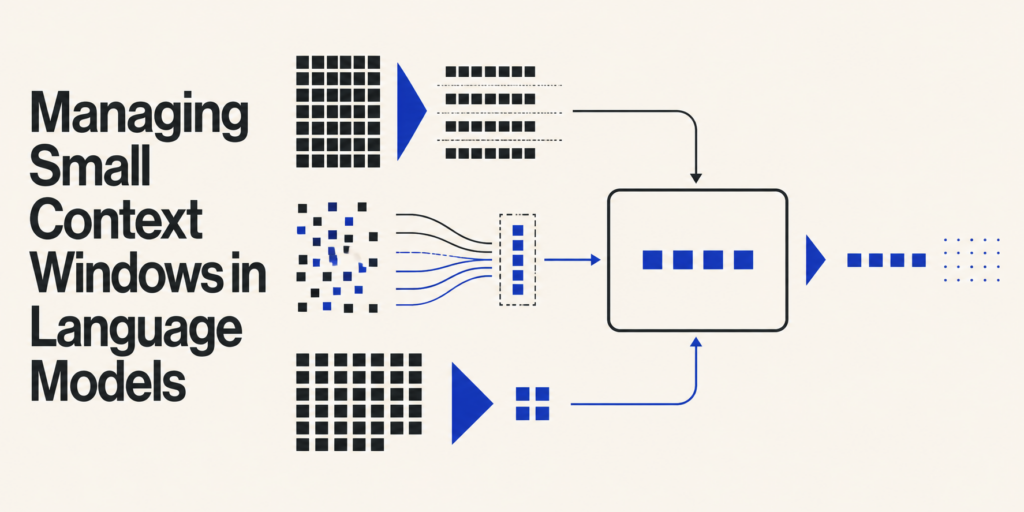
Context for Managing Small Context Windows in Language Models In the rapidly evolving landscape of artificial intelligence, especially within the domain of applied machine learning, the management of small context windows in language models has emerged as a critical area of focus. This article presents three pragmatic strategies designed to optimize the handling of small context windows, accompanied by Python examples that illustrate the application of two of these strategies. The primary topics discussed include: Utilizing context truncation through a sliding window approach to maintain predictable and flat token usage. Employing token budgeting alongside retrieval-augmented generation (RAG) to ensure that only the most pertinent context is included within a prompt. A brief examination of supplementary strategies tailored for specialized applications, including rolling summaries, prompt compression, and observation masking. Introduction In the field of artificial intelligence, there is a prevailing fascination with language models that can process extensive context windows, enabling them to integrate vast amounts of information. However, these large context windows pose significant challenges, such as elevated API costs, increased latency, and the notorious “lost in the middle” problem, where critical information may be overlooked within a voluminous prompt. Consequently, effectively managing small context windows can lead to enhanced performance, reduced costs, and improved focus on relevant data, ultimately refining the model’s output. This article elaborates on three widely adopted strategies for mastering small context windows in language models, supplemented by practical examples to facilitate understanding and implementation. Main Goal and Achievement The central aim of managing small context windows is to enhance the efficiency and effectiveness of language models in processing and generating responses. This can be accomplished through the implementation of practical strategies that prioritize the most relevant information while minimizing unnecessary data. By applying techniques such as sliding window truncation and token budgeting, practitioners can ensure that the model operates within a manageable context size, yielding better performance and lower operational costs. Advantages of Managing Small Context Windows Several advantages arise from effectively managing small context windows in language models: Controlled Token Usage: The sliding window approach enables fixed control over token consumption, leading to predictable latency and cost management. Enhanced Relevance of Information: Token budgeting ensures that only the most pertinent data is included, mitigating the “lost in the middle” issue and facilitating more accurate responses. Versatile Implementation: The strategies discussed can be readily adapted for various applications, from chatbots to automated content generation, enhancing the utility of language models in diverse fields. Reduction in Latency: By concentrating on relevant context and avoiding excessive data processing, response times can be significantly improved, leading to a more efficient user experience. Despite these advantages, it is crucial to acknowledge potential limitations, such as the need for careful parameter tuning and the requirement for additional computational resources in certain strategies, which may introduce complexity in implementation. Future Implications of AI Developments The evolution of artificial intelligence, particularly in the context of language models, suggests a promising future for the management of small context windows. As advancements in AI algorithms continue to emerge, we can anticipate more sophisticated strategies that leverage machine learning techniques to further optimize context management. This could lead to more intuitive user interactions, greater efficiency in data processing, and enhanced capabilities in understanding and generating human-like responses. Furthermore, as industry standards shift toward more cost-effective and efficient AI solutions, the importance of mastering small context windows will likely grow, positioning practitioners to better meet the demands of an increasingly competitive landscape. Closing Remarks In summary, the effective management of small context windows should not be viewed merely as a limitation but rather as an opportunity to innovate and refine AI applications. By employing the strategies outlined in this article, practitioners can enhance the functionality of language models, paving the way for faster, more accurate, and cost-effective solutions in the field of applied machine learning. Disclaimer The content on this site is generated using AI technology that analyzes publicly available blog posts to extract and present key takeaways. We do not own, endorse, or claim intellectual property rights to the original blog content. Full credit is given to original authors and sources where applicable. Our summaries are intended solely for informational and educational purposes, offering AI-generated insights in a condensed format. They are not meant to substitute or replicate the full context of the original material. If you are a content owner and wish to request changes or removal, please contact us directly. Source link : Click Here
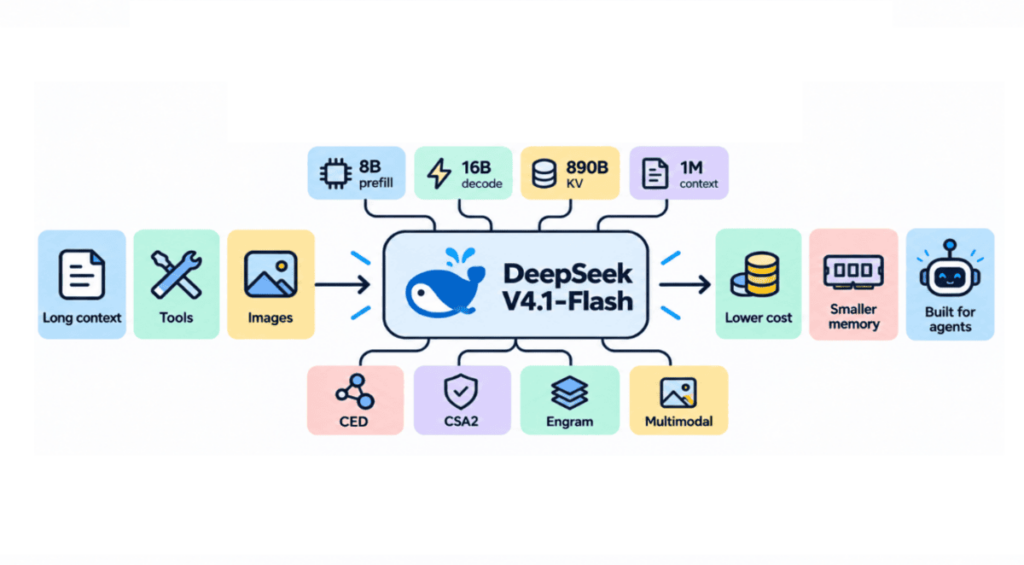
Context The recent release of DeepSeek-V4.1-Flash marks a significant advancement in the field of Natural Language Processing (NLP), particularly for applications involving long-context AI systems. While the performance metrics of the model are noteworthy, the architectural innovations represent the most compelling aspects of this release. DeepSeek addresses critical challenges in the realm of AI agents, including the high costs associated with prefill computations, extensive key-value (KV) caches, prolonged contexts, and the efficiency of maintaining agent states throughout interactions. Rather than merely scaling up model size, DeepSeek has re-engineered various components within the architecture and inference stack to facilitate more economical operations for long-context AI systems. This article will elucidate the transformative changes introduced in DeepSeek-V4.1-Flash and their implications for the field of Natural Language Understanding (NLU). Main Goal and Achievement The central objective of DeepSeek-V4.1-Flash is to create a model that not only excels in computational efficiency but also enhances the performance of long-context AI agents. This goal is achieved through a multifaceted architectural redesign that optimizes both the prefill and decoding stages of language model inference. By implementing a Causal Encoder-Decoder (CED) architecture, the model limits the active parameters during prefill and decoding processes, thereby reducing the computational burden. The model’s ability to manage extensive context windows while minimizing memory requirements is a pivotal achievement that enhances its practicality for real-world applications. Advantages of DeepSeek-V4.1-Flash Reduced Memory Footprint: DeepSeek-V4.1-Flash achieves a global KV cache size of only 890 bytes per token, a substantial reduction that enhances memory efficiency compared to its predecessor, allowing for larger context windows without excessive resource consumption. Optimized Parameter Usage: The model utilizes a total of 552 billion parameters, activating only 8 billion during prefill and 16 billion during decoding. This selective activation significantly lowers computational costs while maintaining performance. Enhanced Context Management: The architecture supports a context window of 1 million tokens, addressing the growing demand for AI systems to process extensive inputs effectively. Improved Inference Speed: Through innovations such as Single-Pass mHC and DSpark Speculative Decoding, the model accelerates token generation, making it more suitable for applications requiring rapid response times. Scalable Architecture: By incorporating techniques such as Compressed Sparse Attention 2 (CSA2) and SWA Bounded Replay, the model minimizes redundant computations across layers, allowing for better resource allocation and faster processing. Caveats and Limitations While the advancements presented in DeepSeek-V4.1-Flash are substantial, it is essential to acknowledge certain limitations. The model’s efficacy in specific domains may still vary, and while it excels in reducing latency and memory usage, its overall intelligence and output quality may not surpass the best-performing models in all scenarios. Additionally, the complexity of its architecture may pose challenges for broader adoption, particularly in resource-constrained environments. Future Implications The developments represented by DeepSeek-V4.1-Flash are expected to significantly influence the future of Natural Language Understanding and AI agent design. As the demand for more sophisticated AI interactions increases, the need for models that balance efficiency with computational power will become paramount. The architectural innovations introduced in this release may serve as a blueprint for future models, promoting a trend toward more efficient memory usage and processing speeds. Furthermore, as open-source implementations based on the MIT licensing gain traction, the dissemination of these ideas could catalyze further research and improvements in the field, potentially leading to groundbreaking advancements in AI applications. Disclaimer The content on this site is generated using AI technology that analyzes publicly available blog posts to extract and present key takeaways. We do not own, endorse, or claim intellectual property rights to the original blog content. Full credit is given to original authors and sources where applicable. Our summaries are intended solely for informational and educational purposes, offering AI-generated insights in a condensed format. They are not meant to substitute or replicate the full context of the original material. If you are a content owner and wish to request changes or removal, please contact us directly. Source link : Click Here

Contextual Overview In the evolving landscape of data analytics and insights, the ability to manipulate and interact with data efficiently is paramount. The integration of MIDI controllers, such as the Behringer FCB1010, into macOS environments exemplifies how unconventional tools can enhance user interaction with data systems. The fcbnerd application serves as a command-line interface that connects MIDI sources to execute specific actions based on footswitch inputs. This innovative approach allows users to streamline their workflows by leveraging MIDI commands to trigger various data-related tasks, thereby enhancing productivity and efficiency for data engineers. Main Goal and Implementation The primary objective of utilizing a MIDI foot controller with the fcbnerd application is to facilitate the execution of commands on macOS through footswitch activation. This method allows for a hands-free interaction model which can be particularly beneficial in environments where multitasking is essential. To achieve this goal, users must configure bindings that link MIDI messages to specific shell commands. For instance, a user can bind a footswitch to open a folder on their system or execute a script that processes data, thereby simplifying the management of data workflows. Advantages of Implementing MIDI Controllers in Data Engineering Enhanced Workflow Efficiency: By integrating MIDI foot controllers, data engineers can streamline their workflows, allowing for quicker access to important commands without the need for manual input. This is particularly advantageous during presentations or data analysis sessions where hands-free operation is preferred. Customizability: The flexibility of the fcbnerd application allows for the customization of MIDI bindings that cater to individual user needs. Each user can tailor the tool to fit their specific workflow requirements, enhancing overall productivity. Real-time Data Interaction: The ability to trigger commands in real-time facilitates immediate interaction with data processes. This is crucial in scenarios that require quick decision-making based on live data feeds. Minimal Permissions Required: Unlike many applications that require extensive permissions to interact with system-level commands, fcbnerd operates by only reading MIDI inputs, thus reducing potential security concerns and simplifying the setup process. Limitations and Caveats While the implementation of MIDI controllers offers numerous advantages, there are inherent limitations. The effectiveness of this approach may vary based on the user’s familiarity with command-line interfaces and the complexity of the commands being executed. Additionally, the reliance on specific MIDI hardware, such as the Behringer FCB1010, may restrict accessibility for users who do not possess compatible equipment. Furthermore, the learning curve associated with configuring MIDI bindings can be a barrier for less technically inclined users. Future Implications in the AI Domain As artificial intelligence continues to advance, the integration of MIDI controllers and command-line tools like fcbnerd could evolve significantly. Future developments may include AI-driven automation that allows for predictive command execution based on user behavior and data patterns. This could enhance the tool’s capability by not only reacting to manual inputs but also anticipating user needs, leading to a more intuitive interaction model. Moreover, as more data analytics processes become automated, the use of MIDI controllers may transition from a niche application to a standard practice in data engineering environments, further streamlining operations and enhancing productivity. Disclaimer The content on this site is generated using AI technology that analyzes publicly available blog posts to extract and present key takeaways. We do not own, endorse, or claim intellectual property rights to the original blog content. Full credit is given to original authors and sources where applicable. Our summaries are intended solely for informational and educational purposes, offering AI-generated insights in a condensed format. They are not meant to substitute or replicate the full context of the original material. If you are a content owner and wish to request changes or removal, please contact us directly. Source link : Click Here


