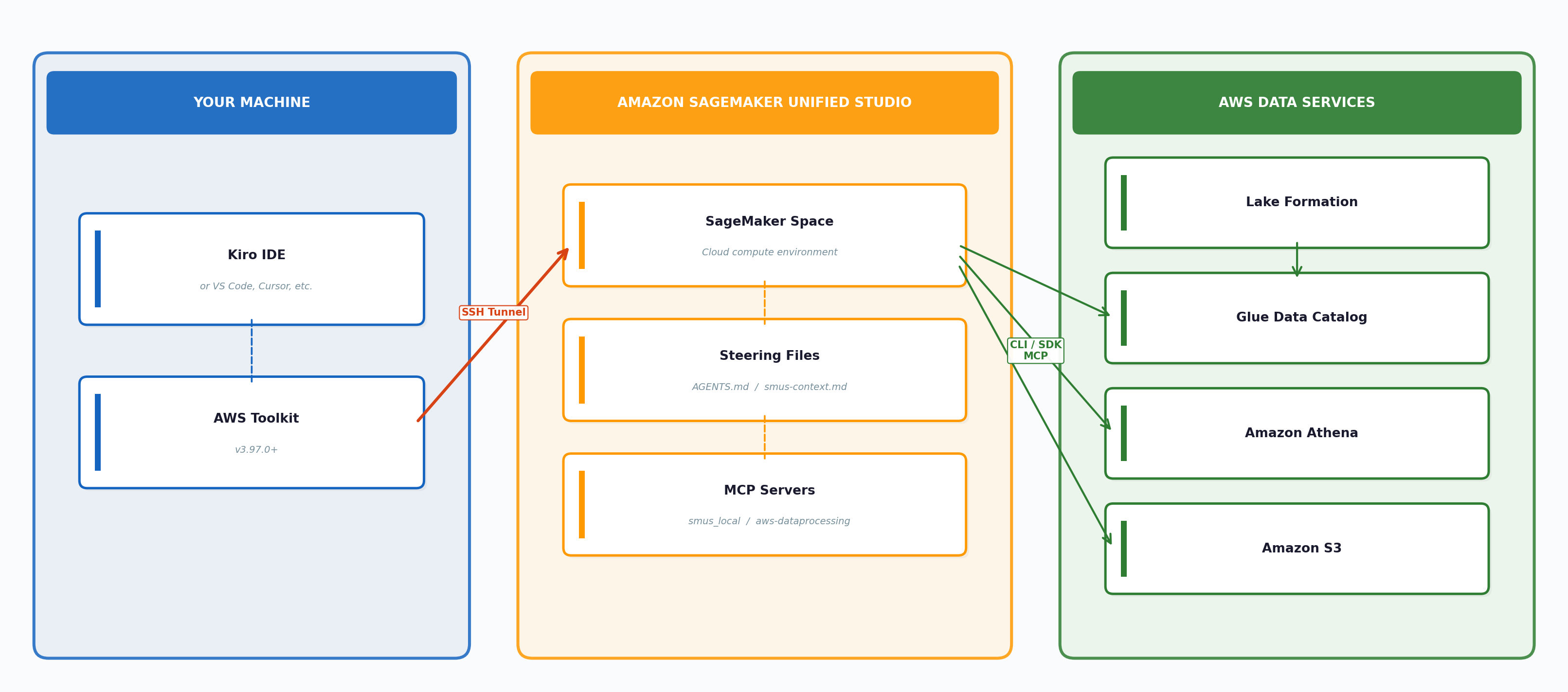
In the rapidly evolving landscape of software development, AI coding assistants are emerging as transformative tools. However, data engineering presents a unique set of challenges that differ significantly from traditional software development. These challenges include governed data access, shared compute environments, and compliance controls that must be consistently enforced. The essential question arises: how can organizations harness the power of AI-assisted development within such a governed data environment? The integration of the AWS Toolkit for Visual Studio Code with tools like Kiro, VS Code, and Cursor provides a solution, facilitating direct connections to Amazon SageMaker Unified Studio. This enables developers to leverage AI-assisted development while ensuring compliance with data governance and project permissions.
By connecting an editor to a SageMaker Unified Studio Space—essentially a cloud-based compute environment—developers gain the benefits of AI-assisted development while SageMaker manages essential aspects such as data governance and compute resources. Additionally, SageMaker Unified Studio automatically generates steering files (such as AGENTS.md) that equip the AI assistant with contextual knowledge about the project environment, ensuring an informed and effective interaction from the outset.
The primary objective of this integration is to streamline the data development process by allowing data engineers to utilize natural language queries to explore and analyze data within a governed environment. This is achieved by establishing a seamless connection between Kiro and Amazon SageMaker Unified Studio, enabling the AI assistant to access project-specific data and configurations without requiring extensive manual setup. By leveraging this integration, data engineers can focus on deriving insights rather than navigating the complexities of data governance and access controls.
While the advantages are substantial, there are important caveats to consider. The AI assistant’s output is inherently non-deterministic, meaning that responses can vary with each session, even when using the same prompt. This variability can lead to inconsistencies in code generation and tool choices, necessitating careful validation of outputs. Additionally, the reliance on natural language processing may inadvertently lead to misinterpretations if prompts are not clearly articulated.
The integration of AI technologies into data engineering is poised to redefine the field significantly. As AI models become more sophisticated, we can anticipate improvements in their contextual understanding and execution capabilities, reducing the need for manual intervention. This evolution could lead to a paradigm where data engineers spend less time on repetitive tasks and more time on strategic initiatives, such as developing new data products and optimizing workflows. Furthermore, as organizations increasingly adopt AI-driven tools, the demand for skilled professionals who can effectively leverage these technologies will undoubtedly rise, emphasizing the need for continuous learning and adaptation in the workforce.
Disclaimer
The content on this site is generated using AI technology that analyzes publicly available blog posts to extract and present key takeaways. We do not own, endorse, or claim intellectual property rights to the original blog content. Full credit is given to original authors and sources where applicable. Our summaries are intended solely for informational and educational purposes, offering AI-generated insights in a condensed format. They are not meant to substitute or replicate the full context of the original material. If you are a content owner and wish to request changes or removal, please contact us directly.
Source link :