In the domain of Smart Manufacturing and Robotics, the efficient management of evolving physical systems is paramount. The concept of Free Boundary Problems (FBPs) is integral to this, as it involves understanding the dynamics of systems where the boundaries of domains change over time. Such scenarios can be observed in various industrial applications, including materials processing, thermal management, and fluid dynamics, where the physical properties of materials and their configurations must adapt to changing conditions.
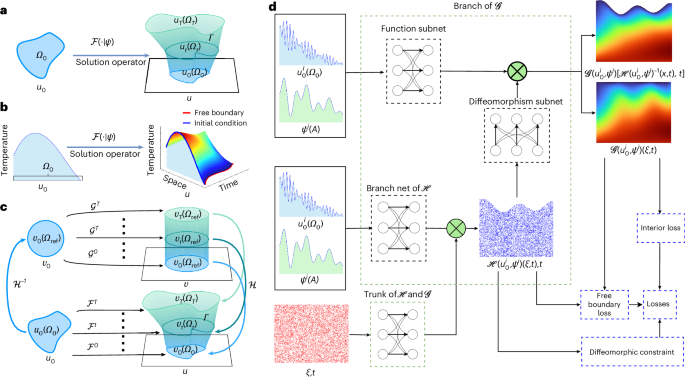
FBPs can be mathematically formulated as a family of evolving domains, where each domain represents a measurable compact set at any given time. The challenge lies in modeling these domains and their associated physical quantities, particularly when the boundaries are not fixed and are influenced by internal and external factors. This aspect of FBPs resonates with industrial technologists who require sophisticated models to predict the behavior of materials under varying operational conditions.
The primary goal of employing advanced methodologies, such as deep neural operators within FBPs, is to accurately predict the behavior of systems with free boundaries. This can be achieved through the development of a solution operator that maps initial conditions to the evolving states of the system. By leveraging neural networks, particularly architectures designed to handle complex mappings, it becomes possible to approximate the solution operator with high fidelity. This approach not only enhances the accuracy of predictions but also allows for real-time computations, which are critical in smart manufacturing environments.
1. **Enhanced Accuracy**: The use of deep neural networks for modeling FBPs allows for high-precision predictions of the evolving boundaries and internal states of materials. Empirical data indicates that the neural network can reduce relative errors significantly, achieving accuracy levels that are essential for critical manufacturing processes.
2. **Real-Time Processing**: Neural operators can process data and generate predictions rapidly, facilitating real-time decision-making in manufacturing environments. This capability is particularly advantageous when quick adjustments are necessary in response to changing operational conditions.
3. **Robustness to Geometric Variability**: The methodology demonstrates robustness against variations in domain geometries, as evidenced by minimal sensitivity to changes in topological complexity. This feature is crucial for industrial applications where materials may undergo significant deformations.
4. **Integration of Physics-Informed Constraints**: By incorporating physics-based constraints within the neural network training process, the model ensures that predictions remain physically plausible, minimizing the risk of unrealistic outcomes that could arise from purely data-driven approaches.
5. **Scalability and Adaptability**: The framework can be adapted to various manufacturing scenarios, enabling the modeling of diverse physical phenomena, from heat transfer to fluid dynamics. This versatility supports a wide range of applications within smart manufacturing.
Despite the numerous advantages, there are notable limitations in the application of deep neural operators in FBPs. The reliance on computational resources means that significant infrastructure investments may be necessary to implement these solutions effectively. Moreover, the quality of predictions can be highly dependent on the availability and quality of training data. In scenarios where data is sparse or of low fidelity, the performance of the neural operator may be compromised.
The ongoing advancements in artificial intelligence (AI) and machine learning are poised to revolutionize the field of Smart Manufacturing. As AI techniques become more sophisticated, they will enhance the modeling and simulation of complex systems, particularly in the context of FBPs. Future developments may lead to:
– **Increased Autonomy**: AI systems could autonomously adapt operations based on real-time feedback, optimizing processes without direct human intervention.
– **Improved Predictive Maintenance**: Enhanced predictive capabilities will enable early identification of potential failures or inefficiencies in manufacturing systems, reducing downtime and maintenance costs.
– **Customization and Flexibility**: AI-driven approaches will allow manufacturers to rapidly customize products in response to market demands, facilitating greater responsiveness and competitiveness.
In conclusion, the integration of deep neural operators in solving FBPs represents a significant leap forward for Smart Manufacturing and Robotics. By leveraging these technologies, industrial technologists can enhance operational efficiency, product quality, and responsiveness to changing market conditions, setting the stage for a more advanced and automated manufacturing landscape.
Disclaimer
The content on this site is generated using AI technology that analyzes publicly available blog posts to extract and present key takeaways. We do not own, endorse, or claim intellectual property rights to the original blog content. Full credit is given to original authors and sources where applicable. Our summaries are intended solely for informational and educational purposes, offering AI-generated insights in a condensed format. They are not meant to substitute or replicate the full context of the original material. If you are a content owner and wish to request changes or removal, please contact us directly.
Source link :