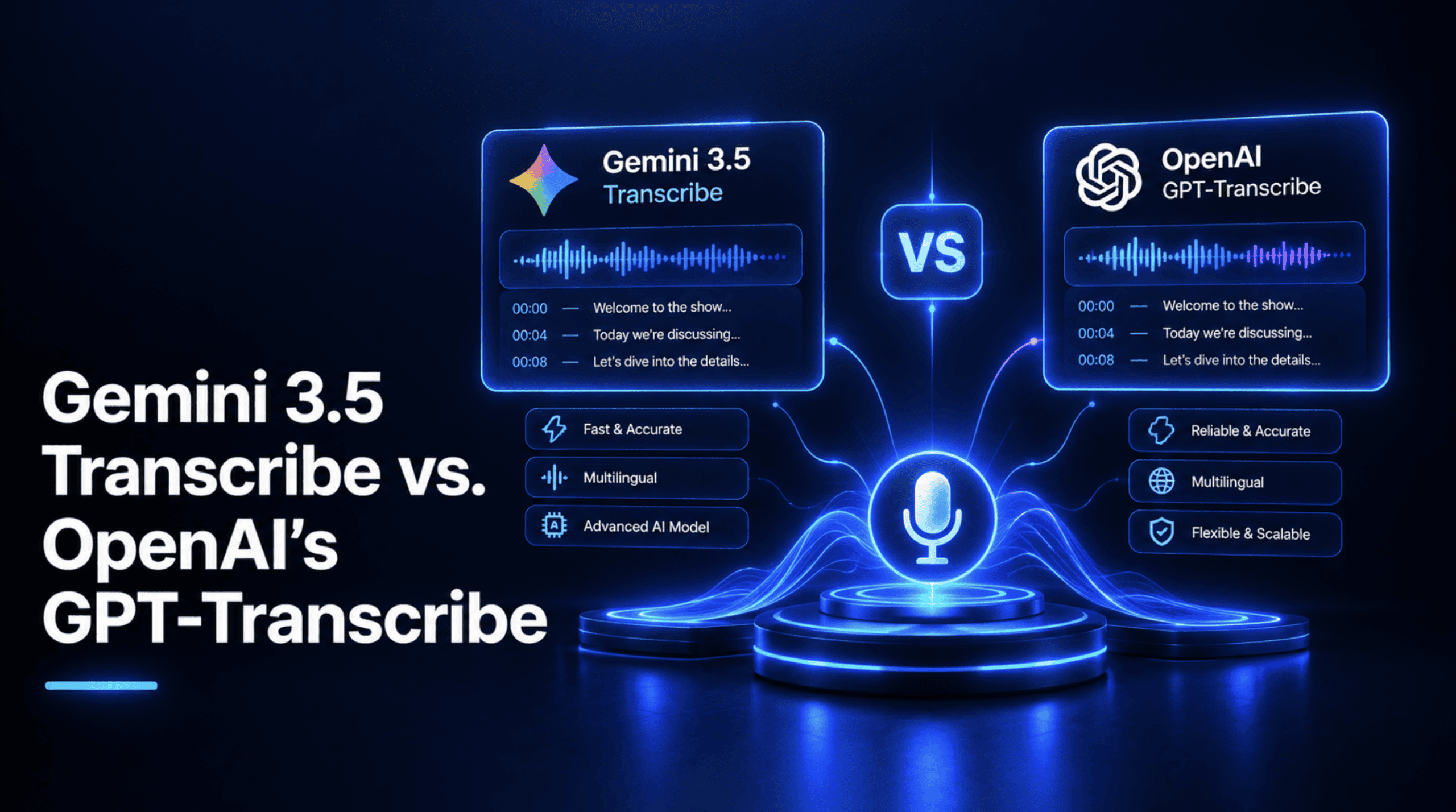
The recent releases of Google’s Gemini 3.5 Transcribe and OpenAI’s GPT-Transcribe provide an invaluable opportunity for comparison within the domain of transcription technologies. Launched respectively on August 26, 2026, and July 28, 2026, these models are positioned closely in timeline, allowing for a nuanced examination of their capabilities. Both transcription services are designed for distinct use cases—one for real-time streaming and the other for pre-recorded audio—enabling a direct and meaningful comparison.
The primary goal articulated in the original blog post is to discern the strengths and weaknesses of Gemini 3.5 Transcribe and GPT-Transcribe in order to assist users in selecting the most appropriate tool for their specific transcription needs. This can be achieved through an in-depth analysis of key performance metrics, including speed, accuracy, and feature set, contextualized within real-world applications. By evaluating these factors, end-users can make informed decisions based on their unique requirements for transcription services.
While both models present unique advantages, there are notable limitations. Gemini 3.5 Transcribe does not currently disclose its pricing for streaming services, which may hinder budgetary planning for potential users. Conversely, GPT-Transcribe lacks built-in speaker diarization and requires additional models for features like word-level timestamps, potentially complicating workflows for users needing these functionalities.
The ongoing advancements in AI transcription technologies signal significant future implications for various sectors, including education, business, and legal fields. As models continue to evolve, we can anticipate improvements in transcription accuracy, processing speed, and user accessibility. These enhancements will likely lead to increased adoption of AI-driven transcription tools in everyday applications, further integrating them into workflows and communication processes. Additionally, as AI develops, we may see the emergence of more sophisticated features, such as real-time language translation and enhanced contextual understanding, paving the way for more seamless global communication.
In summary, the comparison between Gemini 3.5 Transcribe and OpenAI’s GPT-Transcribe reveals critical insights for users seeking effective transcription solutions. Gemini excels in scenarios requiring multi-speaker attribution and rapid transcription, while GPT-Transcribe stands out for its cost-effectiveness and specialization in single-speaker contexts. As these technologies continue to advance, their impact on the field of Natural Language Understanding will become increasingly profound, shaping the future of communication and data management.
Disclaimer
The content on this site is generated using AI technology that analyzes publicly available blog posts to extract and present key takeaways. We do not own, endorse, or claim intellectual property rights to the original blog content. Full credit is given to original authors and sources where applicable. Our summaries are intended solely for informational and educational purposes, offering AI-generated insights in a condensed format. They are not meant to substitute or replicate the full context of the original material. If you are a content owner and wish to request changes or removal, please contact us directly.
Source link :