Content-addressed storage, immutable state, and explicit lifecycle events can significantly enhance the verification of digital credentials.
Digital credentials, such as certificates and licenses, are increasingly prevalent in various sectors, including education and employment. However, once these documents leave their issuing systems, verifying their authenticity poses a considerable challenge. Verifiers often receive documents in formats like PDFs that do not provide a straightforward method for authenticity checks. The lack of means to ascertain whether the document is the original issued file, whether its metadata has been altered, or if the intended recipient has formally accepted it complicates the verification process.
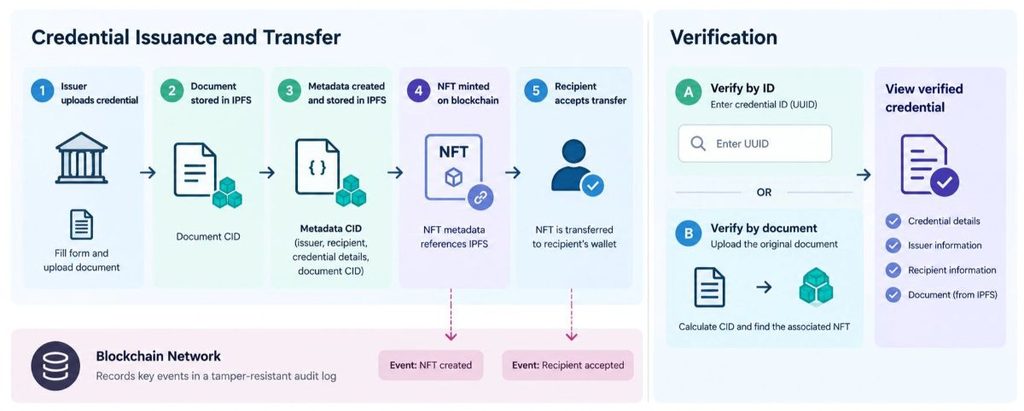
To mitigate these issues, a layered approach is proposed. This involves using content-addressed storage to uniquely identify the document, structured metadata to describe the credential, an immutable state layer to maintain a reliable reference, and explicit lifecycle events to log the issuance and acceptance of the credentials. A practical implementation of this approach is exhibited through the D-Certify project, which showcases how these components can function collectively.
The primary objective of integrating content-addressed storage and blockchain technology in digital credential verification is to create a robust, secure, and transparent verification process. This goal can be achieved by establishing a system where each credential is divided into distinct layers that facilitate independent verification of document integrity, metadata, ownership, and lifecycle history.
Caveats and Limitations: Despite these advantages, the system does not inherently establish trust in the issuer of the credentials. While a CID verifies content integrity, it does not guarantee that the issuer is legitimate. Furthermore, privacy concerns arise as metadata stored in content-addressed systems may still be accessible depending on the configuration, requiring careful management of data access and minimization practices.
As artificial intelligence continues to evolve, its integration into the verification of digital credentials may significantly alter the landscape. AI can enhance the analysis of verification data, providing predictive insights and anomaly detection capabilities that can identify potential fraud or inconsistencies in credential issuance and acceptance. Furthermore, AI-driven systems can streamline the verification process, offering real-time assessments that bolster confidence in the integrity of digital credentials.
Moreover, as organizations increasingly adopt decentralized verification systems, AI can facilitate the management of large datasets, ensuring that verification processes remain efficient and scalable. Future advancements in AI technology may also lead to the development of more sophisticated algorithms for identity verification, further enhancing the reliability of digital credentials.
Disclaimer
The content on this site is generated using AI technology that analyzes publicly available blog posts to extract and present key takeaways. We do not own, endorse, or claim intellectual property rights to the original blog content. Full credit is given to original authors and sources where applicable. Our summaries are intended solely for informational and educational purposes, offering AI-generated insights in a condensed format. They are not meant to substitute or replicate the full context of the original material. If you are a content owner and wish to request changes or removal, please contact us directly.
Source link :