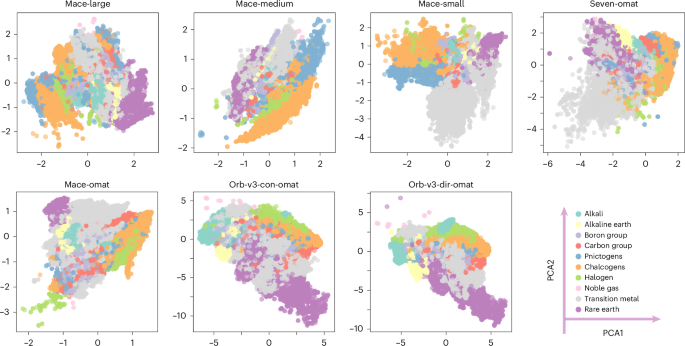
The integration of machine learning interatomic potentials (MLIPs) into smart manufacturing and robotics is revolutionizing how industrial technologists approach materials design and production processes. By leveraging advanced ML models, such as those represented in the study of Platonic representation, various architectures can be employed to enhance energy efficiency and promote sustainability in manufacturing operations. These models utilize diverse datasets to yield insights into material properties, thereby facilitating the design of more effective and innovative manufacturing processes.
In the context of smart manufacturing, the challenge lies in aligning incompatible representations derived from different ML approaches. The analysis of seven foundational MLIPs, each embodying unique architectures and datasets for energy conservation, illustrates the need for a unified representation that enables meaningful comparisons across models. This alignment is crucial for harnessing the full potential of machine learning in developing new materials and optimizing manufacturing workflows.
The primary goal of the Platonic representation framework is to establish a cohesive and standardized method for comparing different machine learning models in terms of their interatomic potentials. This can be achieved through the construction of a unified latent space that accommodates model agnosticism, geometric faithfulness, sufficient diversity, and robustness.
To attain this goal, four key strategies are implemented:
1. **Model Agnosticism**: The approach must function independently of the internal workings of individual models.
2. **Geometric Faithfulness**: The representation should preserve the relative distances and neighborhood relationships among atomic environments.
3. **Diversity**: The framework must encompass a wide chemical space to effectively distinguish between chemically diverse environments.
4. **Robustness**: The representation must be invariant to random seed choices and anchor permutations, ensuring that structural insights remain consistent across model variations.
1. **Improved Comparability**: By creating a common coordinate system, models can be directly compared, allowing technologists to select the most effective MLIP for specific applications. This is supported by evidence that even minimal anchor sets can align embeddings across different architectures.
2. **Enhanced Predictive Power**: A unified representation captures essential chemical trends and relationships, thereby improving the models’ predictive capabilities. The study highlights how utilizing various sampling strategies, such as DIRECT sampling, can lead to better coverage and representation of chemical landscapes.
3. **Facilitation of Model Interoperability**: The framework allows for seamless integration and compatibility between different ML models. This can lead to more versatile applications in manufacturing, as models can be combined to leverage their strengths.
4. **Robustness Against Variability**: The proposed representation framework ensures that variations in training setup do not compromise the integrity of the results. It offers a method to detect deviations and assess the reliability of different models.
5. **Ground-Truth-Free Assessment**: By utilizing manifold geometry, the framework provides a means to evaluate structural typicality without relying on pre-defined labels, which can be particularly beneficial in exploratory research scenarios.
The evolution of artificial intelligence and machine learning is poised to significantly impact the field of smart manufacturing and robotics. As AI technologies continue to advance, the capabilities of MLIPs are expected to improve, leading to more accurate and efficient predictive models. This will enable industrial technologists to innovate at an unprecedented pace, ultimately enhancing productivity and sustainability in manufacturing processes.
Furthermore, the ongoing development of AI will facilitate more sophisticated algorithms capable of analyzing complex data sets, thereby unlocking new insights into material properties and behaviors. This could lead to the discovery of novel materials with superior characteristics, further pushing the boundaries of what is achievable in smart manufacturing.
In conclusion, the integration of Platonic representation in MLIPs offers a pathway to enhance the comparability, predictive power, and robustness of machine learning models in the manufacturing sector. As AI continues to evolve, its influence on material science and manufacturing will undoubtedly expand, fostering a new era of innovation and efficiency in industrial processes.
Disclaimer
The content on this site is generated using AI technology that analyzes publicly available blog posts to extract and present key takeaways. We do not own, endorse, or claim intellectual property rights to the original blog content. Full credit is given to original authors and sources where applicable. Our summaries are intended solely for informational and educational purposes, offering AI-generated insights in a condensed format. They are not meant to substitute or replicate the full context of the original material. If you are a content owner and wish to request changes or removal, please contact us directly.
Source link :