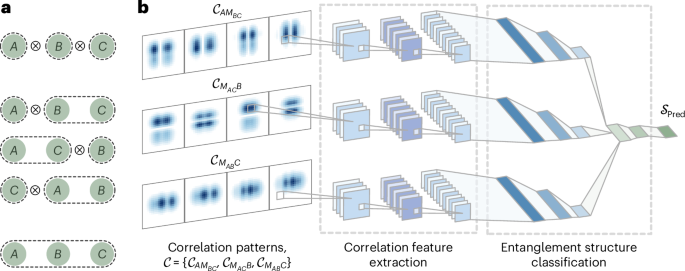
In the realm of quantum mechanics, multipartite entanglement detection extends beyond merely confirming the existence of entangled states; it encapsulates a nuanced understanding of their structural intricacies. Specifically, a state that is \(\mathcalR_1| \cdots | \mathcalR_j\)-separable can be expressed in a decomposed form \(\hat\rho =\sum _\gamma p_\gamma \hat\rho _\mathcalR_1^(\gamma )\otimes \cdots \otimes \hat\rho _\mathcalR_j^(\gamma )\), where \(\mathcalR_i\) denotes an ensemble of modes, and \(\hat\rho _\mathcalR_i^(\gamma )\) represents the reduced density matrix of the state on the given subsystem \(\mathcalR_i\). This classification of multipartite states is critical for advancing technologies in Smart Manufacturing and Robotics, where quantum resources may play pivotal roles in enhancing system efficiencies and capabilities.
The primary goal articulated in the original research is the classification of multipartite continuous-variable entanglement structures utilizing data-augmented neural networks. This objective is achieved through a systematic approach that involves training neural networks on diverse datasets of random, mixed continuous-variable (CV) quantum states. By classifying states according to their entanglement structures, the framework aims to facilitate a more profound understanding of quantum systems, which can be leveraged in practical applications within the Smart Manufacturing sector.
Despite the promising advancements, there are inherent limitations that must be acknowledged. The reliance on extensive training datasets may pose challenges when attempting to generalize findings across various quantum systems. Moreover, the QFI-based criterion for accurately identifying fully inseparable states necessitates comprehensive knowledge of the density matrix, which may not always be feasible in practical scenarios. These factors underscore the need for continuous refinement of methodologies and the importance of balancing theoretical constructs with empirical realities.
The integration of artificial intelligence into quantum mechanics, particularly in the classification of multipartite entanglement structures, heralds a transformative era for Smart Manufacturing and Robotics. As AI technologies evolve, the potential for real-time analysis and adaptive learning will enhance the robustness and versatility of quantum systems. This may lead to breakthroughs in quantum computing, optimization algorithms, and the development of novel quantum materials, ultimately driving innovation across various industrial sectors. Furthermore, the synergistic application of AI and quantum mechanics could pave the way for advanced automation processes, significantly improving operational efficiencies and decision-making capabilities in manufacturing environments.
Disclaimer
The content on this site is generated using AI technology that analyzes publicly available blog posts to extract and present key takeaways. We do not own, endorse, or claim intellectual property rights to the original blog content. Full credit is given to original authors and sources where applicable. Our summaries are intended solely for informational and educational purposes, offering AI-generated insights in a condensed format. They are not meant to substitute or replicate the full context of the original material. If you are a content owner and wish to request changes or removal, please contact us directly.
Source link :