Universal Deployment of Local Agents via LFM2.5-2.6B

Context

The emergence of the LFM2.5-2.6B model marks a significant advancement in the deployment of local agents across diverse hardware platforms. This model is engineered to operate entirely on-device, facilitating tool calling and enabling multi-step workflows while ensuring optimal performance on everyday devices, ranging from laptops to smartphones. Such capabilities empower developers to deploy agents ubiquitously, enhancing privacy by keeping data localized and effectively scaling applications without accruing costs associated with cloud-based inference services. In the context of Generative AI Models & Applications, this innovation underscores a pivotal shift towards decentralized AI, where local processing mitigates security vulnerabilities and aligns with user preferences for data sovereignty.

Main Goal and Achievement

The primary goal articulated within the LFM2.5-2.6B framework is to facilitate the deployment of highly capable AI agents directly on local devices. This objective can be accomplished through the model’s advanced design, which includes a robust architecture that supports efficient inference and extensive agentic reinforcement learning capabilities. By leveraging local hardware, the model not only enhances performance but also reduces reliance on external data processing infrastructures, providing a seamless user experience without compromising data integrity.

Advantages of LFM2.5-2.6B

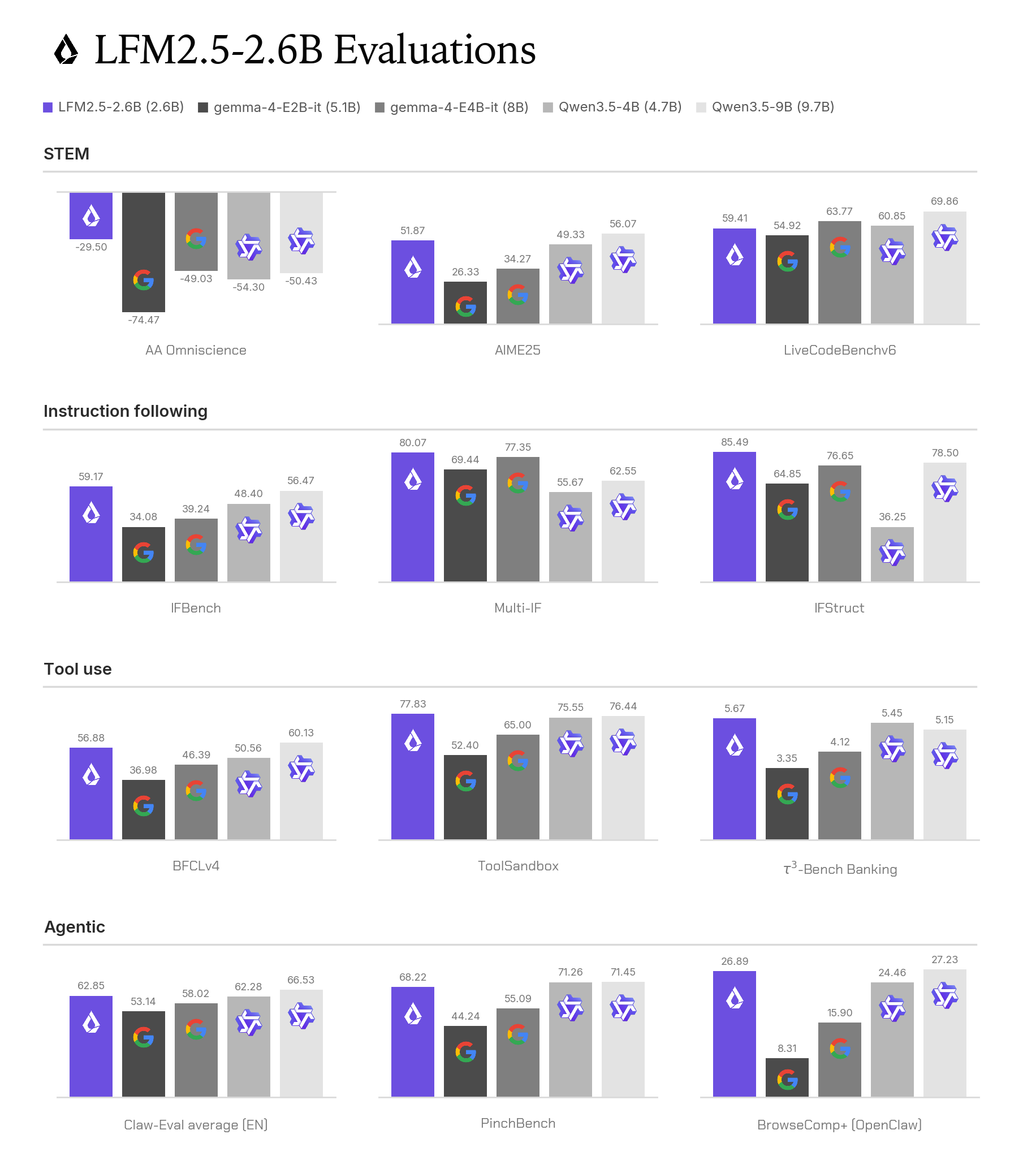
  • Compact Yet Powerful: LFM2.5-2.6B delivers performance comparable to models four times its size in terms of tool utilization, following instructions, and executing multi-step tasks. This efficiency allows for greater accessibility across a range of devices.
  • Localized Data Processing: By processing data on-device, the model ensures enhanced privacy and security, reducing the risk of data breaches commonly associated with cloud computing.
  • Efficient Resource Utilization: The model achieves impressive inference speeds, with reported performance of 220 tokens per second on an Apple M5 Max and 113 tokens per second on an AMD Ryzen CPU, all while operating within a memory footprint of less than 2.5 GB.
  • Robust Training and Optimization: The model’s training regimen is structured into four essential phases, including Supervised Fine-Tuning and Agentic Reinforcement Learning, which optimize its ability to perform complex tasks efficiently.
  • Benchmark Success: LFM2.5-2.6B has been rigorously evaluated against larger models, consistently demonstrating superior performance in instruction following and tool-use benchmarks, affirming its competitive edge.

Limitations and Caveats

While LFM2.5-2.6B presents numerous advantages, it is crucial to acknowledge certain limitations. The model’s performance in coding tasks remains inferior to that of larger models, suggesting that for applications requiring advanced programming capabilities, developers may need to consider alternative solutions. Additionally, the overall capabilities of the model are contingent upon the available hardware, which may restrict its effectiveness on less capable devices.

Future Implications

The ongoing development of AI technologies such as LFM2.5-2.6B portends significant implications for the future of local agent deployment. As the demand for privacy-centric solutions intensifies, models designed for on-device execution will likely gain traction across various sectors, including healthcare, finance, and personal data management. Furthermore, the evolution of mobile computing and edge devices will broaden the applicability of such models, enabling increasingly sophisticated AI interactions in everyday environments. This trajectory not only enhances user experience but also fosters a more secure and ethical approach to AI deployment, aligning with global trends toward data privacy and user empowerment.

Disclaimer

The content on this site is generated using AI technology that analyzes publicly available blog posts to extract and present key takeaways. We do not own, endorse, or claim intellectual property rights to the original blog content. Full credit is given to original authors and sources where applicable. Our summaries are intended solely for informational and educational purposes, offering AI-generated insights in a condensed format. They are not meant to substitute or replicate the full context of the original material. If you are a content owner and wish to request changes or removal, please contact us directly.

Source link :

Click Here

How We Help

Our comprehensive technical services deliver measurable business value through intelligent automation and data-driven decision support. By combining deep technical expertise with practical implementation experience, we transform theoretical capabilities into real-world advantages, driving efficiency improvements, cost reduction, and competitive differentiation across all industry sectors.

We'd Love To Hear From You

Transform your business with our AI.

Get In Touch