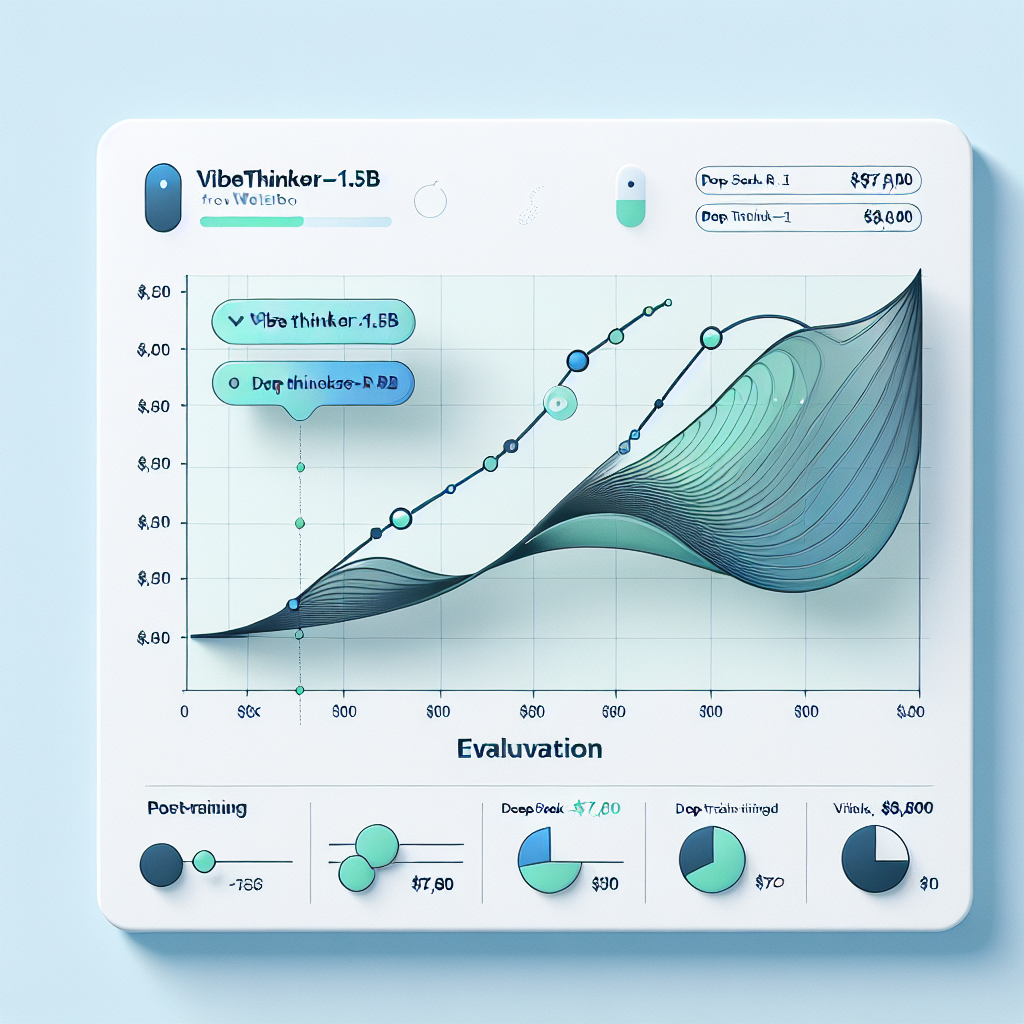
In late 2025, Weibo, a prominent Chinese social media platform, made a significant advancement in the field of open-source artificial intelligence (AI) with the release of its new language model, VibeThinker-1.5B. This 1.5 billion parameter model has emerged as a notable competitor within the generative AI landscape, particularly against other high-capacity models such as DeepSeek-R1. The release of VibeThinker-1.5B is not just a technological milestone; it represents a paradigm shift in how AI models can be structured, trained, and deployed, especially considering its effective post-training budget of only $7,800.
The primary goal of Weibo’s VibeThinker-1.5B is to challenge the conventional wisdom surrounding the scale and resource requirements of high-performance language models. Traditional models often rely on extensive parameters and significant computational resources to achieve superior reasoning capabilities. VibeThinker-1.5B, however, demonstrates that compact models can achieve exceptional performance in reasoning tasks with efficient training methodologies. This goal is achieved through innovative approaches in training that prioritize diversity in responses and effective reinforcement learning techniques.
The advantages of VibeThinker-1.5B are manifold, as evidenced by its performance metrics and resource efficiency:
1. **Cost Efficiency**: With a post-training budget of merely $7,800, VibeThinker-1.5B is 30–60 times less expensive to train compared to larger models like DeepSeek-R1, which can cost between $294,000 and $535,000. This affordability opens new avenues for smaller enterprises and researchers who may have limited budgets.
2. **High Performance**: Despite its smaller size, VibeThinker-1.5B has achieved benchmark-topping performance in reasoning tasks, even outperforming models that are hundreds of times larger. For instance, it excelled in structured reasoning benchmarks, demonstrating that size is not the sole determinant of model effectiveness.
3. **Diversity-First Training Approach**: Utilizing the Spectrum-to-Signal Principle (SSP), VibeThinker-1.5B enhances its learning by maximizing diversity in potential solutions. This approach allows it to explore reasoning spaces more effectively and achieve superior reasoning capabilities without relying on massive parameter counts.
4. **Cross-Domain Reasoning**: The model has shown remarkable performance across various domains, illustrating its versatility. For example, it achieved high scores in benchmarks such as AIME25 and LiveCodeBench v6, indicating its capability to handle different types of reasoning tasks successfully.
5. **Deployment Flexibility**: VibeThinker-1.5B is small enough for deployment on edge devices, such as mobile phones, while also being cost-effective in terms of inference. This flexibility allows organizations to integrate AI capabilities into everyday applications without incurring substantial infrastructure costs.
While VibeThinker-1.5B offers impressive capabilities, it is essential to consider its limitations:
– **General Knowledge Reasoning**: Although it excels in structured logical tasks, VibeThinker-1.5B lags behind larger models in general knowledge reasoning tasks (e.g., GPQA). This limitation suggests that while smaller models can outperform larger ones in specific areas, they may not possess the same breadth of knowledge.
– **Specialization Trade-offs**: The model’s focus on structured reasoning may come at the cost of its ability to handle wide-ranging encyclopedic recall, a common trait found in larger architectures. Organizations must weigh these trade-offs when selecting models for specific applications.
The advancements represented by VibeThinker-1.5B are indicative of a broader shift in the AI landscape towards more efficient and accessible models. As AI technology continues to evolve, several implications can be anticipated:
1. **Increased Accessibility**: The success of compact models like VibeThinker-1.5B may encourage more organizations, especially startups and academic institutions, to engage with AI technologies, fostering innovation and research in the field.
2. **Shift in Training Methodologies**: The emphasis on diverse training approaches could lead to the development of new training paradigms that prioritize efficiency and performance over sheer size. This shift may redefine best practices in model development.
3. **Enhanced Deployment Opportunities**: As models become more resource-efficient, the potential for deploying AI in various settings—ranging from mobile applications to edge devices—will expand, thereby enhancing user experiences and accessibility.
4. **Regulatory Considerations**: As AI models become more prevalent, the need for robust frameworks governing their use will intensify. Companies will need to navigate regulatory landscapes while ensuring ethical deployment and use of AI technologies.
Weibo’s release of VibeThinker-1.5B marks a critical juncture in the generative AI models and applications industry. By demonstrating that smaller models can achieve high-performance outcomes, Weibo challenges prevailing assumptions about model size and resource requirements. The implications of this development extend beyond technical achievements, potentially reshaping the market landscape and influencing future AI research and deployment strategies. For Generative AI scientists, VibeThinker-1.5B is not merely a milestone; it represents a new frontier in the pursuit of intelligent, efficient, and accessible AI solutions.
Disclaimer
The content on this site is generated using AI technology that analyzes publicly available blog posts to extract and present key takeaways. We do not own, endorse, or claim intellectual property rights to the original blog content. Full credit is given to original authors and sources where applicable. Our summaries are intended solely for informational and educational purposes, offering AI-generated insights in a condensed format. They are not meant to substitute or replicate the full context of the original material. If you are a content owner and wish to request changes or removal, please contact us directly.
Source link :