Context: Azure Databricks and Business Value
Microsoft Azure Databricks stands at the forefront of data processing and analytics, delivering a first-party advantage that integrates seamlessly with the Microsoft ecosystem. This integration not only enhances the user experience for businesses already utilizing Microsoft tools but also promises measurable business outcomes. The collaboration between Microsoft and Databricks ensures that the service is co-engineered, allowing for a unified integration roadmap across the Microsoft data and AI stack. This synergy translates into reduced costs, diminished risks, and accelerated time-to-value for organizations leveraging these technologies.
Main Goal: Understanding and Realizing Business Value
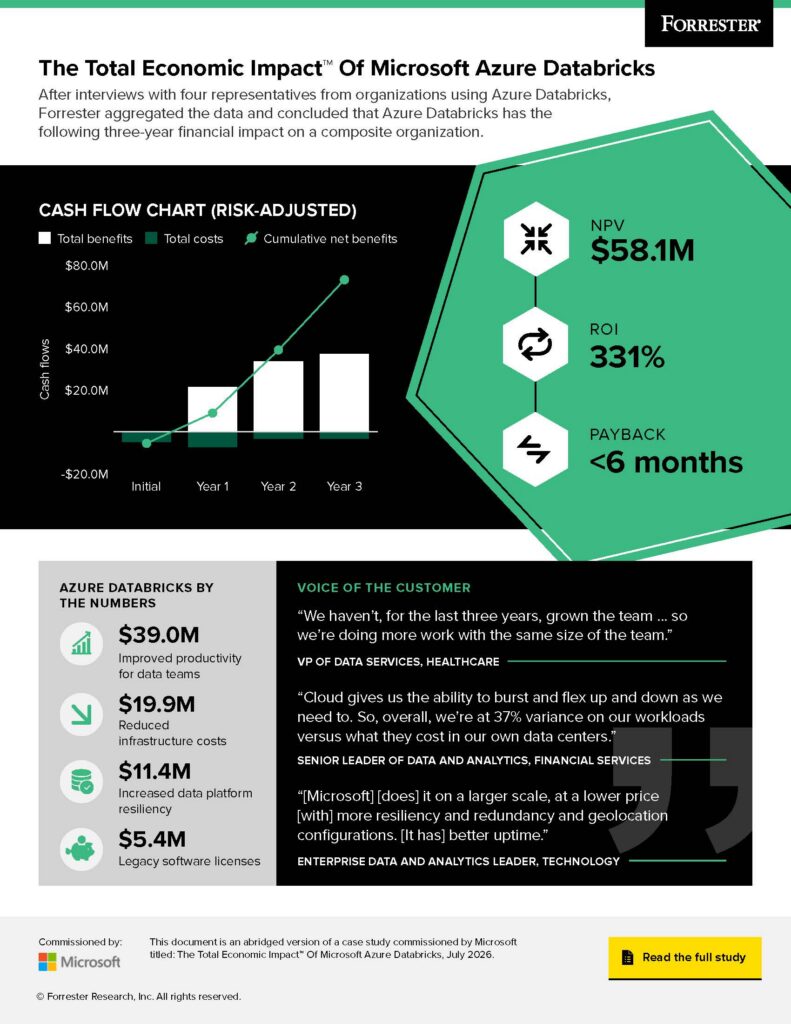
The primary goal elucidated in the original content is to demonstrate the tangible business value derived from adopting Azure Databricks. This value is evidenced through measurable return on investment (ROI) metrics, specifically a reported 331% ROI over three years, alongside a net present value of $58.1 million and a payback period of less than six months. Such metrics illustrate how organizations can recover their investments swiftly while benefiting from enhanced efficiency and performance.
Structured List of Advantages
- Increased Productivity of Data and Analytics Teams: Organizations reported significant productivity improvements, with data teams handling 15% to 25% more work without increasing headcount, thus maximizing resource efficiency.
- Reduced Infrastructure Costs: The transition to a flexible, pay-as-you-go computing model resulted in substantial savings, eliminating the costs associated with overprovisioned hardware.
- Enhanced Data Platform Resiliency: The managed operations of Azure Databricks reduced system outages and obviated the need for custom disaster recovery plans, leading to improved reliability.
- Cost Savings from Legacy Software Retirement: By consolidating databases and ETL tools, organizations could retire outdated software and reallocate database administrators to more strategic tasks, creating additional value.
While these advantages are compelling, it is essential to note that actual results may vary based on the specific circumstances of each organization. The Forrester study highlights a composite organization’s experience, which may not be universally applicable.
Future Implications of AI Developments
Looking ahead, the evolution of artificial intelligence (AI) will significantly impact the data engineering landscape. As AI technologies become increasingly integrated into data processing frameworks like Azure Databricks, organizations can anticipate enhanced capabilities in data analytics, predictive modeling, and real-time decision-making. These advancements are likely to further streamline operations, reduce costs, and increase the speed of insights derived from large datasets. Additionally, the integration of AI tools will facilitate improved governance and compliance within organizations, enabling data engineers to maintain oversight while leveraging automated processes.
Disclaimer
The content on this site is generated using AI technology that analyzes publicly available blog posts to extract and present key takeaways. We do not own, endorse, or claim intellectual property rights to the original blog content. Full credit is given to original authors and sources where applicable. Our summaries are intended solely for informational and educational purposes, offering AI-generated insights in a condensed format. They are not meant to substitute or replicate the full context of the original material. If you are a content owner and wish to request changes or removal, please contact us directly.
Source link :