The advent of assistive technologies, particularly in the realm of robotics and smart manufacturing, has ushered in a transformative approach to enhancing capabilities for individuals with severe hand impairments. This blog post elucidates the pivotal findings from recent developments in dexterous soft hand exoskeletons designed to restore intentional grasping, particularly for patients suffering from conditions such as amyotrophic lateral sclerosis (ALS) or stroke. The integration of these technologies not only benefits individuals directly affected by hand impairments but also offers profound implications for industrial technologists and the smart manufacturing sector at large.
The primary objective of the soft hand exoskeleton is to restore functional use of the hand in individuals who have suffered severe impairments. Co-creation methodologies involving patients have revealed critical insights into user preferences and engineering requirements. Patients have expressed a desire for independence in daily tasks, such as self-feeding, while emphasizing comfort, control, and safety as paramount factors in the design of such assistive devices. The exoskeleton must therefore be lightweight, intention-driven, and capable of adapting to various object shapes and weights, enabling users to engage in activities requiring fine motor coordination.
The development of soft hand exoskeletons presents multiple advantages, particularly for individuals with severe hand impairments. Below is a structured list of these benefits, supported by evidence from ongoing research:
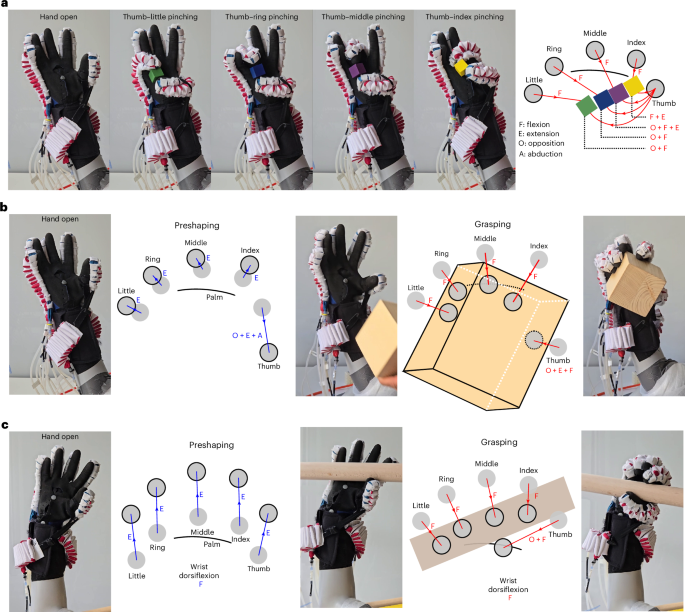
– **Restoration of Grasping Functionality**: The exoskeleton can facilitate a broad range of grasp types, allowing individuals to manipulate objects of various shapes and sizes. For example, patients have demonstrated the ability to reliably grasp and lift everyday items, enhancing their independence.
– **Improved Dexterity Through Thumb Coordination**: The design incorporates bio-inspired actuation systems that mimic natural thumb movements, critical for effective grasping. This functionality significantly increases the stability of the grasp, reducing slippage and enhancing reliability across diverse tasks.
– **Customizable User Experience**: Through co-creation sessions, the design can be tailored to individual needs, thus accommodating varying levels of impairment. This adaptability improves user satisfaction and overall effectiveness, as evidenced by the increased Box-and-Blocks Test scores following iterative design changes.
– **Enhanced User Control via EMG Interfaces**: The use of surface electromyography (sEMG) interfaces allows users to control the exoskeleton through natural muscle contractions, offering a hands-free operation that mirrors voluntary movements. This approach significantly enhances user engagement and satisfaction.
– **High Reliability in Diverse Conditions**: Clinical evaluations have shown a high success rate in grasp and lift actions, with over 95% reliability, ensuring that users can depend on the exoskeleton for daily tasks.
While these advantages are compelling, there are caveats and limitations to consider. For instance, the technology primarily targets individuals with severe impairments, and its effectiveness may vary across different user groups. Additionally, the complexity of the control systems might require users to undergo training to achieve optimal performance.
Looking ahead, advancements in artificial intelligence (AI) are set to significantly enhance the capabilities of soft hand exoskeletons. Machine learning algorithms can improve the detection and prediction of users’ intent by analyzing EMG signals more accurately, thus refining control mechanisms. Furthermore, integrating AI with adaptive learning technologies will allow exoskeletons to evolve based on user interactions, leading to more personalized user experiences.
The potential for real-time error correction and monitoring systems, inspired by human motor control processes, will also play a crucial role. Such systems can significantly mitigate the risks associated with false-positive triggers during operation, thereby enhancing the overall usability and reliability of these technologies.
In summary, the intersection of robotics, smart manufacturing, and AI is poised to revolutionize assistive technology, particularly for enhancing hand function in individuals with severe impairments. As these innovations continue to develop, they will not only benefit affected individuals but also provide valuable insights and tools for industrial technologists aiming to create more inclusive and adaptive workplace environments.
Disclaimer
The content on this site is generated using AI technology that analyzes publicly available blog posts to extract and present key takeaways. We do not own, endorse, or claim intellectual property rights to the original blog content. Full credit is given to original authors and sources where applicable. Our summaries are intended solely for informational and educational purposes, offering AI-generated insights in a condensed format. They are not meant to substitute or replicate the full context of the original material. If you are a content owner and wish to request changes or removal, please contact us directly.
Source link :