The decision between utilizing a managed PostgreSQL service versus a self-hosted PostgreSQL instance is increasingly pertinent for organizations aiming to optimize their database management practices. This choice is particularly critical for technical decision-makers who oversee production workloads. The evaluation encompasses various operational and business outcomes, including control, engineering capacity, resilience, security, cost predictability, risk tolerance, and access to specialized expertise. Ultimately, the decision hinges on the responsibilities an organization is willing to retain versus those it is prepared to delegate to a service provider.
PostgreSQL has established itself as a robust, open-source relational database management system that caters to a diverse range of applications—from small projects to large-scale enterprise systems. Its adherence to standards and expansive ecosystem make it a favorable choice for organizations seeking a versatile database solution equipped with extensive extensibility features.
Upon selecting PostgreSQL, organizations face the important task of determining the optimal operational model—whether to self-host the database on their own infrastructure, deploy it on virtual machines, or utilize a managed cloud service. Each model presents unique advantages and challenges related to control, responsibility, cost, and operational efforts. While self-hosting offers direct oversight over the entire database environment, it also necessitates a comprehensive commitment to platform management. In contrast, managed PostgreSQL services, such as those offered by major cloud providers, can alleviate operational burdens, allowing teams to focus on application and data performance.
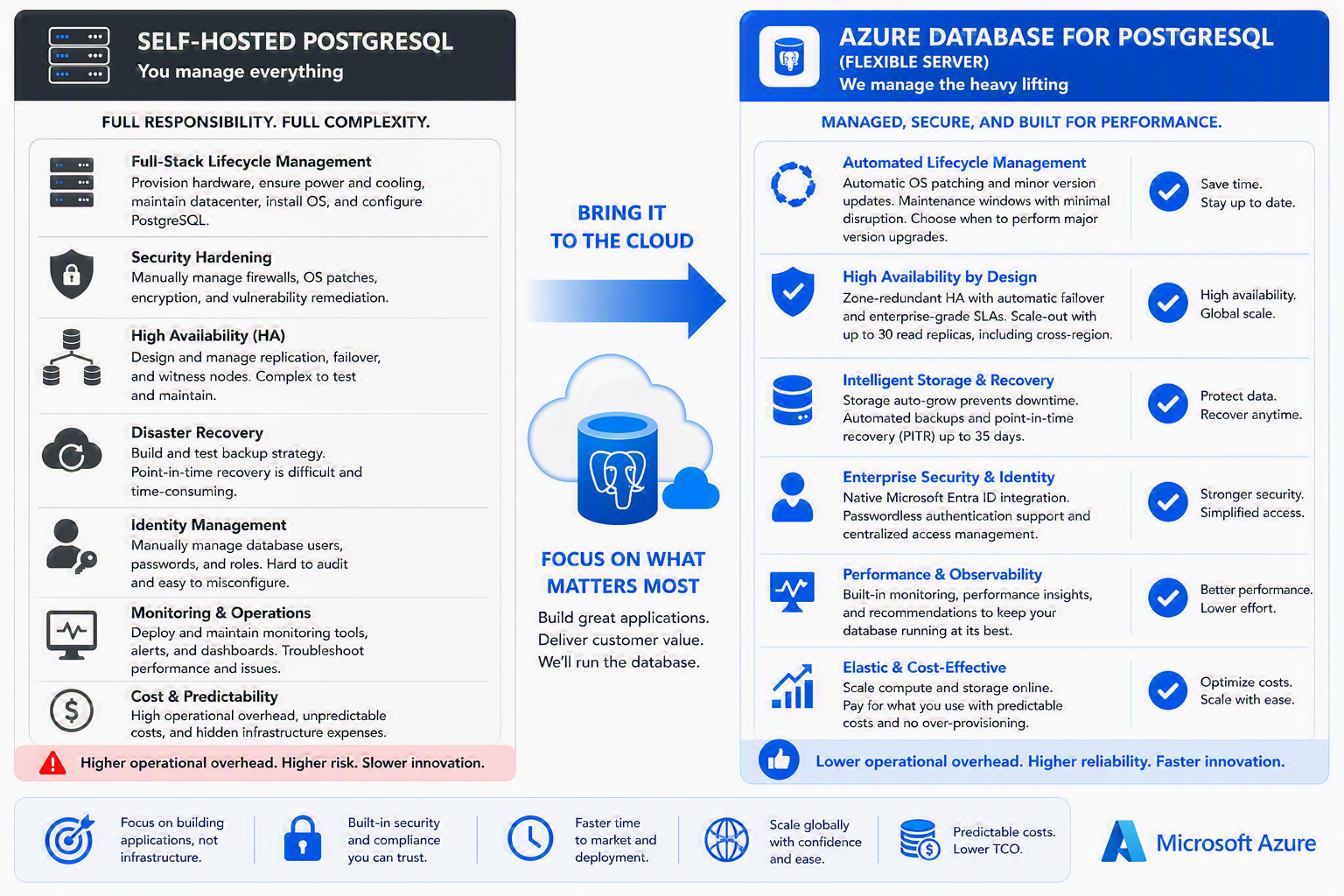
Self-hosting introduces an ongoing operational tax, characterized by the time, expertise, and resources necessary for the provisioning, securing, monitoring, and maintaining of the database platform. These essential activities, while necessary, do not typically contribute to an organization’s core competitive advantage. In a self-managed scenario, engineering teams must oversee the entire technology stack, encompassing lifecycle management, security hardening, high availability (HA), disaster recovery, and identity management. Such operational demands can detract from efforts to enhance applications and refine data models.
Organizations may find managed PostgreSQL services advantageous as they transfer specific infrastructure and platform responsibilities to a cloud provider. This shift not only reduces the operational tax associated with platform administration but also allows organizations to maintain control over critical aspects such as data security, database configuration, and performance management. By utilizing a managed service, organizations can streamline operations and allocate engineering resources more efficiently.
Self-management may be the preferred approach for organizations that require tailored infrastructure, unsupported extensions, or direct control over patching schedules. This model can be particularly beneficial for organizations with established PostgreSQL engineering capabilities and mature operational practices, where the added responsibilities are viewed as a strategic trade-off for increased control and customization.
The shared responsibility model is an effective framework for assessing managed PostgreSQL services. As organizations transition from self-hosted environments to cloud offerings, the delineation of responsibilities shifts. In a platform-as-a-service (PaaS) deployment, the provider assumes management of the operating system and core infrastructure, thus minimizing the operational efforts required to maintain security and availability. While organizations retain ownership of their data and configurations, the reduction in operational burdens fosters a focus on application delivery and performance optimization.
Despite the numerous advantages, organizations must consider potential limitations when opting for a managed PostgreSQL service. These may include less direct control over specific configurations and potential vendor lock-in, which can impact long-term strategy and operational flexibility.
As the landscape of big data engineering evolves, the integration of artificial intelligence (AI) is poised to further transform the management of database services. AI can enhance predictive maintenance, automate complex queries, and optimize performance tuning, thereby reducing the operational burden on engineering teams. This shift will likely lead to increased efficiency and a more agile response to changing business needs, solidifying the role of managed services in the future of database management.
The decision between self-hosted PostgreSQL and a managed service is a strategic one that requires careful consideration of organizational capabilities, risk tolerance, and business objectives. By evaluating the trade-offs and potential implications of each approach, organizations can make informed decisions that align with their long-term goals in the realm of big data engineering.
Disclaimer
The content on this site is generated using AI technology that analyzes publicly available blog posts to extract and present key takeaways. We do not own, endorse, or claim intellectual property rights to the original blog content. Full credit is given to original authors and sources where applicable. Our summaries are intended solely for informational and educational purposes, offering AI-generated insights in a condensed format. They are not meant to substitute or replicate the full context of the original material. If you are a content owner and wish to request changes or removal, please contact us directly.
Source link :