The intersection of artificial intelligence (AI) and agriculture has given rise to innovative solutions aimed at enhancing efficiency and productivity in farming practices. A notable development in this arena is the partnership between Carbon Robotics and iMerit, which has culminated in the deployment of a foundation model capable of real-time, in-field AI customization for agricultural applications. This advancement not only streamlines the weeding process but also significantly reduces the time and resources traditionally required for training AI systems in agriculture.
Carbon Robotics has transitioned from a collection of crop-specific AI models to a singular, comprehensive “large plant model.” This model is adept at recognizing various plant structures across diverse geographical regions and species. The ability to customize the use of autonomous weeders based on farmers’ unique definitions of “crops” and “weeds” marks a significant paradigm shift in smart manufacturing and robotics within the agricultural sector.
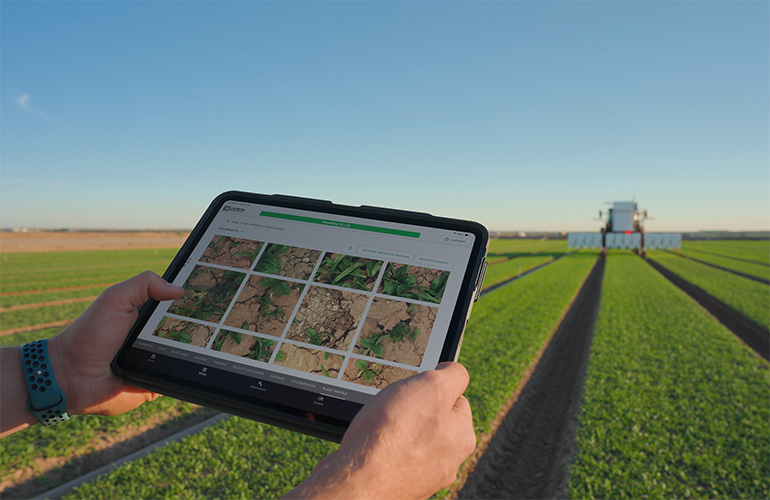
Through the use of an intuitive iPad application, farmers can efficiently tag images from their fields, enabling the AI system to learn and adapt without the need for extensive retraining. This feature ensures that the technology is accessible even to those without a deep technical background.
The primary objective of the partnership between Carbon Robotics and iMerit is to facilitate instantaneous, in-field customization of AI algorithms for agricultural use. This goal is realized through the deployment of a pre-trained foundation model that can be rapidly adapted to the specific needs of various farming environments. By utilizing a streamlined data annotation process provided by iMerit, Carbon Robotics has effectively minimized the time lag typically associated with AI model retraining, allowing for immediate application of the technology on the farm.
However, despite these advantages, it is important to note that the effectiveness of the model may vary based on the quality of the training data and the specific environmental conditions of each farm.
The advancements achieved through the collaboration of Carbon Robotics and iMerit are indicative of a broader trend towards the integration of sophisticated AI technologies in agriculture. As these technologies continue to evolve, we can expect significant shifts in how farming practices are conducted. The potential for AI to enhance precision agriculture will likely lead to increased yields, reduced operational costs, and improved environmental sustainability.
Future developments may also include enhanced machine learning algorithms that can provide predictive analytics, enabling farmers to make more informed decisions regarding crop management and resource allocation. As AI capabilities expand, the role of Industrial Technologists will become increasingly critical in optimizing these systems for real-world applications, ensuring that technological advancements are effectively translated into practical farming solutions.
The partnership between Carbon Robotics and iMerit represents a significant advancement in agricultural technology, demonstrating the potential of AI to revolutionize farming practices. By enabling rapid customization and efficient use of data, these innovations are set to enhance productivity and sustainability in the agricultural sector. As the field of AI continues to evolve, the implications for agricultural practices and the role of technologists in this transformation will be profound.
Disclaimer
The content on this site is generated using AI technology that analyzes publicly available blog posts to extract and present key takeaways. We do not own, endorse, or claim intellectual property rights to the original blog content. Full credit is given to original authors and sources where applicable. Our summaries are intended solely for informational and educational purposes, offering AI-generated insights in a condensed format. They are not meant to substitute or replicate the full context of the original material. If you are a content owner and wish to request changes or removal, please contact us directly.
Source link :