Contextual Background
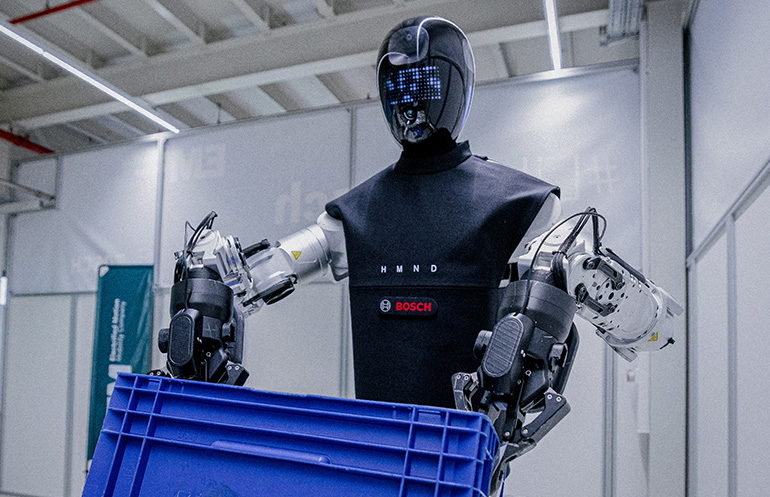
The collaboration between Humanoid, Bosch, and Schaeffler marks a significant milestone in the evolution of humanoid robotics, particularly within the realm of Smart Manufacturing. This partnership aims to scale the production and deployment of the HMND 01 platform, which is designed to operate in industrial environments. As industries increasingly seek to incorporate advanced robotic solutions to enhance productivity and efficiency, such collaborations become pivotal. The completion of a successful proof of concept (POC) in March 2026 has paved the way for this strategic alliance, illustrating the urgency and potential of humanoid robots in real-world applications.
Main Goal and Achievement Strategy
The primary objective of this partnership is to transition from prototype validation to large-scale deployment of humanoid robots in various industrial sectors, including logistics and manufacturing. This goal can be achieved through the strategic collaboration of key players—Humanoid provides innovative robotic solutions, while Bosch offers extensive manufacturing capabilities and Schaeffler integrates these technologies into live operations. By leveraging Bosch’s manufacturing expertise and Schaeffler’s operational framework, Humanoid aims to bring humanoid robots into the mainstream industrial landscape efficiently.
Advantages of the Partnership
- Enhanced Production Capabilities: By partnering with Bosch, Humanoid benefits from robust manufacturing infrastructure, enabling rapid scaling of production to meet market demand.
- Innovative Design for Excellence (DfX): The commitment to DfX principles ensures that the robots are designed for manufacturability, reliability, and cost-effectiveness, which enhances long-term economic viability.
- Proven Technology: The successful execution of the POC demonstrated the technical readiness of the HMND 01 robots, confirming their capability to handle diverse tasks in dynamic environments.
- Strategic Supply Chain Integration: Schaeffler’s role as a preferred supplier facilitates a consistent flow of high-quality components, essential for the production of humanoid robots, thereby minimizing delays and production costs.
- Autonomy and Flexibility: The design of humanoid robots allows them to operate in human-centric spaces without requiring significant modifications to existing infrastructure, offering flexibility in deployment.
Future Implications of AI in Humanoid Robotics
The integration of artificial intelligence (AI) in humanoid robotics is expected to significantly impact the industry in several ways. As AI technologies evolve, the autonomy of humanoid robots is anticipated to increase, with targets aiming for a 99.5% success rate in autonomous operations. This enhancement will not only improve efficiency but also reduce the need for human oversight in routine tasks. Furthermore, AI will play a critical role in facilitating adaptive learning, enabling robots to refine their operational capabilities through experience. The shift towards a simulation-first approach in training will further decrease the reliance on extensive real-world data, streamlining the deployment process. As AI continues to advance, the potential for humanoid robots to undertake more complex and dexterous tasks will expand, positioning them as essential assets in modern manufacturing environments.
Disclaimer
The content on this site is generated using AI technology that analyzes publicly available blog posts to extract and present key takeaways. We do not own, endorse, or claim intellectual property rights to the original blog content. Full credit is given to original authors and sources where applicable. Our summaries are intended solely for informational and educational purposes, offering AI-generated insights in a condensed format. They are not meant to substitute or replicate the full context of the original material. If you are a content owner and wish to request changes or removal, please contact us directly.
Source link :