
Contextual Overview Tomatoes represent a vital aspect of agricultural markets during late spring and early summer, captivating both consumers and producers with their diverse heirloom varieties. For many regions in North America, particularly those with prolonged winters, the cultivation of tomato seeds necessitates an indoor start, typically four to six weeks prior to the last frost. This indoor sowing approach is crucial for maximizing the yield potential of tomato crops in areas where direct sowing is impractical due to climatic constraints. This discussion aims to elucidate the critical strategies for successful tomato seed propagation, providing actionable insights for farmers and AgriTech innovators alike. Main Goal of Successful Tomato Seed Propagation The primary objective of the original post is to equip growers with practical strategies for initiating tomato seeds effectively, thereby enhancing their overall agricultural productivity. Successful propagation can be achieved through a series of methodical practices that include selecting appropriate varieties, optimizing indoor seed-starting setups, ensuring adequate warmth and moisture, and implementing timely transplanting techniques. Advantages of Effective Tomato Seed Propagation Varietal Selection: Choosing the right tomato variety—indeterminate or determinate—can significantly influence yield outcomes. Determinate varieties are advantageous in regions with shorter growing seasons as they produce a concentrated harvest, while indeterminate varieties offer extended production over the growing season. Optimized Seed-Starting Environment: Employing seed cells with proper drainage and utilizing grow lights can enhance germination rates and seedling health. These methods foster robust root systems and vigorous foliage, essential for healthy plant development. Controlled Temperature: Utilizing heat mats to maintain optimal soil temperatures (65 to 85°F) can drastically improve germination rates. This method mirrors the natural warm climates of tomato origins, thus promoting more reliable seedling emergence. Moisture Management: Maintaining consistent soil moisture, without over-saturation, supports rapid growth and development of tomato plants. Incorporating moisture-retentive materials such as peat or coco coir can enhance water retention, crucial for seedlings in arid conditions. Timely Up-Potting: Transplanting seedlings into larger containers once they develop true leaves can prevent root crowding and promote healthy growth. This technique is essential for maximizing the potential yield of each plant. Future Implications of AI in Tomato Cultivation As the AgriTech sector continues to evolve, the integration of artificial intelligence (AI) technologies presents significant opportunities for enhancing tomato cultivation. Future developments may include AI-driven systems for monitoring environmental conditions, automating irrigation, and predicting optimal planting times based on climate data. Such innovations can lead to more efficient resource utilization, thus improving overall crop yields and sustainability. Additionally, AI can facilitate precision agriculture practices, allowing for tailored interventions that meet the specific needs of tomato plants throughout their growth cycle. Disclaimer The content on this site is generated using AI technology that analyzes publicly available blog posts to extract and present key takeaways. We do not own, endorse, or claim intellectual property rights to the original blog content. Full credit is given to original authors and sources where applicable. Our summaries are intended solely for informational and educational purposes, offering AI-generated insights in a condensed format. They are not meant to substitute or replicate the full context of the original material. If you are a content owner and wish to request changes or removal, please contact us directly. Source link : Click Here

Introduction In the field of Applied Machine Learning, data cleaning and preparation are critical components that can significantly influence the efficiency of a data scientist’s workflow. It is estimated that data cleaning occupies up to 80% of a data scientist’s daily activities. Given that Pandas is the predominant library for data manipulation in Python, the proficiency in utilizing this tool is paramount for transitioning from raw data to actionable insights. As such, the ability to enhance data preparation processes not only streamlines workflows but also allows more time for modeling and analysis, ultimately facilitating better communication of insights. Despite the importance of effective data handling, many practitioners tend to rely on outdated coding practices that resemble conventional Python looping structures or use in-place mutations. These methods can lead to several challenges, including the infamous SettingWithCopyWarning, excessive memory usage due to redundant copies, and decreased execution speed due to a lack of vectorization. To address these challenges, it is essential for practitioners to adopt idiomatic Pandas design patterns, which can significantly enhance the efficacy of data cleaning and preparation tasks. Main Goal and Achievements The primary objective outlined in the original post is to promote efficient data cleaning and preparation in Pandas through the adoption of three key techniques: declarative method chaining, memory and speed optimization via categoricals and vectorized string accessors, and group-aware imputation using the .transform() method. Achieving this goal requires a shift from basic syntax to more advanced, idiomatic practices that allow for cleaner and more efficient code. Advantages of Efficient Data Cleaning Techniques Declarative Method Chaining: This technique allows for a sequential application of operations without in-place mutations, thereby reducing the risk of triggering warnings and improving code readability. By using methods like .assign(), .query(), and .pipe(), practitioners can create pipelines that are easier to debug and maintain. Memory and Speed Optimization: Converting low-cardinality categorical data into the category datatype and utilizing vectorized string methods can lead to significant reductions in memory usage and execution time. This optimization enables large datasets to be handled more efficiently, thereby enhancing the overall performance of data manipulation tasks. Group-Aware Imputation with .transform(): This method bypasses the inefficiencies of custom looping structures by allowing Pandas to calculate group-level statistics and align results back to the original DataFrame. This approach not only enhances speed but also maintains accuracy in handling missing values. While these advantages offer substantial improvements, it is essential to recognize that there are limitations. For instance, while categorical transformations can be beneficial for low-cardinality data, they may not provide memory savings in cases of high-cardinality text. Practitioners should, therefore, assess their dataset characteristics before applying these techniques. Future Implications of AI Developments As advancements in artificial intelligence continue to evolve, the landscape of data preparation is likely to undergo transformative changes. Future developments may introduce more sophisticated automated tools that can handle data cleaning and preparation with minimal human intervention. This could potentially reduce the time spent on these tasks, allowing data scientists to focus more on complex modeling and analysis. Additionally, the integration of AI into data pipelines may lead to enhanced predictive capabilities, enabling practitioners to derive insights from datasets that were previously deemed too cumbersome to process efficiently. In conclusion, adopting advanced techniques for data cleaning and preparation in Pandas not only improves workflow efficiency but also enhances the overall quality of machine learning models. By embracing these practices, practitioners can better prepare themselves for the future of data science in an increasingly AI-driven environment. Disclaimer The content on this site is generated using AI technology that analyzes publicly available blog posts to extract and present key takeaways. We do not own, endorse, or claim intellectual property rights to the original blog content. Full credit is given to original authors and sources where applicable. Our summaries are intended solely for informational and educational purposes, offering AI-generated insights in a condensed format. They are not meant to substitute or replicate the full context of the original material. If you are a content owner and wish to request changes or removal, please contact us directly. Source link : Click Here
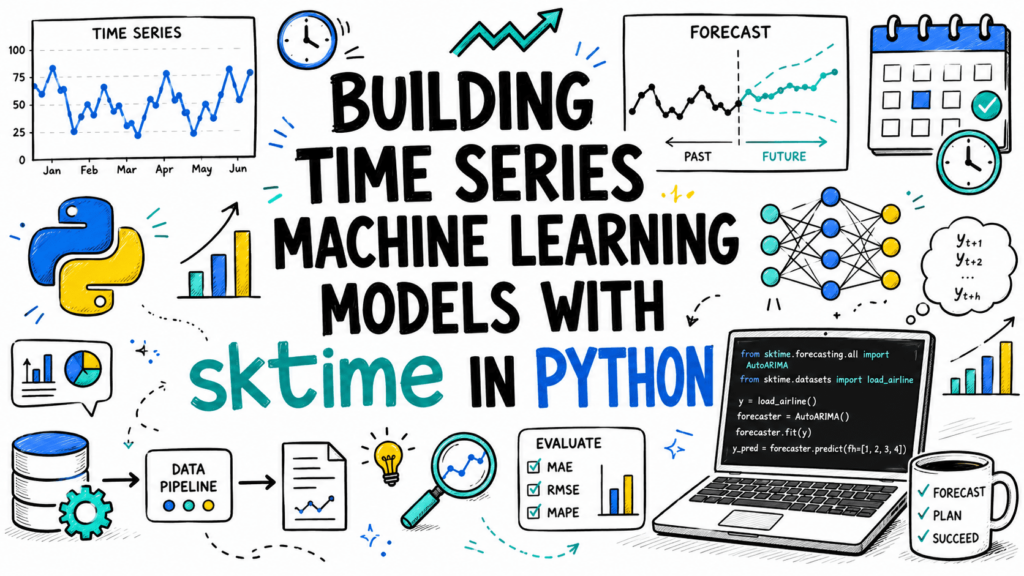
Introduction In the realm of data science, the processing and analysis of time-series data is of paramount importance, particularly in applications involving sensor readings and various metrics that evolve over time. Traditional machine learning frameworks, such as scikit-learn, are often ill-suited for these types of datasets due to their inherent structural complexities—namely seasonality, trends, temporal ordering, and the dependency of future values on historical data. This is where sktime, a Python library specifically designed for time-series analysis, comes into play, offering a scikit-learn-style API tailored for the unique requirements of time-series data. Main Goals of Time-Series Modeling The primary objective of utilizing sktime is to effectively build and evaluate machine learning models that can accurately forecast future values based on past data. Specifically, this article elucidates the methodology for forecasting temperature readings from an industrial HVAC sensor, demonstrating how sktime can streamline the tasks of data preprocessing, model fitting, and evaluation. By leveraging the capabilities of sktime, users can enhance predictive accuracy, improve model interpretability, and efficiently handle the complexities of time-series data. Advantages of Using sktime for Time-Series Analysis Specialized Data Structures: sktime provides tailored data containers such as Series, Panel, and Hierarchical formats that are specifically designed to accommodate the sequential and temporal nature of time-series data. Chronological Data Handling: The library emphasizes the importance of maintaining chronological integrity when splitting datasets for training and testing, thus preventing data leakage and enhancing model validity. Flexible Forecasting Horizons: Users can define absolute or relative forecasting horizons, enabling adaptable modeling strategies that cater to specific forecasting needs. Streamlined Pipelines: sktime facilitates the construction of preprocessing and forecasting pipelines that allow for systematic handling of missing values, trends, and seasonality, thereby ensuring robust model performance. Model Evaluation Metrics: The integration of standard evaluation metrics, such as Mean Absolute Error (MAE) and Mean Absolute Percentage Error (MAPE), empowers users to quantitatively assess model performance and make informed adjustments. Caveats and Limitations While sktime offers a robust framework for time-series analysis, several limitations warrant consideration. The library’s efficacy is contingent upon the quality and granularity of the input data; poor-quality data can lead to inaccurate forecasts. Additionally, sktime’s reliance on the temporal structure of data may impose constraints when applied to datasets lacking consistent time intervals. Users should also be cognizant of the computational resources required for processing large datasets, as the complexity of models can lead to increased processing times. Future Implications of AI Developments in Time-Series Analysis The rapid advancements in artificial intelligence (AI) and machine learning technologies are poised to significantly impact the field of time-series analysis. Enhanced algorithms, particularly those incorporating deep learning techniques, may yield even greater predictive capabilities. Moreover, as AI continues to evolve, the integration of natural language processing (NLP) within time-series frameworks could lead to richer contextual insights, enabling analysts to derive more nuanced interpretations from their data. As the demand for accurate forecasting grows across various industries, ongoing developments in this field will likely result in increasingly sophisticated tools and methodologies, ultimately driving better decision-making processes. Disclaimer The content on this site is generated using AI technology that analyzes publicly available blog posts to extract and present key takeaways. We do not own, endorse, or claim intellectual property rights to the original blog content. Full credit is given to original authors and sources where applicable. Our summaries are intended solely for informational and educational purposes, offering AI-generated insights in a condensed format. They are not meant to substitute or replicate the full context of the original material. If you are a content owner and wish to request changes or removal, please contact us directly. Source link : Click Here

Context: The Banned Book Library Project The Banned Book Library project exemplifies an innovative approach to information dissemination in environments where access to specific literature is restricted. By repurposing WiFi-enabled LED light bulbs as a means to host digital copies of banned books, the initiative reflects a broader concern regarding censorship and the importance of information accessibility. The project leverages technology in a manner reminiscent of a cyberpunk narrative, creating discreet, open-access points for knowledge sharing within communities. Main Goal and Achievement Methodology The principal objective of the Banned Book Library project is to provide a covert platform for accessing literature that may be banned in certain regions. This is achieved by modifying smart light bulbs to function as WiFi access points, allowing individuals to connect and access a library of digital books. The project underscores the importance of innovative thinking in utilizing existing technologies for socio-political purposes, demonstrating how everyday devices can facilitate the preservation and sharing of information in a restricted context. Advantages of the Banned Book Library Initiative Increased Accessibility: By transforming light bulbs into information access points, the project enhances the availability of banned literature to individuals who might otherwise lack access. Cost-Effectiveness: The use of inexpensive smart bulbs makes the project financially viable, allowing for multiple installations without significant expense. Community Engagement: The project encourages local participation in knowledge sharing, fostering a community-oriented approach to combating censorship. Technological Innovation: It showcases the potential of repurposing existing technology for new applications, highlighting the versatility of smart devices in addressing social issues. Environmental Awareness: Utilizing LED bulbs not only provides energy-efficient solutions but also promotes awareness about sustainable practices in technology use. Limitations and Caveats Despite its advantages, the Banned Book Library project faces notable limitations. The primary concern revolves around storage capacity, as the firmware and the hosted literature must all fit within the device’s 4MB limit. This constraint restricts the number and diversity of books that can be made available. Additionally, modifying light bulbs requires technical expertise, which may deter some potential participants from engaging with the project. Furthermore, the security of the WiFi access points may pose risks, as they could potentially expose sensitive user data. Future Implications and the Impact of AI Developments Looking ahead, the intersection of AI and technology will likely enhance projects like the Banned Book Library. Future advancements in AI could lead to improved methods for data compression, enabling more extensive libraries to be hosted within the limited storage of such devices. Additionally, AI-driven algorithms could facilitate more efficient management of digital libraries, allowing for better cataloging, retrieval, and user recommendations based on individual preferences. Moreover, the integration of AI technologies in the development of secure communication protocols could mitigate some of the security concerns associated with public access points. As society continues to grapple with issues of censorship and information access, projects like the Banned Book Library may serve as vital precedents for leveraging technology to foster knowledge sharing in constrained environments. Disclaimer The content on this site is generated using AI technology that analyzes publicly available blog posts to extract and present key takeaways. We do not own, endorse, or claim intellectual property rights to the original blog content. Full credit is given to original authors and sources where applicable. Our summaries are intended solely for informational and educational purposes, offering AI-generated insights in a condensed format. They are not meant to substitute or replicate the full context of the original material. If you are a content owner and wish to request changes or removal, please contact us directly. Source link : Click Here


