
Contextual Overview The recent unveiling of various advanced laptop models by ASUS at Computex highlights significant innovations in the technology sector, particularly focusing on enhanced performance and versatility in portable computing. Among these, the ASUS ExpertBook B5 Flip G2 stands out as a 360-degree convertible laptop that combines functionality with state-of-the-art specifications. Such devices are tailored for professionals, including software engineers, who require robust performance in diverse working environments. The introduction of multiple processor options across the ASUS Zenbook series further illustrates a trend towards enhanced customizability and performance, which is crucial in today’s fast-paced technological landscape. Main Goal and Its Achievement The principal goal of the ASUS ExpertBook B5 Flip G2 and similar models is to provide a multi-functional computing solution that addresses the varying demands of modern professionals. This goal can be achieved through the integration of high-performance processors, extensive memory options, and versatile design capabilities. By offering features such as dual cameras, an advanced stylus for digital drawing, and rapid charging capabilities, ASUS aims to enhance user productivity and adaptability in various work scenarios. Advantages of the ASUS ExpertBook B5 Flip G2 Versatile Design: The 360-degree hinge allows the laptop to function in multiple modes—laptop, tablet, tent, and display—catering to diverse professional needs and enhancing user experience. Lightweight and Portable: Weighing only 2.9 pounds, the ExpertBook B5 Flip G2 is designed for mobility, making it an ideal choice for professionals who work on the go. High Performance: Equipped with Intel’s latest Core 7 350 processor and up to 32GB of LPDDR5X memory, this laptop ensures efficient multitasking and robust performance during software development and other intensive tasks. Rapid Charging: The laptop supports quick charging, allowing users to gain significant usage time with minimal downtime, thus increasing productivity. Comprehensive Connectivity: Featuring multiple Thunderbolt 4 USB-C ports, HDMI 2.1, and USB 3.2 Gen 1 Type-A ports, the device ensures compatibility with a wide range of peripherals, essential for software engineers who often work with various hardware setups. Future Implications of AI Developments The integration of artificial intelligence (AI) into laptop technologies, as seen with the advanced NPU capabilities in the ExpertBook B5 Flip G2, signals a transformative shift in how professionals interact with their devices. AI advancements are expected to enhance computational efficiency, enabling more sophisticated software applications and development tools. As AI continues to evolve, future laptops may incorporate even more intuitive interfaces, predictive analytics, and enhanced security features. This evolution will likely empower software engineers to streamline their workflows, automate repetitive tasks, and leverage data-driven insights for more innovative solutions. Moreover, as AI becomes more embedded in everyday technology, the demand for devices capable of handling complex algorithms and large data sets will grow, further influencing design and functionality in future laptop models. Disclaimer The content on this site is generated using AI technology that analyzes publicly available blog posts to extract and present key takeaways. We do not own, endorse, or claim intellectual property rights to the original blog content. Full credit is given to original authors and sources where applicable. Our summaries are intended solely for informational and educational purposes, offering AI-generated insights in a condensed format. They are not meant to substitute or replicate the full context of the original material. If you are a content owner and wish to request changes or removal, please contact us directly. Source link : Click Here

Context The recent advancements in agricultural technology have prompted a growing emphasis on the integration of artificial intelligence (AI) and robotics into farming practices. The FARMAR project, with Forth UK as a key industry partner, exemplifies this trend by aiming to merge traditional agricultural knowledge with state-of-the-art robotic systems. This initiative’s primary focus is to enhance agricultural resilience, sustainability, and efficiency, thereby addressing pressing challenges faced by the AgriTech sector. Main Goal of FARMAR The overarching objective of the FARMAR project is to develop intelligent robotic systems that can assist in modern farming while preserving the local heritage of agricultural practices. This goal is to be achieved through a collaborative approach that brings together experts in various fields, including technology, agriculture, economics, and social sciences. By employing AI and robotics, the project aspires to support farmers in adapting to contemporary challenges such as labor shortages, climate variations, and increasing operational costs. Advantages of the FARMAR Initiative Enhanced Efficiency: The incorporation of smart ground and aerial robots, which learn from real farming practices, promises to streamline farming operations, thereby increasing productivity. Sustainability: By focusing on sustainable practices, FARMAR aims to improve the ecological footprint of agricultural activities, aligning with global sustainability goals. Local Heritage Preservation: The project emphasizes the importance of integrating local farming knowledge into automated systems, thereby maintaining cultural connections to agricultural practices. Collaboration Across Disciplines: The involvement of experts from various fields ensures that the solutions developed will be comprehensive and consider the multifaceted nature of agricultural challenges. Real-Time Problem Solving: The deployment of robots equipped with on-site computers facilitates immediate responses to farming issues, which can significantly enhance farm management. Limitations While the FARMAR project holds significant promise, it is essential to acknowledge potential limitations. The reliance on technology may introduce challenges related to data privacy, legal regulations, and the cultural adaptation of automated systems in diverse agricultural settings. Moreover, the successful implementation of robotic solutions requires continuous training and oversight by farmers to ensure optimal performance. Future Implications of AI in Agriculture As AI technology continues to evolve, its implications for the agricultural sector are profound. Future developments may lead to even more sophisticated robotic systems capable of performing complex tasks autonomously. This could significantly alleviate the labor burden on farmers, allowing them to focus on strategic decision-making rather than routine tasks. Additionally, advancements in AI could facilitate predictive analytics, enabling farmers to anticipate challenges such as pest outbreaks or crop diseases before they escalate. Ultimately, the integration of AI into agriculture has the potential to revolutionize farming practices, making them more efficient, resilient, and sustainable. Disclaimer The content on this site is generated using AI technology that analyzes publicly available blog posts to extract and present key takeaways. We do not own, endorse, or claim intellectual property rights to the original blog content. Full credit is given to original authors and sources where applicable. Our summaries are intended solely for informational and educational purposes, offering AI-generated insights in a condensed format. They are not meant to substitute or replicate the full context of the original material. If you are a content owner and wish to request changes or removal, please contact us directly. Source link : Click Here
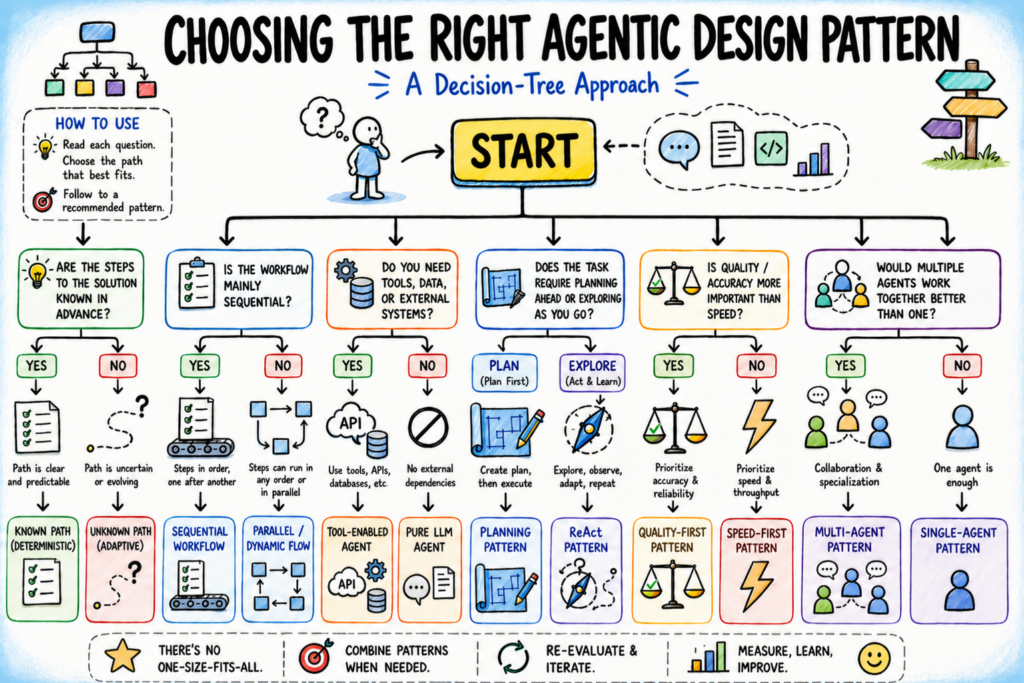
Context In the rapidly evolving field of applied machine learning, selecting the appropriate agentic design pattern is a pivotal decision that can significantly impact the efficiency and effectiveness of AI systems. The original discussion revolves around employing a structured decision tree to facilitate the selection of suitable design patterns tailored to specific tasks within AI development. By understanding the underlying assumptions of different agentic design patterns and leveraging a methodical decision-making framework, practitioners can align their choices with the nuanced requirements of their projects. Introduction The selection of the right agentic design pattern is not merely a technical choice but a critical design decision that can shape the trajectory of an AI project. Misinterpretations of the problem can lead to the application of overly complex solutions when simpler alternatives would suffice, or conversely, to oversimplified approaches that fail to scale in production. Thus, mastering the decision logic governing pattern selection is essential for effective AI system design. Main Goal and Achievement Methodology The primary objective of the original post is to equip AI developers with a structured decision-making tool—the decision tree—that systematically narrows down potential design patterns based on five key questions regarding their task properties. By following this protocol, developers can make informed choices that enhance their AI systems’ adaptability and performance. The decision tree does not yield a definitive answer but serves as a foundation for iterative development, enabling practitioners to refine their choices based on ongoing feedback and evolving project demands. Advantages of Using a Decision Tree for Agentic Design Pattern Selection Enhanced Clarity: The decision tree provides a clear framework for understanding the assumptions underlying each design pattern, allowing developers to align their choices with the specific requirements of their tasks. Reduced Overhead: By identifying the most suitable design pattern early in the development process, teams can minimize unnecessary complexity and technical debt, leading to faster project completion. Improved Adaptability: The iterative nature of the decision tree encourages ongoing evaluation and adjustment of patterns as feedback is gathered, fostering an agile development environment. Informed Risk Management: Recognizing failure signals associated with each pattern equips practitioners to troubleshoot effectively and implement targeted fixes, enhancing system reliability. Facilitated Collaboration: A shared understanding of the decision logic can improve communication among team members, ensuring that everyone is aligned on the rationale behind design choices. Caveats and Limitations While the decision tree offers numerous advantages, it is not without limitations. The effectiveness of this approach hinges on the accurate identification of task properties and assumptions. Misinterpretations at this stage can lead to suboptimal pattern selections. Additionally, the decision tree is most beneficial for problems that exhibit clear task properties; ambiguous or highly dynamic tasks may complicate the decision-making process. Furthermore, over-reliance on this structured approach can stifle creativity and innovative thinking in design. Future Implications of AI Developments As AI technologies continue to evolve, the methodologies for selecting agentic design patterns will need to adapt. Future advancements in machine learning may lead to the emergence of new design patterns that better address the complexities of real-world applications. Moreover, the integration of human-in-the-loop systems in AI workflows could necessitate the refinement of decision trees to account for subjective evaluations and qualitative feedback. Consequently, practitioners must remain vigilant and flexible, ready to update their decision-making frameworks in response to ongoing developments in AI and machine learning. Conclusion The decision tree approach to selecting agentic design patterns represents a significant advancement in the field of applied machine learning. By providing a structured methodology for decision-making, practitioners can enhance the effectiveness of their AI systems while mitigating risks associated with misalignment between task requirements and design choices. As the landscape of AI continues to transform, the principles underlying this decision-making framework will play a crucial role in shaping the future of intelligent systems. Disclaimer The content on this site is generated using AI technology that analyzes publicly available blog posts to extract and present key takeaways. We do not own, endorse, or claim intellectual property rights to the original blog content. Full credit is given to original authors and sources where applicable. Our summaries are intended solely for informational and educational purposes, offering AI-generated insights in a condensed format. They are not meant to substitute or replicate the full context of the original material. If you are a content owner and wish to request changes or removal, please contact us directly. Source link : Click Here
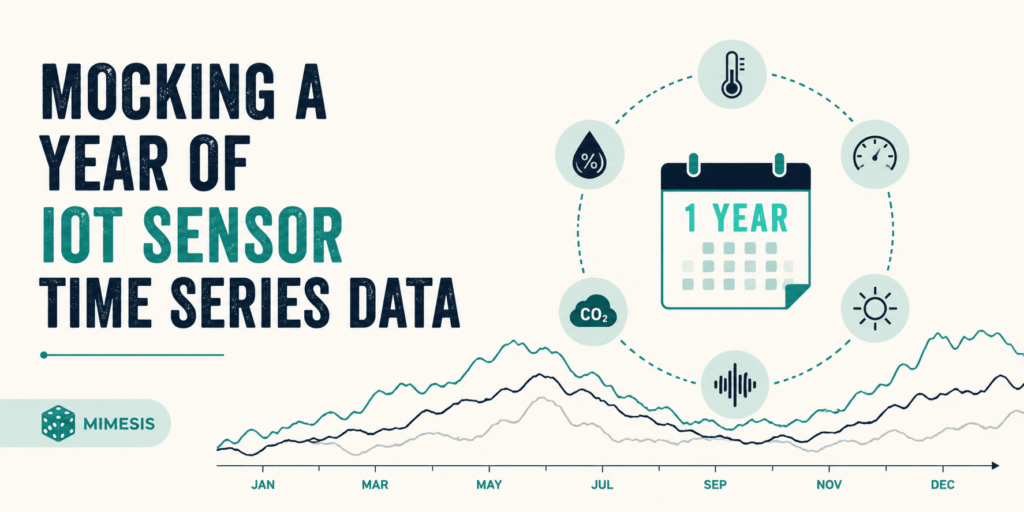
Introduction The mocking of Internet of Things (IoT) sensor data is an essential practice in research and development, particularly within the realms of data science and artificial intelligence (AI). This methodology allows for the simulation of datasets that would otherwise be challenging to obtain in real-world scenarios, facilitating various experimental analyses and projects. However, the generation of synthetic data transcends mere random number generation; it necessitates a coherent chronological timeline, comprehensive device metadata, and the incorporation of natural environmental fluctuations, such as seasonal variations. The open-source tool Mimesis offers a robust framework for the generation of such synthetic data, and this article delineates a structured approach to utilizing it for creating a year’s worth of daily temperature readings with realistic characteristics. Main Goal and Achievements The primary objective of the original post is to demonstrate how to generate a year-long dataset of IoT sensor readings that accurately reflects seasonal temperature variations and includes device-specific metadata. Achieving this goal involves utilizing Python libraries such as Mimesis for data generation, pandas for structuring time series data, and NumPy for mathematical operations to simulate seasonal patterns. Through a systematic process, researchers can create datasets that mimic real-world conditions, thus enhancing the reliability and applicability of their analyses. Advantages of Mocking IoT Sensor Data Enhanced Experimental Analysis: By generating realistic synthetic data, researchers can conduct experiments that closely resemble real-world scenarios, thereby improving the validity of their findings. Cost Efficiency: The ability to create large datasets without the logistical challenges and costs associated with collecting real-world data allows for more extensive and varied analyses. Flexibility in Data Generation: Researchers can customize datasets to explore specific hypotheses or scenarios, adjusting parameters to simulate different conditions. Immediate Availability: Synthetic data can be generated on demand, enabling rapid prototyping and iterative testing of models, which is particularly beneficial in agile development environments. Preparation for Real-World Applications: Mocked datasets can be utilized as training data for machine learning models, preparing them for deployment in real-world applications. Caveats and Limitations While mocking IoT sensor data presents numerous advantages, it is crucial to acknowledge certain limitations. The synthetic datasets may not fully capture the complexities and nuances of real-world data, particularly in cases where environmental interactions play a significant role. Additionally, the effectiveness of the mocked data relies heavily on the accuracy of the mathematical models used to simulate real-world conditions. Researchers must exercise caution in ensuring that their synthetic datasets remain representative of the phenomena they aim to study. Future Implications of AI Developments As advancements in AI and machine learning continue to evolve, the methodologies for generating and utilizing synthetic data will also progress. Future developments may include enhanced algorithms for simulating more complex environmental interactions and improved techniques for validating the realism of synthetic datasets. Moreover, the integration of AI-driven analytics could facilitate real-time data generation, allowing for dynamic adaptations to changing environmental conditions. This evolution will not only augment the capabilities of Natural Language Understanding (NLU) scientists but also expand the applications of synthetic data across various domains, from climate modeling to smart city planning. Conclusion In conclusion, the practice of mocking IoT sensor data represents a critical advancement in the fields of data science and AI, offering researchers the tools necessary to generate realistic datasets for experimental analysis. By leveraging open-source tools such as Mimesis in conjunction with established libraries like pandas and NumPy, researchers can create synthetic data that reflects real-world conditions, thus enhancing the reliability and applicability of their work. As AI continues to develop, the methodologies surrounding synthetic data generation will become increasingly sophisticated, paving the way for more accurate simulations and analyses in the future. Disclaimer The content on this site is generated using AI technology that analyzes publicly available blog posts to extract and present key takeaways. We do not own, endorse, or claim intellectual property rights to the original blog content. Full credit is given to original authors and sources where applicable. Our summaries are intended solely for informational and educational purposes, offering AI-generated insights in a condensed format. They are not meant to substitute or replicate the full context of the original material. If you are a content owner and wish to request changes or removal, please contact us directly. Source link : Click Here

Context and Overview Techtonique.net has re-emerged as a valuable resource for practitioners in the field of data science, particularly those focused on machine learning and exploratory data analysis (EDA). This platform offers various tools that facilitate numerous data science tasks, including editors for R and Python, data visualization capabilities, no-code web interfaces, and a versatile, language-agnostic API for machine learning applications such as classification, regression, survival analysis, reserving, and forecasting. The platform’s recent resurgence, marked by a significant increase in user registrations, indicates a growing interest in its offerings, albeit with a caveat: the service is currently positioned as a passion project, with performance limitations compared to its previous iterations. Main Goal and Achievement Path The primary objective of Techtonique.net is to provide users with accessible machine learning resources that can be utilized effectively without requiring extensive programming knowledge. This goal can be achieved through the platform’s API, which allows users to easily integrate machine learning functionalities into their applications and workflows. By requiring users to register and obtain a token for accessing the API, Techtonique.net ensures a streamlined and secure interaction with its services while fostering a community of users who can share insights and experiences. Advantages of Utilizing Techtonique.net Accessibility: Techtonique.net provides a user-friendly interface that accommodates both novice and experienced data scientists, enabling them to engage with complex machine learning tasks without significant barriers. Language Agnosticism: The API’s design allows for integration with any programming language capable of making HTTP requests, thus broadening its usability across various technical environments. Comprehensive Toolset: The platform encompasses a wide range of functionalities, from EDA to predictive modeling, which can significantly enhance a data engineer’s toolkit and improve their efficiency in project delivery. No-Code Interfaces: For users who prefer to avoid coding, Techtonique.net offers no-code solutions, thus democratizing access to data science tools and fostering an inclusive environment for users of all skill levels. Free Access with Rate Limiting: While the API is free to use, it is subject to rate limits, allowing for initial exploration and experimentation without financial commitment, although users should be mindful of potential slowdowns. Caveats and Limitations Despite its advantages, users should be aware of certain limitations associated with Techtonique.net. Notably, the API operates at a reduced speed compared to previous offerings due to the lack of robust server resources. The removal of advanced functionalities, such as the stochastic simulation API, reflects the current constraints of the platform. Users may experience slower response times, particularly during peak usage periods, which could impact real-time applications. Future Implications The landscape of data science is evolving rapidly, propelled by advancements in artificial intelligence and machine learning. As these technologies continue to mature, platforms like Techtonique.net are likely to adapt and expand their offerings to include more sophisticated tools and models. The integration of AI-driven analytics into existing frameworks could enhance predictive accuracy and operational efficiency, positioning Techtonique.net as a pivotal player in the democratization of data science. Furthermore, as more individuals and organizations recognize the value of data-driven decision-making, the demand for accessible and efficient machine learning tools will only increase, underscoring the importance of platforms that facilitate such capabilities. Disclaimer The content on this site is generated using AI technology that analyzes publicly available blog posts to extract and present key takeaways. We do not own, endorse, or claim intellectual property rights to the original blog content. Full credit is given to original authors and sources where applicable. Our summaries are intended solely for informational and educational purposes, offering AI-generated insights in a condensed format. They are not meant to substitute or replicate the full context of the original material. If you are a content owner and wish to request changes or removal, please contact us directly. Source link : Click Here


