
Context The partnership between the Singapore National Parks Board (NParks), Microsoft, and Conservation International has led to the innovative development of an AI-based mobile application named Fin Finder. This pioneering technology is designed to visually identify shark and ray species, a critical advancement in the ongoing battle against illegal wildlife trade. As shark and ray populations face unprecedented declines, largely attributed to illegal activities, this application aims to enhance conservation efforts through rapid species identification, thereby supporting global biodiversity. Main Goal and Achievement The primary goal of Fin Finder is to provide a swift and reliable method for identifying illegally traded shark and ray species, thus enhancing enforcement against wildlife trafficking. Through the implementation of an AI-driven algorithm, the application matches images of shark and ray fins against a comprehensive database containing over 15,000 entries. This technological innovation allows enforcement officers to accurately identify species in mere seconds, expediting the process of flagging suspicious shipments for further investigation. The collaboration with Microsoft’s AI for Earth program underscores the potential of integrating advanced technology into conservation practices. Advantages of Fin Finder Rapid Identification: The application significantly reduces the time taken for species identification from an average of one week to just seconds, allowing for immediate action against illegal trade. Enhanced Enforcement Capabilities: By equipping officers with an easy-to-use tool for visual identification, the application strengthens the enforcement of CITES regulations, thereby bolstering conservation efforts. Comprehensive Resource Access: Fin Finder serves as a single-platform directory for relevant shark and ray species, providing officers with onsite access to reference materials for verifying CITES-approved permits. Collaboration Across Sectors: The project exemplifies the power of public-private partnerships in addressing environmental challenges, leveraging resources and expertise from diverse stakeholders. Support for Global Biodiversity: As a part of Microsoft’s AI for Earth initiative, Fin Finder contributes to global efforts in preserving wildlife and maintaining ecosystem balance, aligning technology with sustainability goals. Limitations and Caveats While Fin Finder represents a significant leap forward in combating illegal wildlife trade, certain limitations should be acknowledged. The reliance on image quality and environmental conditions can affect the accuracy of species identification. Additionally, while the application streamlines the identification process, it does not eliminate the need for traditional DNA testing in all cases, particularly for ambiguous specimens. The effectiveness of the application is also contingent on the continued collaboration among stakeholders and the regular updating of the species database. Future Implications The advancement of AI technologies within wildlife conservation signifies a transformative shift in the approach to environmental protection. As machine learning algorithms continue to evolve, future enhancements may include improved accuracy in species identification, broader databases encompassing more marine species, and the potential for integrating additional features such as real-time data analytics. Such innovations could further empower conservationists and law enforcement agencies in their efforts to combat wildlife trafficking, ensuring that ecological integrity is preserved for generations to come. Disclaimer The content on this site is generated using AI technology that analyzes publicly available blog posts to extract and present key takeaways. We do not own, endorse, or claim intellectual property rights to the original blog content. Full credit is given to original authors and sources where applicable. Our summaries are intended solely for informational and educational purposes, offering AI-generated insights in a condensed format. They are not meant to substitute or replicate the full context of the original material. If you are a content owner and wish to request changes or removal, please contact us directly. Source link : Click Here

Contextual Overview In the realm of video content creation, trimming is an indispensable editing function that allows creators to enhance their videos by removing unwanted segments, pauses, and other extraneous elements. The emergence of video trimmer tools, particularly those integrated with advanced artificial intelligence (AI), has revolutionized the editing landscape. These tools not only facilitate quick and efficient editing but also enhance the overall quality of the final product by intelligently detecting scene changes, silences, and highlights, thereby saving creators valuable time in manual editing processes. This blog post will explore the primary goal of these tools, specifically in the context of the Computer Vision and Image Processing sectors, and how they serve the needs of vision scientists and content creators alike. Main Goal and Achievements The primary objective of utilizing video trimmer tools is to streamline the editing process, enabling users to produce high-quality, polished videos expeditiously. This goal can be successfully achieved through the implementation of AI-powered functionalities that automate key editing tasks such as scene detection and content refinement. By leveraging machine learning algorithms, these tools can enhance the editing workflow, allowing creators to focus on content creation rather than the intricacies of video editing. Advantages of AI-Powered Video Trimmer Tools Time Efficiency: AI tools drastically reduce editing time by automatically detecting and trimming unnecessary segments, thereby expediting the production process. Quality Preservation: Advanced algorithms ensure that the integrity of the video is maintained, preserving HD and 4K quality throughout the editing process. User-Friendly Interfaces: Many tools, such as LiveLink and Kapwing, offer intuitive interfaces that cater to both novice and experienced users, making video editing accessible to a wider audience. Comprehensive Functionality: These tools often come equipped with additional features such as captioning, resizing, and exporting options, providing a holistic video editing solution. Versatile Application: The capability to export videos in formats optimized for platforms like TikTok, YouTube, and Instagram enhances the utility of these tools for social media creators. Future Implications of AI in Video Editing The trajectory of AI development in video editing tools suggests a transformative impact on the creation and consumption of video content. As machine learning algorithms continue to evolve, we can anticipate even greater automation in video editing processes, including personalized content suggestions based on user behavior and preferences. Furthermore, innovations in AI could lead to more sophisticated analysis of visual content, enabling enhanced capabilities for content creators and vision scientists alike. As these tools become increasingly intelligent, they may redefine not only the efficiency of video production but also the creative possibilities available to content creators in various fields. Disclaimer The content on this site is generated using AI technology that analyzes publicly available blog posts to extract and present key takeaways. We do not own, endorse, or claim intellectual property rights to the original blog content. Full credit is given to original authors and sources where applicable. Our summaries are intended solely for informational and educational purposes, offering AI-generated insights in a condensed format. They are not meant to substitute or replicate the full context of the original material. If you are a content owner and wish to request changes or removal, please contact us directly. Source link : Click Here

Introduction In the contemporary digital landscape, the proliferation of data has made it increasingly essential for organizations to leverage data analytics to derive actionable insights. Businesses now find themselves with vast amounts of data stored in structured databases, commonly accessed through Structured Query Language (SQL). The ability to query this data effectively is crucial; however, challenges arise when complex queries become necessary. SQL stored procedures emerge as a solution to streamline these intricate queries, transforming them into reusable, simplified callables. This blog post explores how SQL stored procedures can facilitate data analytics automation, particularly within the fields of Natural Language Understanding (NLU) and Language Understanding (LU). Understanding SQL Stored Procedures SQL stored procedures are essentially predefined collections of SQL statements that are stored within a database. They function similarly to programming functions, allowing encapsulation of a series of operations into a single executable unit. This encapsulation not only enhances code organization but also promotes dynamic querying capabilities. Particularly in the context of NLU and LU, where data complexity often increases, stored procedures serve as a vital tool for automating repetitive tasks and optimizing query execution. Main Goals and Achievements The primary objective of utilizing SQL stored procedures is to simplify and automate complex data analytics tasks. By encapsulating intricate SQL queries into procedures, data analysts and NLU scientists can reduce the likelihood of errors while enhancing the efficiency of data retrieval processes. Achieving this goal involves the creation of procedures that accept parameters, thus allowing for dynamic querying based on user-defined inputs. For instance, a stored procedure can be designed to aggregate data metrics over specified date ranges, effectively streamlining the process of data analysis. Advantages of SQL Stored Procedures Code Reusability: Stored procedures can be reused across different applications and scripts, reducing redundancy in code writing and maintenance. Enhanced Performance: Executing stored procedures may yield performance improvements since they are compiled and optimized by the database server. Dynamic Querying: By accepting parameters, stored procedures allow for dynamic data retrieval, which is particularly beneficial in environments with varying data requirements. Error Reduction: Encapsulating complex queries into stored procedures minimizes the risk of human error during data retrieval processes. Centralized Logic: Business logic encapsulated within stored procedures simplifies the maintenance and updating of analytical processes across applications. Limitations and Considerations While SQL stored procedures offer numerous advantages, there are notable caveats. One limitation is that they can lead to performance bottlenecks if not correctly optimized, particularly when dealing with large datasets. Additionally, the complexity of managing stored procedures can increase as they proliferate, potentially leading to challenges in version control and documentation. Future Implications of AI Developments The evolution of artificial intelligence (AI) is poised to significantly impact the deployment and effectiveness of SQL stored procedures in NLU and LU. As AI algorithms become more sophisticated, the integration of machine learning with SQL databases may allow for predictive analytics and automated data insights. Such advancements could further enhance the capabilities of stored procedures, enabling them to adapt to evolving data patterns and user requirements autonomously. In this way, AI will not only augment the functionalities of stored procedures but also redefine the landscape of data analytics in the NLU and LU domains. Conclusion In summary, SQL stored procedures represent a pivotal development in the automation of data analytics processes, particularly within the fields of Natural Language Understanding and Language Understanding. By simplifying complex queries and promoting code reusability, they enable data analysts to execute analytics tasks more efficiently. As AI continues to evolve, the potential for integrating these technologies will likely enhance the capabilities of stored procedures, leading to more dynamic and intelligent data analytics solutions. Disclaimer The content on this site is generated using AI technology that analyzes publicly available blog posts to extract and present key takeaways. We do not own, endorse, or claim intellectual property rights to the original blog content. Full credit is given to original authors and sources where applicable. Our summaries are intended solely for informational and educational purposes, offering AI-generated insights in a condensed format. They are not meant to substitute or replicate the full context of the original material. If you are a content owner and wish to request changes or removal, please contact us directly. Source link : Click Here

Introduction The emergence of advanced AI models has revolutionized the landscape of content moderation and compliance across industries. In particular, OpenAI’s gpt-oss-safeguard represents a significant advancement in AI-driven safety mechanisms. This model is designed to interpret and apply user-defined policies with a level of reasoning that enhances transparency and accountability, thereby moving beyond traditional content moderation methods. This article will elucidate the critical functions and implications of the gpt-oss-safeguard model and its potential benefits for data engineers operating within the realm of data analytics and insights. Understanding gpt-oss-safeguard The gpt-oss-safeguard model is built on the gpt-oss architecture, featuring 20 billion parameters (with a variant containing 120 billion parameters). It is specifically fine-tuned for safety classification tasks, employing the Harmony response format, which facilitates auditability by delineating reasoning into distinct channels. This innovative architecture allows the model to process two inputs simultaneously: a system instruction (the policy) and the content subject to that policy. By analyzing these inputs, the model generates conclusions and the rationale behind its decisions. Main Goal: Policy-Driven Safety The primary objective of the gpt-oss-safeguard model is to implement a policy-driven safety framework that enhances compliance and content moderation. Unlike conventional systems that rely on pre-defined rules, this model allows for real-time adjustments to safety policies without necessitating retraining. This flexibility is particularly advantageous for organizations that require swift adaptations to their moderation strategies in response to evolving guidelines or regulatory environments. Advantages of gpt-oss-safeguard 1. **Enhanced Transparency and Accountability**: The model’s output includes reasoning traces, which document how decisions were made. This transparency is essential for auditability, allowing stakeholders to understand and trust the moderation process. 2. **Dynamic Policy Application**: By enabling users to modify policies at inference time, the gpt-oss-safeguard eliminates the lengthy retraining process associated with traditional models. This feature is particularly valuable in fast-paced environments where compliance standards can change rapidly. 3. **Reduction in Black-Box Operations**: Traditional AI moderation systems often operate as black boxes, providing little insight into their decision-making processes. The gpt-oss-safeguard’s reasoning capabilities mitigate this issue, fostering greater confidence among users. 4. **Support for Multilingual Policies**: While primarily optimized for English, the model can be adapted to recognize and apply policies across different languages, though with potential limitations in performance. This capability broadens its applicability for global organizations. 5. **Improved Efficiency in Content Moderation**: The model demonstrates a significant capability in handling multi-policy accuracy, outperforming several existing models in terms of deployment efficiency. This is particularly beneficial for organizations looking to optimize their moderation tools without incurring high computational costs. Limitations and Caveats Despite the compelling advantages, the gpt-oss-safeguard model has inherent limitations: – **Performance Constraints**: Specialized classifiers tailored for specific tasks may outperform the gpt-oss-safeguard in terms of accuracy and reliability. Organizations should evaluate their specific needs when considering the adoption of this model. – **Compute and Resource Intensive**: The computational demands of the gpt-oss-safeguard may exceed those of lighter classifiers, raising concerns regarding scalability, especially for operations with limited resources. – **Potential for Hallucination**: The reasoning provided by the model may not always be accurate, particularly in cases of brief or ambiguous policies. This can lead to misleading conclusions, necessitating human oversight in critical applications. Future Implications As AI technologies continue to evolve, the implications of models like gpt-oss-safeguard are profound. The integration of transparent, policy-driven safety mechanisms will likely become a standard expectation across industries, particularly in sectors that require stringent compliance measures, such as finance, healthcare, and social media. For data engineers, this shift presents an opportunity to leverage advanced AI capabilities, enhancing their roles in data-driven decision-making processes. Moreover, the ability to conduct real-time policy testing and adjustment will empower organizations to remain agile in their compliance strategies, fostering a more responsive approach to content moderation challenges. As AI develops, we anticipate further advancements in model accuracy, efficiency, and multilingual capabilities, ultimately shaping a more secure digital landscape. Conclusion In conclusion, the gpt-oss-safeguard model epitomizes a significant advancement in AI-driven safety mechanisms, offering a promising framework for policy-driven content moderation. Its advantages, particularly in transparency and adaptability, mark a departure from traditional moderation systems. However, organizations must remain cognizant of its limitations and the necessity of human oversight in high-stakes environments. The future of AI in data analytics and insights will likely hinge on the continued evolution of such models, driving innovations that enhance compliance and operational efficiency. Disclaimer The content on this site is generated using AI technology that analyzes publicly available blog posts to extract and present key takeaways. We do not own, endorse, or claim intellectual property rights to the original blog content. Full credit is given to original authors and sources where applicable. Our summaries are intended solely for informational and educational purposes, offering AI-generated insights in a condensed format. They are not meant to substitute or replicate the full context of the original material. If you are a content owner and wish to request changes or removal, please contact us directly. Source link : Click Here

Context: Microsoft’s Leadership in Distributed Hybrid Infrastructure Microsoft has reaffirmed its position as a leader in the realm of distributed hybrid infrastructure, as recognized by Gartner in their 2025 Magic Quadrant. This accolade marks the third consecutive year that Microsoft has been distinguished, underscoring its commitment to facilitating seamless workload management across hybrid environments, edge computing, multicloud, and sovereign settings via Azure. These advancements are pivotal for organizations aiming to optimize their operational frameworks within increasingly complex technological landscapes. Main Goal: Achieving Comprehensive Workload Management The primary objective articulated in the original content is to empower organizations to run various workloads seamlessly across diverse environments. This goal can be achieved through Microsoft Azure’s adaptive cloud approach, which leverages technologies such as Azure Arc and Azure Local. By integrating these technologies, organizations can manage and govern their resources effectively, thus enhancing operational efficiency and scalability. Advantages of Azure’s Adaptive Cloud Approach Unified Management Across Environments: Azure Arc enables organizations to manage resources across on-premises, multicloud, and edge environments, creating a cohesive management experience. This integration allows data engineers to streamline operations and ensure consistent governance across all platforms. Enhanced Flexibility for Workloads: The Azure Local functionality brings Azure services to customer-controlled environments, allowing for the execution of cloud-native workloads locally. This flexibility is particularly beneficial for organizations needing to comply with regulatory requirements while still leveraging cloud capabilities. Improved Security and Compliance: With features such as Microsoft Defender for Cloud, organizations can bolster their security posture and maintain compliance across disparate environments. This aspect is crucial for data engineers who must safeguard sensitive data while navigating complex regulatory landscapes. Accelerated Innovation: By reducing disaster recovery times and freeing engineering resources from routine tasks, organizations can focus on innovation and strategic initiatives. This shift enables data engineers to dedicate more time to developing new solutions rather than maintaining existing systems. While these advantages are substantial, it is important to recognize potential limitations. For instance, integrating Azure services across diverse environments may pose challenges in terms of compatibility and performance optimization, requiring careful planning and execution. Future Implications: The Role of AI in Big Data Engineering The future landscape for data engineers will undoubtedly be shaped by advancements in artificial intelligence (AI) and machine learning (ML). These technologies are expected to enhance data processing capabilities, enabling quicker insights and more sophisticated analytics. As organizations increasingly adopt AI-driven solutions, the need for seamless integration of AI models within hybrid infrastructures will become paramount. Furthermore, the emergence of AI will facilitate improved decision-making processes, allowing data engineers to leverage predictive analytics and automation tools. This evolution will not only streamline operations but also create new opportunities for innovation within the field of big data engineering. Disclaimer The content on this site is generated using AI technology that analyzes publicly available blog posts to extract and present key takeaways. We do not own, endorse, or claim intellectual property rights to the original blog content. Full credit is given to original authors and sources where applicable. Our summaries are intended solely for informational and educational purposes, offering AI-generated insights in a condensed format. They are not meant to substitute or replicate the full context of the original material. If you are a content owner and wish to request changes or removal, please contact us directly. Source link : Click Here

Introduction The evolution of the web has been predominantly centered around human users, resulting in a digital landscape tailored for human interaction. However, with the advent of agentic AI—intelligent agents that can perform tasks on behalf of humans—this paradigm faces significant challenges. The existing web architecture, optimized for human perception and engagement, is increasingly inadequate for machine-based interactions. This reality necessitates a comprehensive reevaluation of the web’s structure to accommodate the unique needs of AI-driven agents. Main Goal: Redesigning the Web for Agentic AI The primary objective illuminated in the original discourse is to transition from a human-centric web to one that equally accommodates machine interactions. Achieving this goal entails redesigning web infrastructure to enhance its semantic clarity and machine-readability, enabling AI agents to navigate, interpret, and execute tasks efficiently without compromising security. Fundamental to this transition is the recognition that the web’s current design presents significant barriers for AI agents, which lack the intuitive capabilities of human users. Advantages of a Machine-Friendly Web Enhanced Usability for AI Agents: A redesign that incorporates semantic structures and standardized interfaces will allow agents to perform tasks with greater accuracy, minimizing errors caused by misinterpretation of visual cues. Improved Security Measures: Implementing strict protocols, such as least privilege access and user intent separation, will safeguard against malicious instructions and enhance trust in agentic browsing. Increased Accessibility: By creating clear pathways for AI interaction, businesses can ensure that their services remain visible and usable, potentially increasing customer engagement and satisfaction. Strategic Business Advantage: Organizations that adapt their web architecture to be agent-friendly are likely to gain a competitive edge, as they will be better positioned to leverage AI-driven efficiencies in their operations. Future-Proofing Digital Services: As AI technologies continue to evolve, a machine-readable web will be essential for businesses to stay relevant and competitive in a landscape increasingly dominated by automated interactions. Caveats and Limitations While the advantages of redesigning the web for AI agents are significant, several caveats must be acknowledged. The complexity of existing enterprise applications poses a considerable challenge, as many systems are deeply entrenched in human-centric workflows. Moreover, the transition to a machine-friendly web will require substantial investment in technology and training to ensure that both developers and users can adapt to new paradigms effectively. Future Implications of AI Developments The trajectory of AI advancements suggests a future where agentic browsing becomes commonplace. As AI models become more sophisticated, their integration into web processes will demand that web developers prioritize machine usability. This shift will likely lead to the development of new standards and practices, ensuring that web design not only accommodates but also maximizes the capabilities of AI agents. Furthermore, businesses that fail to adapt may find themselves at a disadvantage, as the visibility and effectiveness of their web interfaces diminish in an increasingly automated landscape. Conclusion In summary, the transition towards a web that accommodates both human users and machine agents is not merely an option—it is an imperative. By embracing the necessary changes to web architecture, organizations can enhance the usability and security of their digital services, ensuring they remain competitive in an evolving technological landscape. The future of the web hinges on its ability to adapt to the needs of AI, fostering a more integrated and productive relationship between humans and machines. Disclaimer The content on this site is generated using AI technology that analyzes publicly available blog posts to extract and present key takeaways. We do not own, endorse, or claim intellectual property rights to the original blog content. Full credit is given to original authors and sources where applicable. Our summaries are intended solely for informational and educational purposes, offering AI-generated insights in a condensed format. They are not meant to substitute or replicate the full context of the original material. If you are a content owner and wish to request changes or removal, please contact us directly. Source link : Click Here

Context The emergence of generative AI tools has revolutionized the landscape of artistic creation by democratizing access to art-making capabilities. In a fraction of the time and without extensive training, individuals can generate intricate images based on their imagination. Yet, this newfound accessibility has incited considerable criticism, particularly regarding the proliferation of low-quality content across social media platforms such as Instagram and TikTok. Companies are increasingly opting to leverage these AI tools for image and video generation, potentially sidelining traditional artists in the process. This paradigm shift raises questions about the value of art and the role of human creativity in a domain increasingly influenced by artificial intelligence. Main Goal and Achievement The central aim of integrating generative AI into the artistic realm is to foster creative expression among individuals who may not possess traditional artistic skills. This goal can be realized through the development and utilization of user-friendly AI tools that encourage experimentation and innovation in art creation. By enabling a broader audience to engage in the artistic process, these tools can cultivate a new generation of creators who contribute diverse perspectives to the art world. However, achieving this goal necessitates a balance between accessibility and the preservation of artistic integrity, as the artistic merit of AI-generated works remains a contentious topic. Advantages of Generative AI in Art Increased Accessibility: Generative AI tools allow individuals without formal training to create art, thereby lowering barriers to entry and expanding the creative community. Diverse Perspectives: The democratization of art-making promotes the inclusion of varied voices and ideas, enriching the artistic landscape with new narratives and styles. Enhanced Creativity: Artists can leverage AI as a collaborative tool, enhancing their creative process by introducing elements of unpredictability and innovation that may not arise through traditional methods. New Market Opportunities: The emergence of AI-generated art has led to novel market dynamics, evidenced by high-profile sales at auction houses, such as the $24,000 sale of a bitcoin NFT, indicating a growing acceptance of AI as a legitimate medium. Caveats and Limitations Despite the advantages, there are significant caveats to consider. The ease of generating art with AI tools can lead to an oversaturation of content, where the distinction between profound artistry and mere replication becomes blurred. Moreover, the reliance on AI can diminish the perceived value of traditional artistic skills, leading to concerns about the devaluation of human artistry. Additionally, the unpredictability inherent in AI-generated works, while often seen as a benefit, may also produce outcomes that lack coherence or artistic intention. Future Implications Looking forward, the trajectory of AI developments in the art world is poised to impact various aspects of artistic creation and appreciation. As generative AI continues to evolve, it will likely enhance its capabilities, enabling artists to explore increasingly complex themes and styles. Furthermore, the ongoing dialogue surrounding the legitimacy of AI as a co-creator will play a crucial role in shaping public perception and acceptance. The integration of AI in art may lead to the establishment of new artistic movements that redefine traditional concepts of creativity and authorship. Ultimately, the future of AI in the arts hinges on the ability to balance innovation with respect for the rich history of human expression. Disclaimer The content on this site is generated using AI technology that analyzes publicly available blog posts to extract and present key takeaways. We do not own, endorse, or claim intellectual property rights to the original blog content. Full credit is given to original authors and sources where applicable. Our summaries are intended solely for informational and educational purposes, offering AI-generated insights in a condensed format. They are not meant to substitute or replicate the full context of the original material. If you are a content owner and wish to request changes or removal, please contact us directly. Source link : Click Here

Context and Overview The gaming landscape is witnessing a transformative shift with titles such as Vampire: The Masquerade – Bloodlines 2 capitalizing on advanced cloud gaming technologies through platforms like GeForce NOW. This integration not only enhances accessibility but also showcases the potential of robust infrastructure, such as the NVIDIA RTX 5080-class power, to deliver high-performance gaming experiences seamlessly. As gaming becomes increasingly cloud-based, it parallels developments in the Generative AI Models & Applications sector, where the focus is on leveraging AI capabilities to optimize user engagement and interaction in gaming environments. Main Goal and Achievement Strategies The primary goal illustrated in the original content is to highlight the seamless integration of advanced cloud technology with contemporary gaming experiences, thereby enhancing user accessibility and engagement. This can be achieved through: Infrastructure Enhancement: Upgrading server capabilities to support high-performance gaming. Accessibility Improvements: Facilitating instant game access without the need for extensive downloads or high-end hardware. User Engagement: Providing immersive experiences through rich narratives and interactive gameplay. Advantages of Cloud Gaming Integration The integration of cloud gaming technologies presents several advantages that benefit both players and developers: Instant Access: Players can engage with games immediately, as no installation is required. This encourages a broader player base and promotes trial of new titles. Enhanced Graphics and Performance: The use of NVIDIA’s RTX 5080-class power ensures high frame rates and superior graphics quality, thereby elevating the gaming experience. Device Flexibility: Players can access games across various devices, whether high-end PCs or mobile devices, promoting inclusivity in gaming. Dynamic Storytelling: Titles like Bloodlines 2 leverage rich narratives and complex character interactions, enhancing immersion and player agency. Limitations and Caveats While the advantages are significant, certain limitations must be acknowledged: Internet Dependency: A stable and high-speed internet connection is crucial, which may limit access for users in regions with inadequate infrastructure. Latency Issues: Real-time performance can be affected by network latency, which may detract from the gameplay experience. Subscription Costs: While cloud gaming offers convenience, the recurring subscription fees may deter some potential players. Future Implications in AI and Gaming The future landscape of gaming, particularly within the context of AI developments, is poised for significant evolution. The continued refinement of AI technologies will likely drive advancements in: Personalized Gaming Experiences: AI could tailor game narratives and challenges based on individual player behavior and preferences. Real-time Adaptation: AI systems may enable games to adapt in real-time to player decisions, enhancing immersion and engagement. Enhanced NPC Interactions: The development of more sophisticated non-playable characters (NPCs) through AI can lead to deeper and more meaningful player interactions. Predictive Analytics: Game developers can use AI to analyze player data, predicting trends and optimizing game features for better player retention. Disclaimer The content on this site is generated using AI technology that analyzes publicly available blog posts to extract and present key takeaways. We do not own, endorse, or claim intellectual property rights to the original blog content. Full credit is given to original authors and sources where applicable. Our summaries are intended solely for informational and educational purposes, offering AI-generated insights in a condensed format. They are not meant to substitute or replicate the full context of the original material. If you are a content owner and wish to request changes or removal, please contact us directly. Source link : Click Here

Context The landscape of data science interviews is evolving, particularly in the realm of Applied Machine Learning. Traditionally, candidates have been assessed on their technical acumen, including proficiency in programming languages such as SQL and Python, as well as their understanding of machine learning algorithms and statistical analysis. However, a deeper, often overlooked dimension exists within these interviews: the ‘hidden curriculum.’ This refers to the non-technical competencies that employers are increasingly prioritizing, which are vital for success in a collaborative and dynamic working environment. Recognizing this shift is crucial for both job seekers and organizations aiming to optimize their hiring processes. Introduction The primary goal of identifying the hidden curriculum in data science interviews is to equip candidates with the skills to effectively navigate the complexities of real-world data challenges. To achieve this, candidates must not only demonstrate technical expertise but also exhibit critical thinking, adaptability, and effective communication. Understanding how to translate business problems into data-driven solutions and vice versa encapsulates this goal. By mastering these competencies, candidates can position themselves as valuable assets to potential employers. Advantages of Recognizing the Hidden Curriculum Enhanced Communication Skills: Candidates who can articulate their thought processes clearly and adapt their language for different audiences are better equipped to collaborate with diverse teams. This skill is essential for translating complex data insights into actionable business strategies. Improved Problem-Solving Abilities: By recognizing the need for trade-off analysis and decision-making under uncertainty, candidates learn to prioritize tasks effectively and make informed judgments, which is critical in fast-paced environments. Resilience in Ambiguous Situations: Interview scenarios often mimic real-world challenges where data is incomplete or ambiguous. Candidates who can thrive in such conditions demonstrate a mindset that is invaluable in the workplace. Pragmatic Approach to Solutions: Understanding the principle that “better” can be the enemy of “good” encourages candidates to focus on delivering practical solutions rather than striving for unattainable perfection, leading to faster project completions and resource efficiency. Collaborative Mindset: The ability to handle pushback and engage in constructive criticism fosters a collaborative environment, which is essential for successful data science initiatives. Caveats and Limitations While embracing the hidden curriculum offers significant advantages, candidates must also be aware of potential pitfalls. The emphasis on soft skills should not overshadow the necessity of technical proficiency. Additionally, organizations may inadvertently create biases in their hiring processes by overvaluing certain non-technical skills, potentially overlooking technically adept candidates who may lack these competencies. Thus, a balanced evaluation framework that considers both technical and non-technical skills is imperative. Future Implications As artificial intelligence continues to advance, the dynamics of data science interviews are likely to shift further. AI tools may increasingly automate technical assessments, placing greater emphasis on candidates’ soft skills and their ability to work collaboratively within teams. Moreover, as industries evolve, the demand for data scientists who can navigate ethical considerations and societal impacts of data-driven decisions will rise. Consequently, the hidden curriculum will become even more critical in preparing candidates for future roles in a rapidly changing landscape. Disclaimer The content on this site is generated using AI technology that analyzes publicly available blog posts to extract and present key takeaways. We do not own, endorse, or claim intellectual property rights to the original blog content. Full credit is given to original authors and sources where applicable. Our summaries are intended solely for informational and educational purposes, offering AI-generated insights in a condensed format. They are not meant to substitute or replicate the full context of the original material. If you are a content owner and wish to request changes or removal, please contact us directly. Source link : Click Here
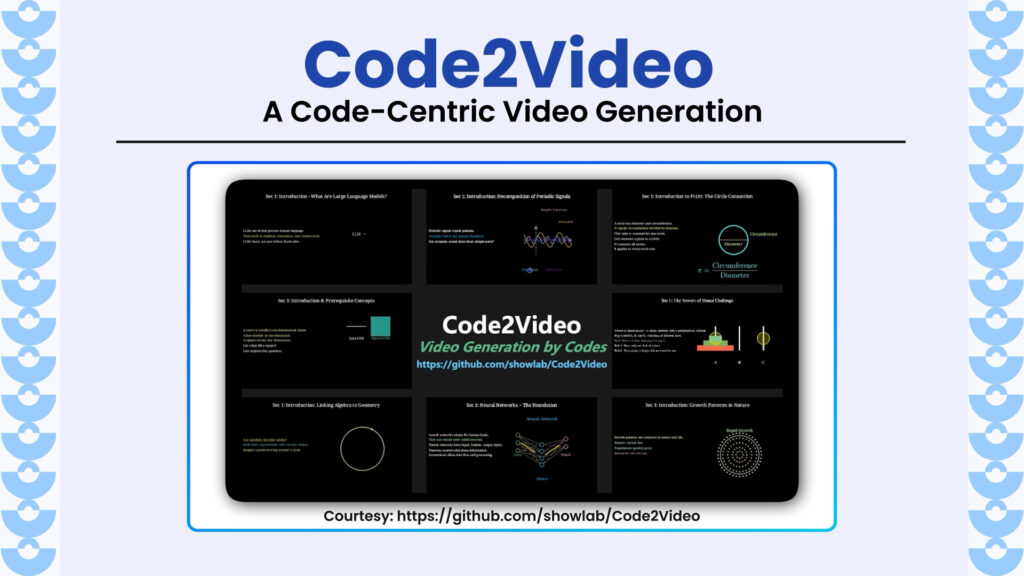
Context In the rapidly evolving domain of Computer Vision and Image Processing, the generation of educational content is becoming increasingly sophisticated. The advent of frameworks such as Code2Video signifies a transformative approach to creating instructional materials. This innovative system operates by generating professional educational videos directly from executable Python code, diverging from conventional pixel-based diffusion and text-to-video models. By positioning code as the primary generative medium, Code2Video enhances visual control, transparency, and interpretability in the development of long-form educational content. Developed by the Show Lab at the National University of Singapore, Code2Video employs a tri-agent architecture comprised of three collaborative components: the Planner, the Coder, and the Critic. This architecture allows for the systematic production of structured and scalable educational videos, which is particularly beneficial for educators and learners alike. Main Goal The principal objective of Code2Video is to facilitate the generation of high-quality educational videos through a code-centric approach. By utilizing executable code as a foundational element, the system ensures a level of precision and clarity that is often lacking in traditional video generation methods. This goal can be achieved through the concerted efforts of the three agents: the Planner organizes the lecture flow, the Coder produces executable code with debugging capabilities, and the Critic provides multimodal feedback to refine the output. This triadic collaboration enables the creation of coherent and instructive videos that can effectively convey complex concepts. Advantages of Code2Video Enhanced Transparency: The use of executable code allows for a clear understanding of the underlying processes, making it easier for educators and students to follow along. Scalability: The tri-agent structure enables the production of videos that can be easily scaled to accommodate various educational topics, from mathematics to computer science. Improved Learning Outcomes: The implementation of the TeachQuiz metric allows for the assessment of knowledge transfer, demonstrating that students can effectively “unlearn” and “relearn” concepts through the generated content. Benchmarking Efficiency: The MMMC Benchmark, derived from established Manim tutorials, ensures that the generated videos meet high standards for aesthetics, efficiency, and educational effectiveness. Performance Boost: Code2Video has shown a 40% performance improvement over traditional direct code generation methods, achieving educational outcomes comparable to those of human-created tutorials. Future Implications The continuous advancement of artificial intelligence holds considerable promise for the future of educational content generation. As AI technologies evolve, we can anticipate even more sophisticated frameworks that integrate enhanced machine learning algorithms and improved data processing capabilities. This evolution may lead to an increased ability to personalize educational experiences, tailoring content to individual learning styles and needs. Furthermore, the integration of AI in video generation systems like Code2Video could foster greater collaboration between educators and AI systems, ultimately enriching the learning environment and improving educational outcomes for students worldwide. Disclaimer The content on this site is generated using AI technology that analyzes publicly available blog posts to extract and present key takeaways. We do not own, endorse, or claim intellectual property rights to the original blog content. Full credit is given to original authors and sources where applicable. Our summaries are intended solely for informational and educational purposes, offering AI-generated insights in a condensed format. They are not meant to substitute or replicate the full context of the original material. If you are a content owner and wish to request changes or removal, please contact us directly. Source link : Click Here


