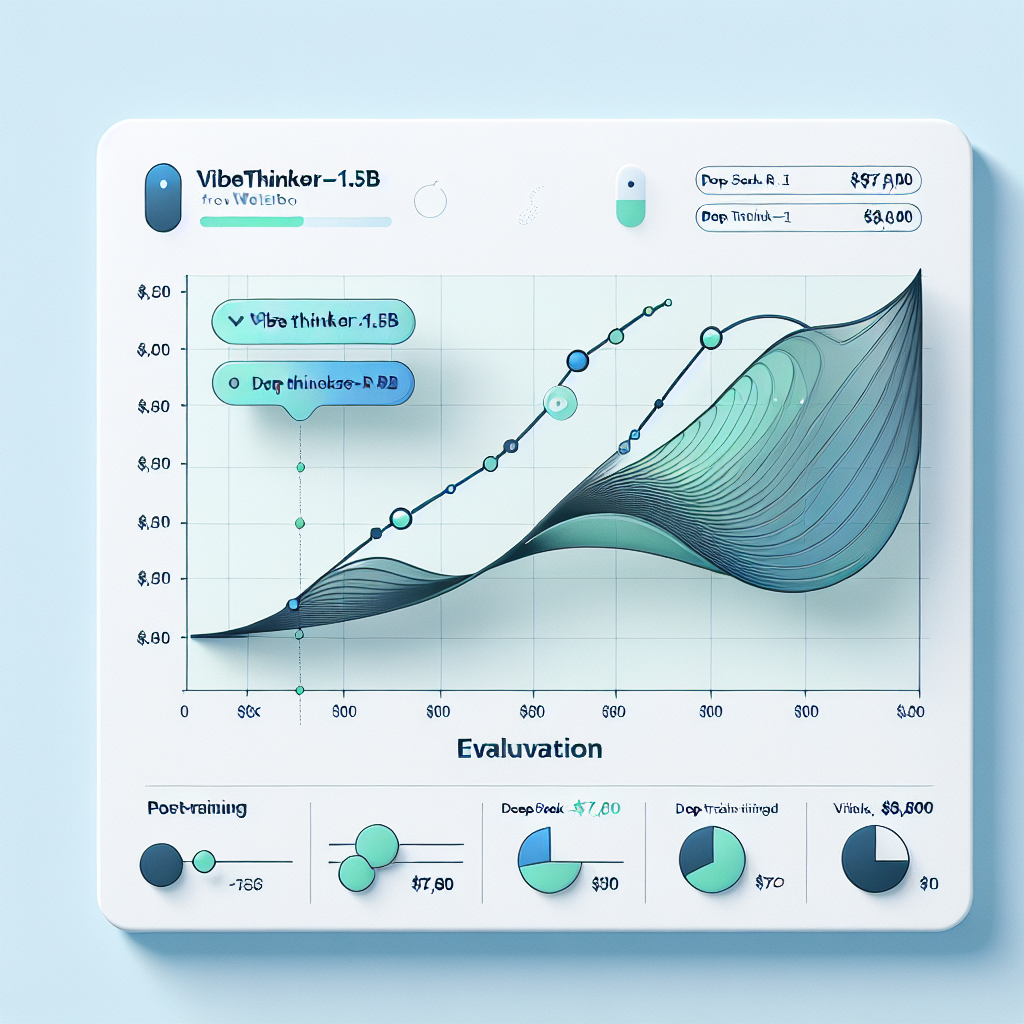
Introduction In late 2025, Weibo, a prominent Chinese social media platform, made a significant advancement in the field of open-source artificial intelligence (AI) with the release of its new language model, VibeThinker-1.5B. This 1.5 billion parameter model has emerged as a notable competitor within the generative AI landscape, particularly against other high-capacity models such as DeepSeek-R1. The release of VibeThinker-1.5B is not just a technological milestone; it represents a paradigm shift in how AI models can be structured, trained, and deployed, especially considering its effective post-training budget of only $7,800. Context and Main Goal The primary goal of Weibo’s VibeThinker-1.5B is to challenge the conventional wisdom surrounding the scale and resource requirements of high-performance language models. Traditional models often rely on extensive parameters and significant computational resources to achieve superior reasoning capabilities. VibeThinker-1.5B, however, demonstrates that compact models can achieve exceptional performance in reasoning tasks with efficient training methodologies. This goal is achieved through innovative approaches in training that prioritize diversity in responses and effective reinforcement learning techniques. Advantages of VibeThinker-1.5B The advantages of VibeThinker-1.5B are manifold, as evidenced by its performance metrics and resource efficiency: 1. **Cost Efficiency**: With a post-training budget of merely $7,800, VibeThinker-1.5B is 30–60 times less expensive to train compared to larger models like DeepSeek-R1, which can cost between $294,000 and $535,000. This affordability opens new avenues for smaller enterprises and researchers who may have limited budgets. 2. **High Performance**: Despite its smaller size, VibeThinker-1.5B has achieved benchmark-topping performance in reasoning tasks, even outperforming models that are hundreds of times larger. For instance, it excelled in structured reasoning benchmarks, demonstrating that size is not the sole determinant of model effectiveness. 3. **Diversity-First Training Approach**: Utilizing the Spectrum-to-Signal Principle (SSP), VibeThinker-1.5B enhances its learning by maximizing diversity in potential solutions. This approach allows it to explore reasoning spaces more effectively and achieve superior reasoning capabilities without relying on massive parameter counts. 4. **Cross-Domain Reasoning**: The model has shown remarkable performance across various domains, illustrating its versatility. For example, it achieved high scores in benchmarks such as AIME25 and LiveCodeBench v6, indicating its capability to handle different types of reasoning tasks successfully. 5. **Deployment Flexibility**: VibeThinker-1.5B is small enough for deployment on edge devices, such as mobile phones, while also being cost-effective in terms of inference. This flexibility allows organizations to integrate AI capabilities into everyday applications without incurring substantial infrastructure costs. Limitations and Caveats While VibeThinker-1.5B offers impressive capabilities, it is essential to consider its limitations: – **General Knowledge Reasoning**: Although it excels in structured logical tasks, VibeThinker-1.5B lags behind larger models in general knowledge reasoning tasks (e.g., GPQA). This limitation suggests that while smaller models can outperform larger ones in specific areas, they may not possess the same breadth of knowledge. – **Specialization Trade-offs**: The model’s focus on structured reasoning may come at the cost of its ability to handle wide-ranging encyclopedic recall, a common trait found in larger architectures. Organizations must weigh these trade-offs when selecting models for specific applications. Future Implications The advancements represented by VibeThinker-1.5B are indicative of a broader shift in the AI landscape towards more efficient and accessible models. As AI technology continues to evolve, several implications can be anticipated: 1. **Increased Accessibility**: The success of compact models like VibeThinker-1.5B may encourage more organizations, especially startups and academic institutions, to engage with AI technologies, fostering innovation and research in the field. 2. **Shift in Training Methodologies**: The emphasis on diverse training approaches could lead to the development of new training paradigms that prioritize efficiency and performance over sheer size. This shift may redefine best practices in model development. 3. **Enhanced Deployment Opportunities**: As models become more resource-efficient, the potential for deploying AI in various settings—ranging from mobile applications to edge devices—will expand, thereby enhancing user experiences and accessibility. 4. **Regulatory Considerations**: As AI models become more prevalent, the need for robust frameworks governing their use will intensify. Companies will need to navigate regulatory landscapes while ensuring ethical deployment and use of AI technologies. Conclusion Weibo’s release of VibeThinker-1.5B marks a critical juncture in the generative AI models and applications industry. By demonstrating that smaller models can achieve high-performance outcomes, Weibo challenges prevailing assumptions about model size and resource requirements. The implications of this development extend beyond technical achievements, potentially reshaping the market landscape and influencing future AI research and deployment strategies. For Generative AI scientists, VibeThinker-1.5B is not merely a milestone; it represents a new frontier in the pursuit of intelligent, efficient, and accessible AI solutions. Disclaimer The content on this site is generated using AI technology that analyzes publicly available blog posts to extract and present key takeaways. We do not own, endorse, or claim intellectual property rights to the original blog content. Full credit is given to original authors and sources where applicable. Our summaries are intended solely for informational and educational purposes, offering AI-generated insights in a condensed format. They are not meant to substitute or replicate the full context of the original material. If you are a content owner and wish to request changes or removal, please contact us directly. Source link : Click Here

Contextualizing Initial Interest Confusion in Legal Doctrine The concept of “initial interest confusion” (IIC) has been a contentious issue in trademark law, particularly highlighted in the case of Pennsylvania State University v. Vintage Brand LLC. This case revolves around allegations of merchandise counterfeiting, wherein the jury previously found defendants liable for willful trademark violation. However, the defendants contested the verdict, particularly regarding the invocation of IIC, which was not originally part of the claims made by the plaintiff. The presiding judge’s remarks suggest that IIC may be more of a conceptual “vibe” rather than a robust legal doctrine, raising questions about its applicability and relevance in contemporary legal contexts. Main Goal of the Original Post The primary objective articulated in the original blog post is to critically assess the validity and operational utility of the IIC doctrine within trademark law. The court’s position indicates that while IIC may serve as an analytical tool within the multi-factor confusion analysis, it does not provide substantive value beyond the established likelihood-of-consumer-confusion factors. This suggests a need for the legal community to reevaluate the reliance on IIC in legal arguments and its implications for trademark disputes. Advantages of Reevaluating Initial Interest Confusion Clarity in Legal Standards: By moving away from IIC, legal professionals can focus on more definitive criteria for trademark confusion, aligning with the established Lapp factors. Reduction of Legal Ambiguity: Eliminating IIC as a standalone doctrine may diminish confusion among juries and courts regarding its interpretation and application. Enhanced Legal Strategy: Legal practitioners can concentrate on concrete evidence of consumer confusion rather than abstract notions of IIC, potentially leading to more favorable outcomes in trademark litigation. Encouragement of Consumer-Centric Analysis: Shifting focus to consumer behavior and actual confusion rather than speculative concepts can lead to a more equitable legal framework. Caveats and Limitations Despite the advantages of reassessing IIC, it is important to acknowledge potential limitations. The evidence presented in the case suggests that while IIC may lack a strong legal foundation, it still reflects certain consumer perceptions. Thus, a complete dismissal of IIC may overlook nuances in consumer behavior and market dynamics that could be relevant in specific cases. Future Implications of AI in Legal Contexts The ongoing evolution of artificial intelligence (AI) technologies is poised to reshape the landscape of trademark law and, by extension, the discourse surrounding concepts like initial interest confusion. As AI systems become increasingly capable of analyzing consumer behavior, legal professionals may access data-driven insights that can substantiate or refute claims of confusion with greater precision. Furthermore, AI could facilitate the identification of trademark infringements in real time, potentially reducing the incidence of actual confusion in the marketplace. In conclusion, the intersection of legal doctrine and advanced technologies invites a critical reassessment of existing frameworks such as IIC. By embracing a more data-driven approach, legal professionals can enhance their strategies, ultimately leading to more effective trademark protection and consumer clarity. Disclaimer The content on this site is generated using AI technology that analyzes publicly available blog posts to extract and present key takeaways. We do not own, endorse, or claim intellectual property rights to the original blog content. Full credit is given to original authors and sources where applicable. Our summaries are intended solely for informational and educational purposes, offering AI-generated insights in a condensed format. They are not meant to substitute or replicate the full context of the original material. If you are a content owner and wish to request changes or removal, please contact us directly. Source link : Click Here

Context The recent release of LeRobotDataset:v3 marks a significant advancement in the field of robotics and machine learning, particularly within the context of Generative AI Models and Applications. This new dataset format addresses key limitations found in its predecessor, LeRobotDataset:v2, by optimizing the storage and accessibility of large-scale datasets. The previous format constrained the storage of episodes to individual files, which presented considerable file-system limitations when scaling datasets to millions of episodes. The enhanced v3 version consolidates multiple episodes into single files, employing relational metadata to access individual episode information seamlessly. Moreover, it introduces native support for streaming datasets, thus enabling the processing of extensive datasets in real-time without the need for local downloads. Main Goals and Achievement Strategies The primary goal of LeRobotDataset:v3 is to democratize access to extensive robotics datasets, facilitating the training of models on potentially millions of episodes. This is achieved through the innovative consolidation of data structures and the introduction of streaming capabilities that allow for on-the-fly data processing. By utilizing the new StreamingLeRobotDataset interface, researchers can access and manipulate datasets with greater efficiency, significantly reducing the barriers to entry for developers and data scientists in the robotics domain. Advantages of LeRobotDataset:v3 Scalability: The new format supports the storage of large datasets by merging multiple episodes into single files, leading to improved management of file system limitations. Streamlined Data Access: The introduction of streaming capabilities allows users to process data in real-time without the necessity for extensive local storage, which is particularly beneficial for applications requiring rapid data analysis. Rich Metadata Integration: The dataset format incorporates comprehensive metadata, enhancing the ability to index and search across diverse robotics datasets on platforms like the Hugging Face Hub. Flexible Data Structure: The architecture supports various data types, including tabular and visual data, which can be easily utilized within popular machine learning frameworks such as PyTorch. Community Contributions: The format encourages community engagement and contributions, as users can easily visualize and share datasets through the Hugging Face platform. Caveats and Limitations While the advantages are compelling, there are certain limitations to consider. The initial pre-release of the LeRobotDataset:v3 may present stability issues, and users should be cautious when deploying it in production environments. Additionally, the transition from v2.1 to v3.0 may require users to adapt their workflows to accommodate the new data structures and access methodologies. Future Implications The advancements represented by LeRobotDataset:v3 have profound implications for the future of AI and robotics. As the accessibility of large-scale datasets improves, we can expect a surge in innovative applications of Generative AI in robotics. This democratization of data will enable a broader range of researchers and developers to engage in robotics research, fostering collaboration and accelerating advancements in the field. Furthermore, as AI models become increasingly sophisticated, the ability to train on vast amounts of diverse data will be crucial for developing robust, generalizable algorithms capable of operating in real-world environments. Conclusion In summary, the release of LeRobotDataset:v3 signifies an important step forward in the realm of robotics and AI. By addressing prior limitations and enhancing both the scalability and accessibility of datasets, this new format is set to empower researchers and practitioners in the field. As the landscape of machine learning continues to evolve, the implications of such advancements will undoubtedly shape the future of AI applications in robotics. Disclaimer The content on this site is generated using AI technology that analyzes publicly available blog posts to extract and present key takeaways. We do not own, endorse, or claim intellectual property rights to the original blog content. Full credit is given to original authors and sources where applicable. Our summaries are intended solely for informational and educational purposes, offering AI-generated insights in a condensed format. They are not meant to substitute or replicate the full context of the original material. If you are a content owner and wish to request changes or removal, please contact us directly. Source link : Click Here


